The Chicago Archaeopteryx: 3D Preservation and the Sensory Evolution of the Urvogel ("First Bird")


Abstract
For over a century and a half, Archaeopteryx lithographica has served as the quintessential icon of evolutionary biology, bridging the gap between non-avian dinosaurs and modern birds. However, the flattened nature of most Solnhofen limestone specimens has historically obscured critical anatomical details, leaving significant gaps in our understanding of early avian physiology. The recent description of the fourteenth known specimen, the "Chicago Archaeopteryx" (FMNH PA 830), has fundamentally challenged and expanded our knowledge of this transitional taxon. Acquired by the Field Museum of Natural History, this three-dimensionally preserved fossil has revealed a suite of "weird" and previously unseen features—from complex sensory organs in the snout to specialized flight feathers—that illuminate the rapid evolutionary adaptations driven by the energetic demands of powered flight. This report synthesizes these new findings to reconstruct the life, ecology, and evolutionary significance of the Chicago Archaeopteryx.
Introduction: The Urvogel and the Chicago Discovery
Since its discovery in 1861, merely two years after the publication of Charles Darwin’s On the Origin of Species, Archaeopteryx has held a celebrity status in paleontology.1 Known as the "Urvogel" or first bird, it provided the first tangible evidence linking theropod dinosaurs to birds, possessing a mosaic of features: the teeth, claws, and bony tail of a reptile, alongside the wings and feathers of a bird.3 Yet, for 160 years, the limitations of preservation—specifically the crushing of delicate bones into two-dimensional slabs—left many mysteries locked within the Solnhofen limestone.1
In 2025, a joint team from the Field Museum of Natural History and the Institute of Vertebrate Paleontology and Paleoanthropology (IVPP) described a new specimen that would alter this landscape: the Chicago Archaeopteryx (FMNH PA 830).5 unearthed by quarry workers near Solnhofen, Germany, in 1990, the specimen resided in private collections for decades before its acquisition by the Field Museum in 2022.3
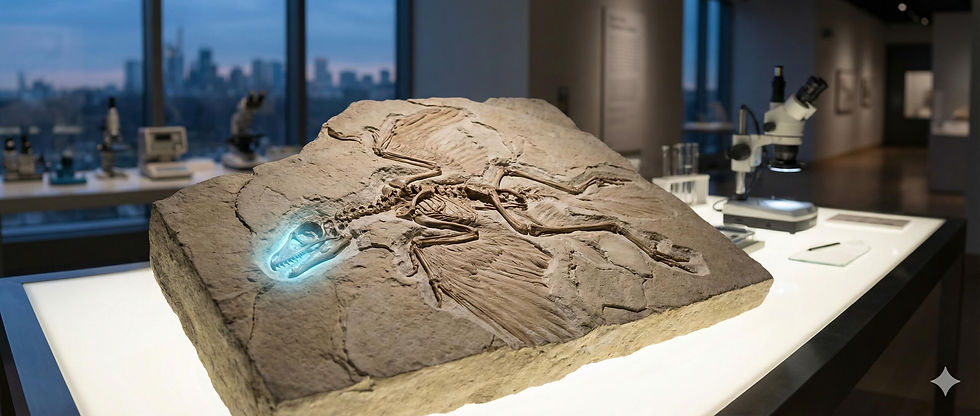
Unlike its predecessors, the Chicago specimen is the smallest known individual—roughly the size of a pigeon—and is preserved with remarkable three-dimensional fidelity.2 The preparation of the fossil, led by Akiko Shinya and Constance Van Beek, required over 1,300 hours of meticulous labor using pin vises and dental grinders.8 Crucially, the team utilized ultraviolet (UV) induced fluorescence and high-resolution micro-CT scanning to visualize soft tissues and internal bone structures that were invisible to the naked eye.9 These techniques revealed "tiny, glowing dots" and skin impressions that provide the first evidence of advanced sensory and aerodynamic adaptations in the earliest known bird.10
Cranial Morphology: The Evolution of the Avian Head
The three-dimensional preservation of the FMNH PA 830 skull allowed researchers to reconstruct the Archaeopteryx head with unprecedented detail. The findings suggest that the transition from a reptilian snout to an avian beak involved complex changes in kinesis, sensation, and feeding mechanics.
The Intermediate Kinetic Palate
Modern birds possess a kinetic skull, where the beak can move independently of the braincase (cranial kinesis). This mobility is facilitated by a specialized arrangement of the palatal bones. In contrast, non-avian theropods generally possessed rigid, akinetic skulls.12
Digital 3D reconstruction of the Chicago specimen revealed a palate that is evolutionarily intermediate between the rigid condition of troodontids (close dinosaurian relatives) and the highly kinetic condition of Cretaceous birds and modern Neornithes.1 The palatal bones in Archaeopteryx were beginning to reduce and decouple, laying the biomechanical groundwork for the flexible, lightweight skulls that characterize modern avian diversity.1 This reduction in rigidity likely facilitated a wider gape and faster jaw closure, essential adaptations for capturing agile prey.9
The Bill-Tip Organ and Remote Touch
Perhaps the most surprising discovery within the skull was the evidence of a bill-tip organ.13 CT scans of the premaxilla (the bone forming the tip of the upper snout) identified a complex network of neurovascular canals and large foramina opening at the tips of both the upper and lower jaws.13
In modern birds such as snipes and kiwis, these structures house mechanoreceptors that facilitate "remote touch"—a sensory modality that allows birds to detect prey hidden in the substrate through vibrations and pressure differentials.16 The presence of these neurovascular openings in Archaeopteryx suggests that the sensitive rostrum of non-avian theropods had already evolved into a specialized sensory organ. This implies that Archaeopteryx possessed a tactile sensitivity comparable to modern probing birds, allowing it to root for insects or invertebrates in the soil or under tree bark.14
Oral Papillae and the Mobile Tongue
Under UV illumination, preparators observed a series of "tiny, glowing dots" on the roof of the mouth.10 Comparison with modern avian anatomy identified these structures as oral papillae—fleshy, keratinized cones that line the choana and palate.14 In extant birds, these structures act like a biological ratchet, aiding in the unidirectional transport of food down the throat and preventing live prey from escaping.19
Co-occurring with these soft-tissue structures is the preservation of an ossified basihyal bone, a small element of the hyoid apparatus that supports the base of the tongue.13 The presence of the basihyal indicates that Archaeopteryx possessed a highly mobile tongue, distinct from the fleshy, immobile tongues of crocodiles and many non-avian dinosaurs. The combination of a mobile tongue and oral papillae suggests a sophisticated intra-oral processing system. This efficiency in handling and swallowing food was likely a critical adaptation to meet the high metabolic costs of powered flight.14
Post-Cranial Anatomy: The Mechanics of Flight
While the skull adaptations point to high metabolic demands, the post-cranial skeleton and plumage of the Chicago specimen provide definitive evidence regarding the flight capabilities of Archaeopteryx.
The Tertial Feathers
The Chicago specimen documents, for the first time in Archaeopteryx, the presence of tertial feathers.1 Tertials are specialized flight feathers that attach to the humerus (upper arm) and bridge the aerodynamic gap between the secondary feathers of the forearm and the body wall.
In non-avian feathered dinosaurs like Anchiornis and Microraptor, wing feathers typically terminate at the elbow, leaving a gap that creates drag and reduces lift.1 The Chicago specimen displays a fan of tertials that is remarkably extensive, covering 85% of the surface area relative to the secondaries—a proportion significantly higher than the 11-56% observed in modern birds.9 This massive tertial fan would have created a continuous aerodynamic surface from wingtip to torso, significantly enhancing lift generation.21
The presence of tertials in Archaeopteryx, and their absence in closely related non-avian paravians, serves as a key diagnostic feature for the "avian" condition.8 It strongly supports the hypothesis that Archaeopteryx was capable of powered flight rather than merely passive gliding, as the continuous wing surface is essential for efficient flapping dynamics.20
The "Multiple Origins of Flight" Hypothesis
The identification of tertials in Archaeopteryx has profound implications for phylogenetic debates. If the common ancestor of paravians (including dromaeosaurs and troodontids) possessed tertials, one would expect to see vestigial tertials in species like Microraptor. Their absence in non-avian lineages suggests that the tertial-supported wing evolved independently in the avian lineage.20 This supports the "multiple origins of flight" hypothesis, which posits that various dinosaur lineages experimented with aerodynamic adaptations, but only the lineage possessing the complete avian bauplan (including tertials) survived to give rise to modern birds.12
The Manus and Digit Mobility
The preservation of soft tissue around the hands (manus) clarifies the functional role of the fingers during locomotion. UV analysis revealed that the first and second digits were bound together in a sheath of soft tissue, rendering them rigid.20 This rigidity is biomechanically necessary to support the leading edge of the wing (the alula and primary feathers) against the aerodynamic forces of flight.20
However, the third digit was not encased in this tissue and remained distally mobile.9 This challenges previous reconstructions that depicted all three fingers as free or all bound. A mobile third digit would have allowed Archaeopteryx to retain grasping functionality, likely for climbing or manipulating prey, even while the rest of the hand was adapted for the wing apparatus.20
Ecological Synthesis: A Generalist Lifestyle
The debate over whether Archaeopteryx was arboreal ("trees down") or cursorial ("ground up") has persisted for decades. The Chicago specimen suggests that this dichotomy is a false dilemma; Archaeopteryx appears to have been a generalist adapted for a complex, mixed lifestyle.1
Podotheca and Ground Foraging
The "podotheca" refers to the keratinous scales and pads covering the foot. The Chicago specimen preserves the first detailed traces of toe pads in Archaeopteryx.1 Morphometric analysis indicates that these pads resemble those of modern ground-foraging birds rather than strictly arboreal perchers or raptorial predators.1 The pads are relatively flat, lacking the bulbous, frictional texture seen in dedicated climbers, suggesting that Archaeopteryx spent significant time walking or running on the ground.20
The Mosaic Lifestyle
The integration of ground-adapted feet, a sensory-rich snout for probing soil, and a mobile third finger for climbing paints a portrait of an ecological generalist. Archaeopteryx likely foraged on the forest floor using its bill-tip organ to find prey, utilized its mobile tongue to rapidly process food, and relied on its tertial-enhanced wings to fly between habitats or escape predators.1 This "ecological flexibility" may have been a key factor in the survival of the avian lineage compared to more specialized paravians.
Table 1: Comparative Features of the Chicago Archaeopteryx vs. Non-Avian Paravians
Feature | Chicago Archaeopteryx (FMNH PA 830) | Non-Avian Paravians (e.g., Anchiornis) | Evolutionary Significance |
Wing Feathers | Tertials present (humeral/ulnar); continuous surface.1 | Tertials absent; gap between wing and body.20 | Adaptation for powered flight; drag reduction. |
Hand Digits | Digits 1 & 2 bound in soft tissue; Digit 3 mobile.20 | Digits typically free or lacking specific fusion.20 | Digits 1-2 rigid for wing support; Digit 3 for climbing. |
Palate | Intermediate; semi-kinetic.5 | Rigid; akinetic.12 | Transition toward independent beak movement. |
Oral Cavity | Oral papillae present; mobile tongue.10 | Oral papillae absent (in fossil record); often immobile tongue. | High-efficiency feeding to support flight metabolism. |
Snout | Bill-tip organ (neurovascular foramina).13 | Simple sensory pits (crocodilian-like) or absent. | "Remote touch" foraging; high sensory acuity. |
Foot Ecology | Ground-foraging toe pads.1 | Variable; often predatory or arboreal. | Indicates generalist/mixed lifestyle. |
Conclusion
The Chicago Archaeopteryx (FMNH PA 830) represents a watershed moment in the study of avian origins. By lifting the veil of two-dimensional preservation, this specimen has revealed that the "first bird" was biologically more complex than previously imagined. It possessed a sensory-rich snout, a high-efficiency feeding apparatus, and a wing structure that definitively separates it from its non-avian dinosaur cousins. These findings resolve longstanding debates regarding the flight capabilities of Archaeopteryx, confirming it as an active flyer with a sophisticated aerodynamic surface.20 Furthermore, the evidence of a mixed terrestrial-arboreal lifestyle suggests that the evolutionary success of birds may have been rooted in the ecological versatility of their ancestors. As the Chicago specimen takes its place in the scientific record, it underscores the utility of revisiting classic taxa with modern technology, proving that even after 160 years, the Solnhofen limestone still has secrets to yield.
Works cited
"Chicago Archaeopteryx" Unveiled: New Clues on Dinosaur–Bird Transition Revealed by Chinese–American Research Team, accessed February 14, 2026, https://english.cas.cn/newsroom/research_news/life/202505/t20250515_1043717.shtml
UV light and CT scans helped scientists unlock hidden details in a beautifully-preserved fossil Archaeopteryx | ScienceDaily, accessed February 14, 2026, https://www.sciencedaily.com/releases/2025/05/250514111227.htm
Chicago Museum Unveils the 'Most Important Fossil Ever ..., accessed February 14, 2026, https://www.smithsonianmag.com/smart-news/chicago-museum-unveils-the-most-important-fossil-ever-discovered-the-feathered-dinosaur-archaeopteryx-180984312/
Archaeopteryx - Wikipedia, accessed February 14, 2026, https://en.wikipedia.org/wiki/Archaeopteryx
"Chicago Archaeopteryx" Unveiled: New Clues on Dinosaur–Bird Transition Revealed by Chinese–American Research Team, accessed February 14, 2026, https://english.cas.cn/print/index.shtml?docurl=https://english.cas.cn/special-reports/2025q2/202512/t20251219_1138174.shtml
New Archaeopteryx Fossil Rewrites Early Bird Evolution, accessed February 14, 2026, https://scitechdaily.com/new-archaeopteryx-fossil-rewrites-early-bird-evolution/
Unveiling The Chicago Archaeopteryx - Field Museum, accessed February 14, 2026, https://www.fieldmuseum.org/blog/unveiling-the-chicago-archaeopteryx
The earliest known bird had complex tongue bones and fleshy “teeth” on the roof of its mouth—which might have helped it snag the food it needed for flight, accessed February 14, 2026, https://www.eurekalert.org/news-releases/1114981
(PDF) Chicago Archaeopteryx informs on the early evolution of the ..., accessed February 14, 2026, https://www.researchgate.net/publication/391739196_Chicago_Archaeopteryx_informs_on_the_early_evolution_of_the_avian_bauplan
Scientists Just Revealed a Never-Before-Seen Feature Inside Archaeopteryx's Skull, accessed February 14, 2026, https://indiandefencereview.com/never-seen-feature-archaeopteryxs-skull/
Bone, Skin, Claw Lasted…150 Million Years? | The Institute for Creation Research, accessed February 14, 2026, https://www.icr.org/content/bone-skin-claw-lasted%E2%80%A6150-million-years
New, Perfectly-Preserved Specimen of Archaeopteryx Discovered | Sci.News, accessed February 14, 2026, https://www.sci.news/paleontology/chicago-archaeopteryx-13912.html
Avian features of Archaeopteryx feeding apparatus reflect elevated demands of flight, accessed February 14, 2026, https://pubmed.ncbi.nlm.nih.gov/41658498/
The earliest known bird had complex tongue bones and fleshy “teeth ..., accessed February 14, 2026, https://www.fieldmuseum.org/about/press/the-earliest-known-bird-had-complex-tongue-bones-and-fleshy-teeth-on-the-roof
Archaeopteryx — The Earliest Known Bird — Had a Strange Mouth, but Fed Like Modern Birds | Discover Magazine, accessed February 14, 2026, https://www.discovermagazine.com/archaeopteryx-the-earliest-known-bird-had-a-strange-mouth-but-fed-like-modern-birds-48632
(PDF) Tactile bill-tip organs in seabirds suggest conservation of a deep avian symplesiomorphy - ResearchGate, accessed February 14, 2026, https://www.researchgate.net/publication/384103414_Tactile_bill-tip_organs_in_seabirds_suggest_conservation_of_a_deep_avian_symplesiomorphy
Ecomorphological patterns in trigeminal canal branching among sauropsids reveal sensory shift in suchians - PMC, accessed February 14, 2026, https://pmc.ncbi.nlm.nih.gov/articles/PMC10093182/
Archaeopteryx's Feeding-Related Structures Reflect Elevated Demands of Flight, Scientists Say | Sci.News, accessed February 14, 2026, https://www.sci.news/paleontology/archaeopteryx-feeding-structures-flight-14539.html
Photograph of the roof of the oropharynx of laughing dove (A) and of... | Download Scientific Diagram - ResearchGate, accessed February 14, 2026, https://www.researchgate.net/figure/Fig-1-Photograph-of-the-roof-of-the-oropharynx-of-laughing-dove-A-and-of_fig2_330216073
This exquisite Archaeopteryx fossil reveals how flight took off in birds, accessed February 14, 2026, https://www.sciencenews.org/article/archaeopteryx-fossil-bird-flight
Chicago Archaeopteryx informs on the early evolution of the avian bauplan - PubMed, accessed February 14, 2026, https://pubmed.ncbi.nlm.nih.gov/40369075/
Exceptional preservation and foot structure reveal ecological ..., accessed February 14, 2026, https://pmc.ncbi.nlm.nih.gov/articles/PMC9768147/


Comments