The Geometry of Society: Why Some Spiders Cooperate and Others Just Coexist

1. Introduction: The Puzzle of Biological Organization
The history of life on Earth is fundamentally a history of transitions in levels of organization. Independent replicating entities have repeatedly coalesced to form higher-level units, a process known as the Major Evolutionary Transitions. Prokaryotes merged to form eukaryotic cells; single cells adhered to become multicellular organisms; and solitary individuals aggregated to form complex societies. A central question in evolutionary biology is why some of these aggregations evolve into highly integrated, "unitary" entities—such as a human body or a honeybee colony—where the parts lose their autonomy, while others remain "modular" associations, like a coral reef or a herd of wildebeest, where the individual retains primacy.
In her seminal 2025 synthesis, "Transitions in Levels of Organization: Lessons from Social and Colonial Spiders," evolutionary ecologist Leticia Avilés offers a profound resolution to this dichotomy. Avilés posits that the trajectory of social evolution is not merely a product of genetic relatedness or ecological pressure, but is fundamentally channeled by the physical geometry of the organism's extended phenotype.1
Spiders (Araneae) provide an unparalleled system for investigating these transitions. Unlike the eusocial insects (ants, bees, wasps, and termites), which trace their sociality to a few ancient origins, spiders have evolved group living independently dozens of times. Furthermore, they exhibit two distinct and divergent social structures that map perfectly onto the unitary-modular axis: the "social" (cooperative) spiders, which function as integrated wholes, and the "colonial" spiders, which function as aggregations of neighbors. This report provides an exhaustive analysis of the mechanisms driving these divergent evolutionary paths, exploring how the geometry of silk—the orb versus the tangle—interacts with ecological gradients to determine the fate of arachnid societies.
2. The Theoretical Framework: Modular versus Unitary Systems in Spiders
To understand spider sociality, one must first define the organizational endpoints. Avilés argues that biological systems can be categorized based on the degree of integration and the autonomy of their constituent parts.
2.1 The Unitary System
A unitary system is characterized by high integration, interdependence, and a unified function. The "group" behaves as the individual.
Biological Analogue: The metazoan animal (e.g., a mammal). The body is the unit of selection. Cells are specialized (liver, heart, skin) and cannot survive independently. Germ lines are sequestered, meaning only specific cells reproduce.
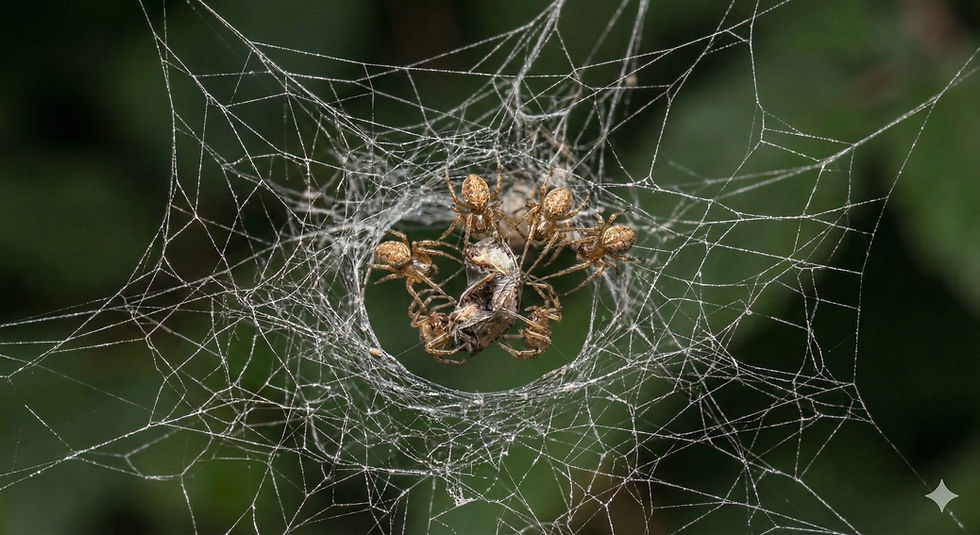
Spider Equivalent: The "Social" (Cooperative) Spider (e.g., Anelosimus eximius). These spiders live in communal nests, hunt cooperatively, feed communally, and exhibit high reproductive skew. They are the "superorganisms" of the spider world.
Key Characteristics: Obligate group living, lack of discrimination between kin, shared resources, and a developmental trajectory that is nearly impossible to reverse.2
2.2 The Modular System
A modular system is characterized by the repetition of autonomous, functional units. The "group" is an aggregation of individuals that benefit from proximity but retain their sovereignty.
Biological Analogue: Modular organisms like plants, sponges, or corals. A tree is a collection of reiterated modules (branches/leaves). If a branch is cut, it can often root and survive; if a section of coral is broken, it regenerates.
Spider Equivalent: The "Colonial" Spider (e.g., Metepeira incrassata). These spiders build individual capture webs supported by a shared framework. They defend their personal space, capture their own prey, and maintain individual reproductive autonomy.
Key Characteristics: Territoriality, individual maintenance of capture zones, and flexibility to live solitarily or in groups depending on environmental conditions.1
2.3 The Avilés Synthesis: Geometry and Ecology
The core insight of the 2025 Annual Review is that the path a lineage takes—toward the unitary superorganism or the modular colony—is determined by the intersection of Ecology (the "Why") and Geometry (the "How"). Ecology provides the selective pressure to group, usually driven by the need to capture large prey or survive harsh weather. However, the geometry of the web acts as a constraint or "filter." It determines whether the resulting group can integrate into a seamless whole or must remain a partitioned neighborhood.4
3. The Geometric Determinant: Silk as a Social Filter
The extended phenotype of a spider—its web—is not just a tool for catching prey; it is the physical substrate of its social interactions. The structural properties of the web dictate the limits of cooperation.
3.1 The Constraint of the Orb: The Path to Modularity
The orb web is one of nature's most sophisticated sensors. It is a two-dimensional, tension-based structure designed to transmit vibration signals from the periphery to the hub.
Vibrational Physics as a Barrier: The orb relies on precise tension to localize prey. When a fly hits the web, the vibration travels along radial threads to the spider's legs. The physics of this transmission require a "quiet" background. If a second spider were to inhabit the same orb, its mass and movement would dampen the signal and introduce "noise," making prey localization impossible.
The Tensometer Problem: The spider essentially acts as a tensometer, measuring the strain on the radii. A shared orb would confuse this measurement. Consequently, spiders with orb-weaving ancestry (such as the families Araneidae and Uloboridae) are physically constrained from sharing a capture surface.
The Result—Coloniality: Because they cannot share the capture web, these spiders can only form societies by aggregating their individual webs into a shared support network. This forces a modular organization. The geometry of the orb prohibits the evolution of the unitary superorganism.5
3.2 The Freedom of the Tangle: The Path to Unitarity
In contrast, spiders that build irregular, three-dimensional webs (such as the cobwebs of Theridiidae or the woolly webs of Eresidae) face fewer constraints.
Mechanical Redundancy: A 3D tangle or sheet-and-tangle web functions more like a trap or an obstacle course than a delicate sensor. It relies on knock-down threads to entangle prey, which then fall onto a sheet or are rushed by the spiders. The structure is chaotic and redundant.
Integration Potential: The presence of multiple spiders does not catastrophically disrupt the function of a tangle. In fact, it enhances it. The 3D geometry allows multiple individuals to attack from different angles, creating a "swarm" effect that can subdue prey much larger than any single spider could handle.
The Result—Sociality: This geometry permits the sharing of the capture surface. Once the capture surface is shared, the defense and maintenance become communal, paving the way for the evolution of a unitary system where the colony functions as a single predatory entity.1
3.3 Comparative Web Architecture
The following table summarizes the functional differences between the two primary web geometries and their social consequences.
Feature | Two-Dimensional Orb (Modular) | Three-Dimensional Tangle (Unitary) |
Primary Function | Sensor / Interceptor | Trap / Barrier / Shelter |
Vibration Sensitivity | High (Critical for localization) | Moderate (Localization via amplitude/tension) |
Interference Tolerance | Low (Conspecifics blind the sensor) | High (Conspecifics aid in capture) |
Structural Scalability | Limited (Material constraints of span) | Infinite (Volumetric expansion) |
Predator Defense | Low (Spider exposed on 2D plane) | High (3D barrier protects retreat) |
Social Outcome | Coloniality (Aggregated territories) | Sociality (Shared communal nest) |
Representative Families | Araneidae, Uloboridae, Tetragnathidae | Theridiidae, Eresidae, Agelenidae |
6
4. The Ecological Drivers: Why Group?
While geometry dictates the form of the society, ecology provides the necessity. Solitary spiders are efficient predators, so what forces drive them to tolerate conspecifics and form groups? The research points to two primary ecological gradients: the size of available prey and the intensity of environmental disturbance.
4.1 The Prey Size Hypothesis
One of the most robust findings in social spider ecology is the relationship between colony size and prey size.
The Upper Limit of Solitary Capture: A solitary spider is mechanically limited to capturing prey that is roughly its own size or slightly larger. Large, energy-rich insects (like large beetles, orthopterans, or hymenopterans) often escape solitary webs or are too dangerous to subdue alone.
The Cooperative Advantage: Social spiders, utilizing their 3D communal webs, can capture prey up to 10 times larger than an individual spider. Cooperative hunting allows for the subjugation of massive prey items, unlocking a caloric resource that is unavailable to solitary competitors.
Geographic Correlation: This explains why true social spiders are concentrated in the lowland tropics. These environments are "high productivity" zones with a high biomass of large flying insects. In contrast, at high elevations or latitudes where insects are smaller and scarcer, the energetic cost of maintaining a large colony outweighs the benefits, restricting these areas to subsocial or solitary species.10
4.2 The Disturbance Hypothesis: Rain and Predation
The second major driver is the physical hostility of the environment, specifically rain intensity and predation risk.
The Cost of Silk Replacement: In the tropical rainforest, heavy daily rains can destroy delicate silk structures. For a solitary spider, the energetic cost of rebuilding a web every day is prohibitive.
The Fortress Strategy: A dense, three-dimensional communal nest offers structural resilience. The outer layers of a large Anelosimus nest act as a rain shield, protecting the spiders and the brood chambers deep inside. The "Disturbance Hypothesis" suggests that group living is a survival strategy against the elements.
Predation Pressure: The tropics are also teeming with predators, particularly ants and wasps. Solitary spiders are vulnerable to these attacks. A colonial or social structure provides a "selfish herd" benefit—individuals in the center of the group are shielded by those on the periphery. Furthermore, the complex 3D webbing of social species can physically exclude predatory ants.10
4.3 The "Productivity-Stability" Nexus
Combining these factors, Avilés proposes that unitary sociality evolves in environments that are both productive (lots of large prey) and stable (year-round food supply), but structurally challenging (high rain/predation).
Seasonality: High seasonality (distinct winter or dry season) disrupts the continuous growth of large colonies. This is why Anelosimus social species are strictly tropical. In contrast, the modular colonial spiders, which have faster life cycles and more flexible structures, can persist in more seasonal or temperate environments.14
5. The Unitary Trajectory: Life in the Superorganism
The evolutionary path of the unitary system, exemplified by the genera Anelosimus and Stegodyphus, represents a radical departure from standard arachnid biology. These spiders have evolved convergent traits that mirror the integration of cells in a body.
5.1 Cooperative Hunting Mechanics
Hunting in Anelosimus eximius is a coordinated ballet governed by simple feedback loops, distinct from the individualistic hunting of colonial spiders.
Synchronization: When prey strikes the web, hundreds of spiders may emerge. They move in synchronized bursts—stopping and starting simultaneously. This behavior, likely mediated by vibrational cues through the continuous 3D web, prevents the spiders from jamming each other and allows them to close in on the prey as a unified front.
The "Ricochet" Effect: The dense tangle ensures that if prey escapes one spider, it tumbles further into the trap where others are waiting. There is no competition for the "kill shot"; the prey is subdued by the collective injection of venom.15
5.2 Metabolic Scaling and Efficiency
One of the most striking findings in Avilés's work is the application of metabolic scaling theory to spider colonies.
Allometric Scaling: Just as the metabolic rate of a mammal scales with its body mass to the power of roughly -0.25 (Kleiber’s Law), the energy consumption per spider in a social colony decreases as colony size increases.
Economies of Scale: Large colonies are more efficient. The surface area-to-volume ratio of the 3D nest decreases as it grows, requiring less silk per capita to maintain protection. This "economy of scale" allows the colony to allocate more energy to reproduction, fueling the rapid growth of the group. This scaling benefit is unique to the unitary geometry; modular colonies, which scale linearly, do not see this efficiency gain.6
5.3 Reproductive Biology: The Incest Trap
The most controversial and defining feature of social spiders is their reproductive system.
Obligate Inbreeding: Unlike the vast majority of animals that avoid incest to prevent genetic defects, social spiders are obligate inbreeders. Males and females do not disperse; they mate with their siblings within the natal nest.
Female-Biased Sex Ratios: Because mating is local, the competition between males for mates is limited to brothers. According to Local Mate Competition (LMC) theory, this favors mothers who produce highly female-biased broods (since only a few males are needed to fertilize all females). In Anelosimus, sex ratios can be as skewed as 1:10 (male:female).
Demographic Acceleration: This skew accelerates colony growth. A colony composed of 90% females grows much faster than one with a 50:50 ratio, as females are the "productive" unit (laying eggs and building webs). This hyper-growth strategy allows social spiders to quickly monopolize ephemeral resource patches.18
5.4 Caste Differentiation and Personality
While they lack the morphological castes of ants (e.g., queens vs. workers), social spiders exhibit behavioral differentiation that functions as a caste system.
Personality Types: Individuals vary in "boldness." In Stegodyphus dumicola, bold spiders are more likely to participate in foraging and defense, while shy spiders focus on nest maintenance and brood care.
Matriphagy: In Stegodyphus, this altruism reaches a terminal extreme. Adult females, including virgins who have helped rear the brood, will eventually liquefy their internal organs and allow the spiderlings to consume them. This ultimate sacrifice ensures the survival of the colony's genetic future, treating the individual body as a disposable resource for the "superorganism".21
6. The Modular Trajectory: The Resilient Neighborhood
The modular pathway, taken by colonial spiders, represents an alternative solution to the problem of group living. It prioritizes individual autonomy and genetic diversity over integration.
6.1 The "Selfish Herd" in a Web
Colonial spiders like Metepeira incrassata (the "Labyrinth Spider") form massive aggregations, but their social dynamic is fundamentally competitive.
Structure: A colony consists of hundreds of individual orb webs suspended from a shared, chaotic framework of non-sticky "barrier" lines.
Benefits: The primary benefit is predator defense. Wasps and hummingbirds find it difficult to navigate the barrier lines to pluck spiders from their orbs. Spiders in the center of the colony suffer significantly less predation than those on the edge.
Costs: Living in the center comes with a cost—prey depletion. Spiders on the periphery catch more food. This creates a trade-off: the center is safe but hungry; the edge is well-fed but dangerous.
Dynamics: This leads to a dynamic "spacing strategy." Spiders constantly jostle for optimal positions. Unlike the cooperative stasis of social spiders, a colonial web is a flux of territorial disputes. Large females often force smaller ones to the periphery.23
6.2 Philoponella: The Aggressive Neighbor
The genus Philoponella (Uloboridae) offers further insight into the modular limit. These spiders lack venom glands and must wrap prey alive.
Territorial Aggression: Despite their lack of venom, they are aggressive toward conspecifics. Research shows they defend their orb webs vigorously. While they may tolerate neighbors on the support frame, any intrusion onto the capture spiral is met with hostility.
Limited Cooperation: Occasionally, Philoponella individuals may wrap a particularly large prey item together, but this is viewed as "co-action" rather than true cooperation, as they often fight over the carcass immediately after. The geometric constraint of the orb prevents the smooth sharing of the spoils.26
6.3 Cyrtophora: The Tent-Web Anomaly
The genus Cyrtophora presents a fascinating test case for the geometry hypothesis.
The Web: Cyrtophora citricola does not build a standard sticky orb. It builds a horizontal, fine-mesh sheet (derived from an orb) with a 3D knock-down tangle above it. This structure is more durable than a typical orb and can support higher densities of spiders.
The Social State: Because the web is 3D and durable, Cyrtophora colonies can become massive and persist for years, resembling social spider nests. However, the spiders remain territorial and do not cooperate in brood care.
Interpretation: Avilés argues that Cyrtophora represents a transition point. The shift from 2D orb to 3D tent allowed for higher density and permanence (closer to unitary), but because the evolutionary history was rooted in solitary orb-weaving behavior (territoriality), they retained a modular social structure. They are "dense modulars" rather than "true unitaries".28
7. The Evolutionary Fate: Dead Ends and Survivors
The most profound implication of the modular-unitary dichotomy lies in the long-term evolutionary fate of the lineages.
7.1 The "Evolutionary Dead End" Hypothesis
Phylogenetic studies reveal a startling pattern: sociality in spiders is a "twiggy" phenomenon. Social species appear at the tips of phylogenetic trees, with no ancient social lineages.
The Mechanism of Extinction: The transition to the unitary state involves a genomic bottleneck. The switch to obligate inbreeding drastically reduces the effective population size (N_e).
Genomic Melt: With small N_e, natural selection becomes less efficient. Slightly deleterious mutations, which would be purged in a large outbreeding population, drift to fixation. This accumulation of genetic load is known as "genomic melt."
Ecological Trap: Furthermore, the specialization required for social life (loss of dispersal ability) makes these species vulnerable to environmental change. If their specific rainforest niche dries out or prey crashes, they cannot disperse to new habitats. They are trapped in their specialized, inbred phenotype.31
7.2 The Stability of the Modular Strategy
In contrast, colonial lineages appear to be evolutionarily stable.
Genetic Resilience: Because colonial spiders maintain outbreeding (males disperse between colonies), they retain high genetic diversity. They do not suffer from inbreeding depression.
Plasticity: The modular strategy is reversible. A Metepeira spider can survive alone if the colony is destroyed. A social Anelosimus typically cannot. This resilience allows modular lineages to persist over geological timescales and diversify into new species.34
7.3 Divergence Rates (dN/dS)
Comparative genomics supports this. Analyses of the ratio of non-synonymous (amino acid changing) to synonymous (silent) mutations (dN/dS) show that social lineages have significantly higher ratios, indicating a relaxation of purifying selection and the accumulation of harmful mutations. Colonial lineages show ratios typical of solitary species, confirming their genomic health.36
8. Broader Biological Implications: The Universal Dichotomy
The lessons derived from spiders extend far beyond arachnology. They offer a template for understanding how complexity arises in all biological systems.
8.1 Multicellularity: Animals vs. Plants
The contrast between social and colonial spiders mirrors the contrast between animals and plants.
Animals (Unitary): Like social spiders, animals generally develop from a single bottleneck (the zygote), ensuring high genetic relatedness among cells (clonality). They have a fixed body plan (geometry) that requires integration. Cancer is the result of "cheating" cells, much like a selfish spider in a colony, and is ruthlessly suppressed.
Plants (Modular): Like colonial spiders, plants grow by adding modules. They are less integrated; a mutation in one branch does not necessarily doom the whole tree. They rely on rigid cell walls (like the spider's territory) to maintain structure rather than active, centralized integration.38
8.2 Eusocial Insects: The Role of the Nest
Why are ants and termites so successful compared to the "dead end" social spiders?
The Geometry of the Nest: Avilés argues that the nest of a termite or bee is the ultimate 3D integrated environment. It buffers the colony so effectively that it allows them to dominate diverse ecosystems.
The Key Difference: Eusocial insects retained the ability to disperse (nuptial flights) and mate with non-relatives (outbreeding). They achieved the unitary benefit of the superorganism (caste systems, cooperation) without the genetic cost of inbreeding that plagues social spiders. This suggests that the spider's "dead end" is not due to sociality per se, but due to the specific coupling of sociality with inbreeding in their evolutionary history.2
9. Conclusion: The Geometry of Destiny
The study of social and colonial spiders provides a powerful lens through which to view the evolution of complexity. It challenges the notion that social evolution is a uniform march toward higher cooperation. Instead, it reveals a branching path, where the physical constraints of the extended phenotype—the geometry of the web—act as a switch.
The Unitary Path, unlocked by the irregular 3D web, offers the immense rewards of cooperative hunting and metabolic efficiency. It allows spiders to transcend their solitary limits and become "superorganisms" capable of subduing giants. Yet, this path is fraught with genomic peril, often leading to an evolutionary dead end due to inbreeding and specialization.
The Modular Path, constrained by the precise geometry of the orb, limits the depth of cooperation but ensures genomic resilience. These spiders form vast cities of individuals, balancing competition and facilitation, maintaining the flexibility to survive in a fluctuating world.
Ultimately, Avilés’s synthesis reminds us that biology is physical. The evolution of societies, like the evolution of bodies, is not just a game of genes and fitness, but a construction project constrained by the laws of physics and the geometry of the space we inhabit.
Source Citations in Text:
1 Avilés (2025) Abstract & Definitions.
10 Ecological Drivers (Prey, Disturbance).
1 Geometry Hypothesis (3D vs 2D).
6 Metabolic Scaling.
31 Genomic Consequences & Evolutionary Dead Ends.
24 Colonial Behavior (Philoponella, Metepeira).
28 Cyrtophora Case Study.
38 Multicellularity Parallels.
Works cited
Transitions in Levels of Organization: Lessons from Social and Colonial Spiders, accessed January 10, 2026, https://www.researchgate.net/publication/394288323_Transitions_in_Levels_of_Organization_Lessons_from_Social_and_Colonial_Spiders
Transitions in Levels of Organization: Lessons from Social and Colonial Spiders, accessed January 10, 2026, https://www.annualreviews.org/content/journals/10.1146/annurev-ecolsys-102723-054147?TRACK=RSS
Transitions in Levels of Organization: Lessons from Social and Colonial Spiders, accessed January 10, 2026, https://discovery.researcher.life/article/transitions-in-levels-of-organization-lessons-from-social-and-colonial-spiders/6b75824241883377a79b7f1aaa090f1f
Transitions in Levels of Organization: Lessons from Social and Colonial Spiders, accessed January 10, 2026, https://www.annualreviews.org/content/journals/10.1146/annurev-ecolsys-102723-054147
Disguise or surprise: spider antipredator adaptations as a function of the architecture of their webs | Insect Systematics and Diversity | Oxford Academic, accessed January 10, 2026, https://academic.oup.com/isd/article/8/4/4/7732325
Scaling of the extended phenotype: convergent energetics from diverse spider web geometries - PMC - PubMed Central, accessed January 10, 2026, https://pmc.ncbi.nlm.nih.gov/articles/PMC11614543/
Energy Absorption of Spider Orb Webs During Prey Capture: A Mechanical Analysis | Request PDF - ResearchGate, accessed January 10, 2026, https://www.researchgate.net/publication/281927453_Energy_Absorption_of_Spider_Orb_Webs_During_Prey_Capture_A_Mechanical_Analysis
The effects of geometric regularity in spider web architecture on the capture of prey - UBC Library, accessed January 10, 2026, https://ojs.library.ubc.ca/index.php/expedition/article/view/195689/191172
(PDF) Are three‐dimensional spider webs defensive adaptations? - ResearchGate, accessed January 10, 2026, https://www.researchgate.net/publication/227513711_Are_three-dimensional_spider_webs_defensive_adaptations
The Ecology of Spider Sociality: A Spatial Model | The American Naturalist: Vol 199, No 6, accessed January 10, 2026, https://www.journals.uchicago.edu/doi/full/10.1086/719182
Differences in group size and the extent of individual participation in group hunting may contribute to differential prey-size use among social spiders - NIH, accessed January 10, 2026, https://pmc.ncbi.nlm.nih.gov/articles/PMC3871347/
Gradients of precipitation and ant abundance may contribute to the altitudinal range limit of subsocial spiders: insights from a transplant experiment - NIH, accessed January 10, 2026, https://pmc.ncbi.nlm.nih.gov/articles/PMC2605798/
Rain, predators, and spider sociality: A manipulative experiment - ResearchGate, accessed January 10, 2026, https://www.researchgate.net/publication/317412413_Rain_predators_and_spider_sociality_A_manipulative_experiment
Habitat productivity predicts the global distribution of social spiders - Frontiers, accessed January 10, 2026, https://www.frontiersin.org/journals/ecology-and-evolution/articles/10.3389/fevo.2015.00101/full
The mechanisms behind synchronized hunts in spiders - TheScienceBreaker, accessed January 10, 2026, https://www.thesciencebreaker.org/breaks/evolution-behaviour/the-mechanisms-behind-synchronized-hunts-in-spiders
Anelosimus eximius | INFORMATION - Animal Diversity Web, accessed January 10, 2026, https://animaldiversity.org/accounts/Anelosimus_eximius/
Smaller colonies and more solitary living mark higher elevation populations of a social spider - ResearchGate, accessed January 10, 2026, https://www.researchgate.net/publication/6390092_Smaller_colonies_and_more_solitary_living_mark_higher_elevation_populations_of_a_social_spider
Spiderlab -Social Spiders - AU Biology, accessed January 10, 2026, https://bio.au.dk/en/research/research-areas/genetics-and-evolution/spiderlab/research/social-spiders
The Evolution of Sociality in Spiders | Request PDF - ResearchGate, accessed January 10, 2026, https://www.researchgate.net/publication/229348897_The_Evolution_of_Sociality_in_Spiders
Maternal care and subsocial behaviour in spiders - ResearchGate, accessed January 10, 2026, https://www.researchgate.net/publication/258202598_Maternal_care_and_subsocial_behaviour_in_spiders
Stegodyphus dumicola - Wikipedia, accessed January 10, 2026, https://en.wikipedia.org/wiki/Stegodyphus_dumicola
Selection for Collective Aggressiveness Favors Social Susceptibility in Social Spiders - PMC - NIH, accessed January 10, 2026, https://pmc.ncbi.nlm.nih.gov/articles/PMC5871622/
Metepeira incrassata - Wikipedia, accessed January 10, 2026, https://en.wikipedia.org/wiki/Metepeira_incrassata
Spiders get better web sites by rising early | Cornell Chronicle, accessed January 10, 2026, https://news.cornell.edu/stories/2000/05/spiders-get-better-web-sites-rising-early
Colony size and parasitoid load in two species of colonial Metepeira spiders from Mexico (Araneae: Araneidae) - PubMed, accessed January 10, 2026, https://pubmed.ncbi.nlm.nih.gov/28312657/
Colonial web-building spiders: balancing costs and benefits of group-living - ResearchGate, accessed January 10, 2026, https://www.researchgate.net/publication/284385449_Colonial_web-building_spiders_balancing_costs_and_benefits_of_group-living
Aggression in a western Amazonian colonial spider, Philoponella republicana (Araneae: Uloboridae) - BioOne Complete, accessed January 10, 2026, https://bioone.org/journals/the-journal-of-arachnology/volume-50/issue-3/JoA-S-20-093/Aggression-in-a-western-Amazonian-colonial-spider-Philoponella-republicana-Araneae/10.1636/JoA-S-20-093.full
Variation in Life History and Behavioral Traits in the Colonial Spider Parawixia bistriata (Araneidae), accessed January 10, 2026, https://trace.tennessee.edu/cgi/viewcontent.cgi?article=3377&context=utk_graddiss
(PDF) Long-Term Colony Dynamics and Fitness in a Colonial Tent-Web Spider Cyrtophora citricola - ResearchGate, accessed January 10, 2026, https://www.researchgate.net/publication/354350932_Long-Term_Colony_Dynamics_and_Fitness_in_a_Colonial_Tent-Web_Spider_Cyrtophora_citricola
Adaptive advantages and the evolution of colony formation in Cyrtophora (Araneae: Araneidae) - ResearchGate, accessed January 10, 2026, https://www.researchgate.net/publication/229927082_Adaptive_advantages_and_the_evolution_of_colony_formation_in_Cyrtophora_Araneae_Araneidae
Sociality in spiders is an evolutionary dead-end - bioRxiv, accessed January 10, 2026, https://www.biorxiv.org/content/10.1101/2024.04.22.590577v1.full-text
The age and evolution of sociality in Stegodyphus spiders: a molecular phylogenetic perspective | Proceedings B | The Royal Society, accessed January 10, 2026, https://royalsocietypublishing.org/rspb/article/274/1607/231/56564/The-age-and-evolution-of-sociality-in-Stegodyphus
Evolution of sociality in spiders leads to depleted genomic diversity at both population and species level | Request PDF - ResearchGate, accessed January 10, 2026, https://www.researchgate.net/publication/317316764_Evolution_of_sociality_in_spiders_leads_to_depleted_genomic_diversity_at_both_population_and_species_level
Dispersal behaviour and colony structure in a colonial spider - ResearchGate, accessed January 10, 2026, https://www.researchgate.net/publication/257387889_Dispersal_behaviour_and_colony_structure_in_a_colonial_spider
7 Sociality in Spiders | Request PDF - ResearchGate, accessed January 10, 2026, https://www.researchgate.net/publication/321096936_7_Sociality_in_Spiders
The genomic consequences and persistence of sociality in spiders - PMC - NIH, accessed January 10, 2026, https://pmc.ncbi.nlm.nih.gov/articles/PMC11960701/
Genomic signatures of recent convergent transitions to social life in spiders - PMC - NIH, accessed January 10, 2026, https://pmc.ncbi.nlm.nih.gov/articles/PMC9681848/
Evolution and ecology in modular organisms - Field Museum, accessed January 10, 2026, https://www.fieldmuseum.org/blog/evolution-and-ecology-modular-organisms
Multicellularity in animals: The potential for within-organism conflict - ResearchGate, accessed January 10, 2026, https://www.researchgate.net/publication/362186439_Multicellularity_in_animals_The_potential_for_within-organism_conflict
Superorganism Immunity: A Major Transition in Immune System Evolution - Frontiers, accessed January 10, 2026, https://www.frontiersin.org/journals/ecology-and-evolution/articles/10.3389/fevo.2020.00186/full
Sociality in Spiders (Chapter 7) - Comparative Social Evolution, accessed January 10, 2026, https://www.cambridge.org/core/books/comparative-social-evolution/sociality-in-spiders/77661383AD0D85E045E3DE472B9A594E


Comments