The Sulfur City: Chemoautotrophy and Facultative Coloniality in Two Species of Spiders of Vromoner Cave

Updated: Mar 6

1. Introduction: The Anomaly in the Dark
In the canon of subterranean biology, the distinction between the surface world and the deep cave is typically defined by scarcity. Subterranean ecosystems are often characterized as energy-limited environments, oligotrophic deserts where specialized life forms—troglobites—eke out a precarious existence on the meager detritus that filters down from the sunlit world above. They are realms of silence, slow metabolism, and low population densities. However, every rule in biology has its exception, and the Sulfur Cave (or Spilia tou Vromonerou), located in the rugged Vromoner Canyon along the border of Greece and Albania, stands as a spectacular violation of these established speleological norms.1
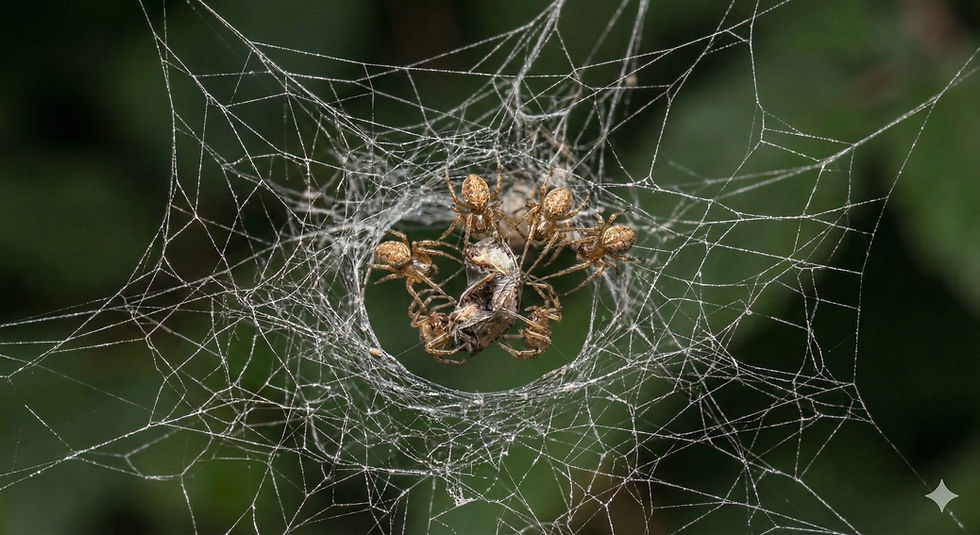
Here, in an aphotic chamber saturated with the toxic stench of hydrogen sulfide (H_2S), researchers have uncovered an ecosystem of startling abundance and complexity. Dominating this noxious environment is a biological structure of unprecedented scale: a continuous, colonial spiderweb spanning over 100 square meters (approximately 1,140 square feet) and housing an estimated population of over 111,000 arachnids.1 This discovery, first noted by speleologists in 2022 and subsequently analyzed by a multinational biological expedition in 2024, challenges our fundamental understanding of arachnid behavior, chemical ecology, and the evolutionary boundaries of sociality.3
The "megacity," as it has been colloquially termed, is not composed of evolved social spiders, but of two typically solitary and mutually predatory species: the barn funnel weaver, Tegenaria domestica, and the sheet weaver, Prinerigone vagans.5 In the pitch-black, sulfur-choked atmosphere of the Vromoner Cave, these rivals have forged an uneasy truce, constructing a cooperative infrastructure that traps the millions of midges rising from the sulfidic stream below. This report provides an exhaustive analysis of this unique ecosystem, dissecting the geological, chemical, and behavioral mechanisms that have allowed a solitary predator to construct a metropolis in the dark.
1.1 The History of Discovery
The revelation of the Sulfur Cave ecosystem was not immediate but the result of iterative exploration. The cave itself was known to locals, its name Vromoner translating to "smelly water" in Greek, a testament to the potent sulfur springs that issue from its depths.6 However, the biological significance of the site remained obscured by the very toxicity that defines it.
In 2022, a team from the Czech Speleological Society, led by the renowned caver Marek Audy, entered the Vromoner Canyon to survey the region's karstic features. Their primary objective was geological—mapping the extensive sulfuric acid caves suspected to exist in the limestone outcrops.2 It was during these initial surveys that Audy and his team encountered the "living curtain"—a wall of silk so dense it obscured the cave rock, vibrating with the movement of thousands of spiders.7 Audy described the web as a "blanket," noting that "when there's danger, the female crawls back and hides, and no creature of a higher order can dig her out of there".8
Recognizing the biological magnitude of the find, the speleologists contacted the scientific community. This led to a targeted biological expedition in 2024, led by Dr. István Urák of the Sapientia Hungarian University of Transylvania.1 Urák’s team, equipped for biological sampling and genetic analysis, ventured into the lethal atmosphere to conduct the first census of the colony. Their findings, published in the journal Subterranean Biology, confirmed the staggering population numbers and the unique dual-species composition of the web.6
1.2 The Significance of the Find
The discovery of the Sulfur Cave spider colony is significant for three primary reasons:
Scale of Cooperation: It represents the first documented case of colonial web formation in Tegenaria domestica and Prinerigone vagans, species previously considered strictly solitary.6
Energy Source: It provides a macro-scale example of a terrestrial ecosystem fueled almost entirely by chemoautotrophy (chemical energy) rather than photosynthesis, offering a terrestrial analogue for deep-sea hydrothermal vent communities.6
Evolutionary Plasticity: It demonstrates the speed at which behavioral adaptations can occur when environmental constraints (such as food scarcity) are removed, offering a window into the early stages of social evolution.9
2. Geological Setting: The Sulfuric Crucible
To understand the biology of Sulfur Cave, one must first understand its geology. The cave is not merely a hole in the ground; it is a chemical reactor. Located in the Vromoner Canyon, which was carved by the Sarandaporo River, the cave is part of a larger hypogenic system that includes the nearby Atmos Cave and Turtle Cave.6
2.1 Sulfuric Acid Speleogenesis (SAS)
Most caves are epigenic, formed by surface water enriched with carbon dioxide (carbonic acid) dissolving limestone from the top down. Sulfur Cave, however, is hypogenic, formed by aggressive fluids rising from below. This process is known as Sulfuric Acid Speleogenesis (SAS).
In the Vromoner system, groundwater rich in hydrogen sulfide (H_2S) rises through faults in the limestone bedrock. This sulfide is likely geogenic, originating from deep hydrocarbon reservoirs or the reduction of evaporitic sulfates (gypsum/anhydrite) at depth.6 When this anoxic, sulfide-rich water reaches the water table or the cave air, it mixes with oxygen.
The oxidation of hydrogen sulfide yields sulfuric acid (H_2SO_4), a significantly more potent solvent than carbonic acid. The reaction can be summarized as:
H_2S + 2O_2 \rightarrow H_2SO_4
This sulfuric acid immediately reacts with the calcium carbonate (CaCO_3) of the limestone walls, converting it into gypsum (CaSO_4 \cdot 2H_2O) and carbon dioxide (CO_2). The gypsum, being soluble and structurally weak, eventually falls away or is washed out, enlarging the cave void.10
2.2 The Cave Environment
The result of this ongoing speleogenesis is a cave environment that is chemically active and hostile. The atmosphere within Sulfur Cave contains hydrogen sulfide concentrations ranging up to 14 parts per million (ppm).11 While this is below the lethal threshold for short-term human exposure (which is around 100-500 ppm), it is chronically toxic and sufficient to create a "rotten egg" stench that permeates the canyon.
Hydrologically, the cave is dominated by a thermal stream that flows through the main passage. This water maintains a remarkably constant temperature of approximately 26°C (79°F) year-round.2 This thermal stability is a crucial factor for the spider colony. Unlike surface spiders, which must contend with the vagaries of weather, winter freezes, and summer droughts, the inhabitants of Sulfur Cave live in a perpetual, warm, humid incubator.
The water itself is heavily charged with dissolved H_2S, with measurements reaching as high as 65 mg/L.12 This stream is the primary vector for the chemical energy that sustains the ecosystem. As the water flows through the cave, it degasses, releasing sulfide into the air and replenishing the atmospheric concentration that sustains the microbial biofilms on the walls.
Parameter | Measurement | Significance | Source |
Location | Vromoner Canyon, Albania/Greece | Hypogenic Karst Zone | 6 |
Cave Type | Active Sulfuric Acid Cave | Ongoing enlargement | 11 |
Stream Temperature | ~26°C (Constant) | Metabolic stability for ectotherms | 12 |
Air Temperature | Up to 29°C | High humidity/warmth | 11 |
Dissolved H_2S | Up to 65 mg/L | Primary energy source | 12 |
Atmospheric H_2S | Up to 14 ppm | Toxic to non-adapted life | 11 |
3. The Chemoautotrophic Engine
The foundation of the Sulfur Cave ecosystem is bacterial. In the absence of sunlight, photosynthesis is impossible. Instead, the primary production of organic matter is achieved through chemoautotrophy—the synthesis of organic compounds using energy derived from inorganic chemical reactions.
3.1 The Biofilms: Beggiatoa and Thiothrix
The visual signature of this process is the thick, white biofilm that coats the sediments and wet rocks along the cave stream. These mats are composed primarily of sulfur-oxidizing bacteria (SOB), specifically filamentous genera such as Beggiatoa and Thiothrix.13
These bacteria are specialists in the "sulfide-oxygen interface." They position themselves exactly where the sulfide-rich water meets the oxygen-rich cave air. Utilizing specialized enzymes, they oxidize the sulfide to elemental sulfur (which they store as intracellular granules, giving the mats their white color) and eventually to sulfate.
The energy released by this oxidation is used to fix carbon dioxide into biomass. These biofilms are not thin, microscopic layers; in Sulfur Cave, they are thick, mucilaginous mats that represent a massive standing crop of protein and carbohydrates.2
3.2 The "Snottites"
In areas of the cave where condensation is high and degassing is intense, the microbial community forms pendulous structures known as "snottites" (or microbial draperies). These mucous-like formations hang from the ceiling and walls, resembling stalactites made of phlegm.14
Research in similar cave systems, such as the Frasassi Caves in Italy and Cueva de Villa Luz in Mexico, has identified Acidithiobacillus as the primary architect of snottites.15 These bacteria oxidize sulfur so aggressively that they produce concentrated sulfuric acid as a metabolic byproduct. The pH of a snottite can be as low as 0 or 1—comparable to battery acid.16
While the spiders and midges cannot live on the snottites due to this extreme acidity, the presence of these structures highlights the intensity of the chemical energy being processed in the cave. The ecosystem is literally dripping with acid and energy.
3.3 Isotopic Evidence
To confirm that the food web is indeed fueled by this chemical process rather than by organic matter washing in from the surface, researchers utilized stable isotope analysis (\delta^{13}C and \delta^{15}N).
In photosynthetic ecosystems, carbon isotope ratios (\delta^{13}C) typically fall within a specific range characteristic of the Calvin cycle in plants. However, chemoautotrophic bacteria use different carbon fixation pathways that result in distinct isotopic signatures. The analysis of the Sulfur Cave invertebrates revealed "light" carbon and nitrogen values that did not match the vegetation outside the cave.13
Specifically, the carbon and nitrogen signatures of the spiders were traced back to the sulfur-oxidizing microbes.2 This confirms that the colony is a self-contained, subterranean ecosystem. The spiders are not eating surface insects that wandered in; they are eating cave-born insects that ate cave-born bacteria.
4. The Trophic Bridge: Tanytarsus albisutus
Between the microscopic bacteria and the macroscopic spiders sits a crucial intermediary: the midge Tanytarsus albisutus. Without this small fly, the energy locked in the bacterial biofilms would remain inaccessible to the arachnids.
4.1 The Midge Explosion
Tanytarsus albisutus is a species of non-biting midge (Chironomidae). Its larvae are aquatic and have adapted to the harsh conditions of the sulfidic stream. Most aquatic insects would perish in water with 65 mg/L of dissolved H_2S due to its toxicity and the associated hypoxia (low oxygen) that typically accompanies sulfidic waters.
However, chironomid larvae, often known as "bloodworms," possess high concentrations of hemoglobin-like molecules that allow them to scavenge oxygen efficiently in hypoxic environments. In Sulfur Cave, the larvae graze directly on the abundant Beggiatoa biofilms.2 The food supply is effectively infinite; the bacteria grow faster than the larvae can consume them.
This unlimited food source leads to population densities that are staggering. Researchers estimated the density of midge larvae at approximately 45,000 individuals per square meter of stream bed.6
4.2 The "Mana from Below"
When the larvae metamorphose into winged adults, they emerge from the water in massive clouds. The estimated standing population of adult midges in the air at any given time is over 2.4 million.20 These midges are weak fliers and are phototactic (attracted to light), though in the absolute darkness of the cave, they likely rely on other cues or simply drift on the thermal air currents rising from the warm stream.
For the spiders living on the walls above, this emergence is a relentless, passive delivery of food. The midges drift into the webs in such numbers that the spiders do not need to hunt. They simply wait. The density of prey is so high that it suppresses the usual competitive behaviors seen in predators. This phenomenon—where an unlimited food source leads to high predator densities—is key to understanding the spider "megacity."
5. The Architects: Tegenaria domestica
The primary architect of the colonial web is Tegenaria domestica, commonly known as the barn funnel weaver or domestic house spider. This is a cosmopolitan species, familiar to homeowners across Europe and North America as the builder of messy, funnel-shaped webs in cellars, sheds, and dark corners.1
5.1 Typical Surface Biology
In a typical surface environment, T. domestica is solitary and territorial. It constructs a sheet of non-sticky silk that leads to a tubular retreat (the funnel) where the spider hides. When an insect crosses the sheet, the spider detects the vibrations, rushes out, and subdues the prey.
If two Tegenaria meet on a surface web, the interaction is almost invariably aggressive. They will fight for territory, and cannibalism is not uncommon, especially if there is a size disparity. The webs are usually discrete, separated by enough space to prevent conflict.
5.2 The Cave Giants
In Sulfur Cave, the biology of T. domestica has been fundamentally altered. The population within the web complex is estimated at 69,000 individuals.1 They live in extremely close proximity, with funnel retreats often adjacent to one another.
The spiders in the cave have been noted to be physically robust, a testament to the abundance of food. István Urák’s team observed that the spiders exhibit a seasonal pattern in fecundity, with significantly larger egg clutches produced in early summer.6 This seasonality is curious given the constant cave temperature, suggesting that some external cue (perhaps barometric pressure or subtle changes in the stream's chemistry due to surface rainfall) still influences their biological clocks, or that they retain a genetic memory of surface seasonality.
5.3 Silk Mechanics in Acidic Air
A critical question regarding the Tegenaria presence is the stability of their silk. Spider silk is a protein polymer. In the acidic, humid atmosphere of a sulfur cave, proteins can denature, and silk can lose its tensile strength.
However, research into Tegenaria silk has shown it to be remarkably resistant. Studies suggest that T. domestica silk possesses natural anti-bacterial properties, inhibiting the growth of common bacteria like Bacillus subtilis.21 This antimicrobial defense may be crucial in the cave, where the humidity promotes intense fungal and bacterial growth that would otherwise rot the web.
Furthermore, the "acidification" of the silk gland is a natural part of the spinning process for spiders (pH drops from 7 to 5 in the duct to trigger fiber formation).22 It is possible that the ambient acidity of the cave environment does not degrade the silk as quickly as expected, or that the spiders are producing silk with a modified amino acid profile to withstand the chemical assault.
6. The Tenants: Prinerigone vagans
Living alongside the Tegenaria is a second species: Prinerigone vagans. This is a small spider from the family Linyphiidae (sheet weavers), often called the marsh dwarf sheet-weaver.23
6.1 Ecology of the "Dwarf"
Prinerigone vagans is typically found in wetlands and marshes, making it pre-adapted to the high humidity of the Sulfur Cave. In the surface world, it builds small, inconspicuous sheet webs near the ground to catch tiny flying insects.
In the Sulfur Cave, the population of P. vagans is estimated at 42,000 individuals.1 Unlike the large Tegenaria, which dominate the structural framework of the web, the Prinerigone occupy the interstices—the spaces between the larger funnels.
6.2 The Commensal Relationship
The relationship between Tegenaria (large, aggressive) and Prinerigone (small, delicate) is the most surprising aspect of the colony. In a Petri dish, a Tegenaria would almost certainly eat a Prinerigone. In the cave, they co-exist.
This arrangement appears to be a form of commensalism or mutualism. The massive structure of the Tegenaria web provides a substrate for the Prinerigone. In return, the smaller spiders may capture tiny midges that are too small to trigger the Tegenaria's sensors, or they may simply act as a "clean-up crew," consuming distinct prey size classes.
There is no evidence of cooperative hunting between the species (e.g., they don't attack prey together), but the lack of intraguild predation (spiders eating spiders) is a significant behavioral deviation.
7. The Megacity: Architecture and Dynamics
The web itself is a marvel of bio-engineering. It is not a single, monolithic sheet spun by a queen, but an aggregate structure formed by the fusion of thousands of individual webs.
7.1 Structural Integration
The "living curtain" covers the walls and ceiling of the cave passage, extending from approximately 50 meters into the cave.24 It spans an area of over 100 square meters.25 The density of the silk is high enough to create a distinct microclimate near the rock face, likely trapping humidity and creating a buffer zone of still air.
The web consists of multiple layers. The base layer is the mesh of the Tegenaria funnels, anchored to the rock. Over time, as spiders move and spin new silk, the layers build up, creating a "blanket" effect. Marek Audy noted that the web is thick and spongy, offering protection to the inhabitants.8
7.2 Population Density
The density of spiders in this web is extraordinary. With ~111,000 spiders in ~100 m^2, the average density is over 1,000 spiders per square meter (roughly 100 per square foot). This density is virtually unheard of for non-social spiders.
Species | Estimated Population | Density (approx.) |
Tegenaria domestica | 69,000 | ~690 per m^2 |
Prinerigone vagans | 42,000 | ~420 per m^2 |
Total | 111,000 | ~1,110 per m^2 |
7.3 Maintenance and Hygiene
Maintaining such a structure in a high-humidity environment requires constant effort. Fungal attack is a constant threat. The spiders likely engage in constant repair, cutting out old, moldy silk and replacing it with fresh threads. The anti-bacterial properties of Tegenaria silk mentioned earlier would be a critical asset here. Additionally, the sheer number of spiders moving over the web may help keep it clean of dust and debris, although in a cave, dust is minimal.
8. The Sociology of Survival: Facultative Coloniality
The central paradox of Sulfur Cave is the peace that reigns in the colony. Why do these solitary predators not turn on each other?
8.1 The Resource Abundance Hypothesis
The most robust explanation is the Resource Abundance Hypothesis. Territoriality and aggression are energetically expensive behaviors. They evolve when resources (food, mates, shelter) are scarce and defendable. If a resource is infinite, the benefit of defending it drops to zero, while the cost (risk of injury) remains high.
In Sulfur Cave, the midges are effectively infinite. A spider does not need to guard its sector of the web to ensure survival; the food will come regardless. Therefore, the evolutionary pressure for aggression is relaxed. The spiders have switched to a strategy of facultative coloniality—living together not because they need to help each other (as in bees or ants), but because they can tolerate each other to exploit a rich patch.
8.2 The Sensory Deprivation Hypothesis
A secondary factor may be the environment itself. Tegenaria use both vibration and vision (though their eyesight is poor) to identify threats.
Darkness: The cave is in the aphotic zone (0 lux). Visual cues for aggression—such as the posturing of a rival male—are absent.
Sensory Overload: The cave is loud. The stream rushes, the midges buzz, and thousands of spiders move. This constant vibrational background noise might "jam" the specific signals that usually trigger a territorial attack. The spiders may be in a state of sensory habituation, ignoring the constant jostling of neighbors because reacting to every vibration would be impossible.
8.3 Genetic Divergence and "Plasticity"
Genetic analysis has shown that the Sulfur Cave populations of T. domestica and P. vagans are genetically distinct from their surface relatives.6 This suggests that there is no gene flow between the cave and the surface. The colony is a closed loop.
This isolation allows for rapid evolution. It is possible that the cave population has been selected for reduced aggression. Aggressive individuals who wasted energy fighting neighbors might have been out-competed by "docile" individuals who spent all their energy eating and laying eggs. Over generations, this would lead to a genetically distinct, pacifist strain of house spider.
István Urák refers to this as "genetic plasticity," noting that the capacity for this behavioral shift exists in the species' genome but is only expressed under extreme conditions.1
9. Comparative Speleobiology
To fully appreciate the Sulfur Cave discovery, it is necessary to place it in the context of other chemoautotrophic ecosystems.
9.1 Movile Cave (Romania)
Movile is the most famous chemoautotrophic cave. Sealed for 5.5 million years, it contains a high density of spiders (Agraecina cristiani) and other invertebrates. However, Movile is a "dry" system relative to Vromoner's flowing river, and its atmosphere is lower in oxygen (7-10%) and higher in CO_2. The spider density in Movile is high, but they do not form a single, massive colonial web. They remain hunters.
9.2 Frasassi Caves (Italy)
The Frasassi system contains sulfidic lakes and abundant life, including Niphargus amphipods and various spiders. While it shares the SAS geology and "snottite" biofilms, it lacks the specific Tegenaria/Prinerigone megacity structure.
9.3 The Vromoner Uniqueness
Vromoner is unique because of the open connection combined with high energy. Because the cave is not sealed (the river flows out), surface species like Tegenaria and Prinerigone could enter. Once inside, they found an energy source (the midges) that far exceeded anything on the surface.
This created a "Goldilocks" scenario:
Access: Surface pre-adapted species could get in.
Energy: Unlimited food allowed for density.
Stability: Constant 26°C allowed for year-round activity.
In sealed caves like Movile, only ancient troglobites remain. In Vromoner, we are witnessing the colonization phase of cave evolution—a snapshot of surface species adapting to the underworld in real-time.
10. Future Research and Conservation
The Sulfur Cave ecosystem is a fragile anomaly. While the spider population appears robust, it is entirely dependent on the hydrological stability of the Sarandaporo River and the deep sulfur springs.
10.1 Conservation Challenges
The cave straddles the border between Greece and Albania, complicating conservation efforts. The region is remote, but any alteration to the watershed—such as damming the Sarandaporo or agricultural runoff altering the water chemistry—could destroy the bacterial biofilms. If the bacteria die, the midges die. If the midges die, the spider megacity collapses.
There is also the risk of human disturbance. The web is located only 50 meters from the entrance. Unregulated caving tourism could damage the delicate "living curtain" or introduce pathogens (fungi) that could decimate the genetically isolated spider population.
10.2 Future Inquiries
Scientific questions abound:
Venom Evolution: Has the venom of the cave spiders changed? Do they need potent venom if the prey is defenseless midges?
Social Evolution: Will these spiders eventually become truly eusocial? Are we witnessing the birth of a new social species?
Microbiome: How do the spiders handle the sulfur load in their diet? Do they have specialized gut bacteria to detoxify the midge biomass?
11. Conclusion: The Nightmare and the Miracle
To the casual observer, the Sulfur Cave—with its rotten-egg stench, acid-dripping walls, and writhing carpet of 111,000 spiders—might seem like a vision of hell. Yet, to the biologist, it is a miracle of adaptation.
The "Sulfur City" demonstrates the boundless opportunism of life. It shows that the rigid behavioral categories we assign to animals—"solitary," "aggressive," "territorial"—are not immutable laws, but flexible strategies. When the constraints of the surface world are stripped away and replaced with the alien bounty of the sulfur springs, the rules change. The barn spider, the lonely sentinel of the cellar, lays down its arms and joins its neighbors to build a metropolis in the dark.
This ecosystem stands as a testament to the power of chemoautotrophy to sustain complex macroscopic life, offering a terrestrial glimpse into the types of alien ecosystems that might exist in the subsurface oceans of Europa or Enceladus. In the dark, toxic silence of the Vromoner Canyon, life has not just survived; it has built a kingdom.
Citations and Data Sources
Discovery & Expeditions: 1
Geology & Atmosphere: 6
Spider Biology & Counts: 1
Microbiology & Trophic Web: 2
Behavioral Ecology: 9
Silk Mechanics: 21
Works cited
World's Biggest Spiderweb Found in Horror Cave Crawling With 111,000 Spiders - VICE, accessed November 26, 2025, https://www.vice.com/en/article/worlds-biggest-spiderweb-found-in-horror-cave-crawling-with-111000-spiders/
Giant Spider Colony Discovered in Unique Chemoautotrophic Cave - New Atlas, accessed November 26, 2025, https://newatlas.com/biology/sulfur-cave-largest-spiderweb/
Our Lecturer Helped Discover the World's Largest Spider Web, accessed November 26, 2025, https://sapientia.ro/en/news/our-lecturer-helped-discover-the-worlds-largest-spider-web
World's largest spider megacity: 1,11,000 spiders living together in a massive web inside a Sulphur cave | - The Times of India, accessed November 26, 2025, https://timesofindia.indiatimes.com/etimes/trending/worlds-largest-spider-megacity-111000-spiders-living-together-in-a-massive-web-inside-a-sulphur-cave/articleshow/125169275.cms
This 'spider megacity' may be the largest web ever found. But what's inside is even more extraordinary | The Independent, accessed November 26, 2025, https://www.the-independent.com/news/science/spider-megacity-web-sulfur-cave-albania-greece-b2860505.html
An extraordinary colonial spider community in Sulfur Cave (Albania/Greece) sustained by chemoautotrophy - Subterranean Biology - Pensoft Publishers, accessed November 26, 2025, https://subtbiol.pensoft.net/article/162344/
This Massive Web—Home to More Than 100,000 Spiders—Found in a Cave in Europe Could Be the World's Largest - Smithsonian Magazine, accessed November 26, 2025, https://www.smithsonianmag.com/smart-news/massive-spiderweb-possibly-the-worlds-largest-found-in-european-cave-180987652/
1140-square-foot super-web reveals the surprising 'constant party' life of cohabiting spiders, accessed November 26, 2025, https://www.pbs.org/newshour/science/1140-square-foot-super-web-reveals-the-surprising-constant-party-life-of-cohabiting-spiders
Massive colony of 111000 spiders from different species found deep inside a sulfur cave, accessed November 26, 2025, https://www.earth.com/news/massive-colony-of-111000-spiders-from-different-species-discovered-deep-inside-sulfur-cave/
Community genomic analysis of an extremely acidophilic sulfur-oxidizing biofilm - PMC, accessed November 26, 2025, https://pmc.ncbi.nlm.nih.gov/articles/PMC3246232/
Exploring Biodiversity and Food Webs in Sulfur Cave in the Vromoner Canyon on the Greek–Albanian Border - MDPI, accessed November 26, 2025, https://www.mdpi.com/1424-2818/16/8/477
An extraordinary colonial spider community in Sulfur Cave (Albania/ Greece) sustained by chemoautotrophy* | Subterranean Biology, accessed November 26, 2025, https://subtbiol.pensoft.net/article/162344/download/pdf/1442101
Exploring Biodiversity and Food Webs in Sulfur Cave in the Vromoner Canyon on the Greek–Albanian Border - ResearchGate, accessed November 26, 2025, https://www.researchgate.net/publication/382932882_Exploring_Biodiversity_and_Food_Webs_in_Sulfur_Cave_in_the_Vromoner_Canyon_on_the_Greek-Albanian_Border
The geomicrobiology of limestone, sulfuric acid speleogenetic, and volcanic caves: basic concepts and future perspectives - Frontiers, accessed November 26, 2025, https://www.frontiersin.org/journals/microbiology/articles/10.3389/fmicb.2024.1370520/full
Convergent Community Assembly among Globally Separated Acidic Cave Biofilms | Applied and Environmental Microbiology - ASM Journals, accessed November 26, 2025, https://journals.asm.org/doi/10.1128/aem.01575-22
Field photographs of the collection site for snottite sample RS24. Note... - ResearchGate, accessed November 26, 2025, https://www.researchgate.net/figure/Field-photographs-of-the-collection-site-for-snottite-sample-RS24-Note-elemental-sulfur_fig3_51454874
Schematic of integrated biogeochemical cycling in microbial ecosystems... - ResearchGate, accessed November 26, 2025, https://www.researchgate.net/figure/Schematic-of-integrated-biogeochemical-cycling-in-microbial-ecosystems-related-to-the_fig2_228625145
Nitrogen and carbon stable isotope values of selected taxa in Sulfur Cave. - ResearchGate, accessed November 26, 2025, https://www.researchgate.net/figure/Nitrogen-and-carbon-stable-isotope-values-of-selected-taxa-in-Sulfur-Cave_tbl1_382932882
It's the first time two spider species seen living cooperatively, and the first recorded instance of colonial web-building in what's known as a chemoautotrophic cave. : r/science - Reddit, accessed November 26, 2025, https://www.reddit.com/r/science/comments/1opw0fw/worlds_largest_web_houses_110000_spiders_thriving/
The World's Largest Spiderweb: A Colony of Over 100,000 Spiders Discovered in a Cave Crossed by a Stream of Toxic Water - La Brújula Verde, accessed November 26, 2025, https://www.labrujulaverde.com/en/2025/11/the-worlds-largest-spiderweb-a-colony-of-over-100000-spiders-discovered-in-a-cave-crossed-by-a-stream-of-toxic-water/
Nitrogen inaccessibility protects spider silk from bacterial growth - Company of Biologists journals, accessed November 26, 2025, https://journals.biologists.com/Toolbox/DownloadCombinedArticleAndSupplmentPdf?resourceId=224483&multimediaId=1978436&pdfUrl=%2Fcob%2Fcontent_public%2Fjournal%2Fjeb%2F222%2F20%2F10.1242_jeb.214981%2F3%2Fjeb214981.pdf
Influence of Spider Silk Protein Structure on Mechanical and Biological Properties for Energetic Material Detection - PubMed Central, accessed November 26, 2025, https://pmc.ncbi.nlm.nih.gov/articles/PMC10934110/
111,000-spider colony weaves record web in Greece cave | The Jerusalem Post, accessed November 26, 2025, https://www.jpost.com/science/article-872957
Over 100000 Unlikely Spider Species in a Cave Built the Largest Web in the World, accessed November 26, 2025, https://www.discovermagazine.com/over-100-000-unlikely-spider-species-in-a-cave-built-the-largest-web-in-the-world-48270
The Mystery of 111000 Spiders Living in a Giant Subterranean Web - Nautilus Magazine, accessed November 26, 2025, https://nautil.us/the-mystery-of-111000-spiders-living-in-a-giant-subterranean-web-1246387/
Arachnid super-web reveals the surprising 'constant party' life of cohabiting spiders - Netscape News, accessed November 26, 2025, https://isp.netscape.com/news/odd/story/0001/20251114/0787583c8638928d742127ab4ee09d31
Scientists Have Found The World's Largest Spider Web - All That's Interesting, accessed November 26, 2025, https://allthatsinteresting.com/worlds-largest-spider-web
Carbonic Anhydrase Generates CO2 and H+ That Drive Spider Silk Formation Via Opposite Effects on the Terminal Domains - NIH, accessed November 26, 2025, https://pmc.ncbi.nlm.nih.gov/articles/PMC4122339/


Comments