More Than Weeds: How the Collapse of Kelp Forests Threatens Global Economies

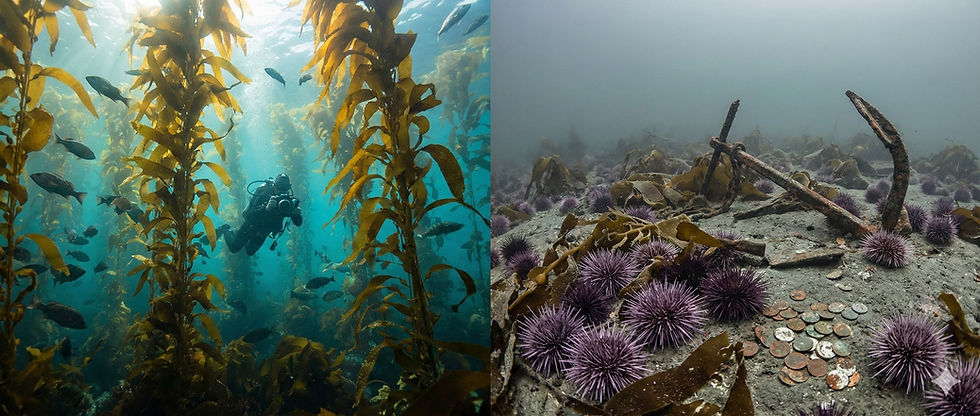
Introduction: The Vanishing Cathedrals of the Coast
In the cool, nutrient-rich waters that hug the temperate coastlines of our planet, a biological phenomenon exists that rivals the complexity and productivity of the Amazon rainforest. These are the kelp forests—towering underwater ecosystems defined by giant brown macroalgae that rise from the seafloor to the surface, creating a three-dimensional habitat that sustains a staggering diversity of marine life. For millennia, these sub-tidal jungles have served as the silent engines of coastal prosperity, fueling fisheries, buffering shorelines against the violence of ocean storms, and cycling the fundamental elements of life—carbon, nitrogen, and oxygen. They are the "blue lungs" of the nearshore ocean, a critical component of the planetary biosphere that has, until recently, operated largely out of sight and out of mind.
However, the narrative of the kelp forest is undergoing a profound and tragic shift. It is no longer a story solely of abundance and resilience; it has become a chronicle of vulnerability and collapse. A seminal 2025 review by Matthew S. Edwards, published in the Annual Review of Ecology, Evolution, and Systematics, titled "Kelp Forests Under Threat and the Loss of Ecosystem Services They Provide," serves as a grim milestone in the field of marine ecology. This comprehensive synthesis catalogues a converging array of threats—biological, physical, and anthropogenic—that are systematically dismantling these ecosystems at a pace that far outstrips their natural capacity for recovery.1
From the warming waters of Tasmania, where "tropicalization" is erasing cold-water species, to the rugged coast of Northern California, where lush canopies have been replaced by desolate urchin barrens, the signal is clear: the stability of the global kelp forest is fracturing. The Edwards review highlights that these losses are not merely aesthetic or ecological tragedies; they represent a massive economic and utilitarian blow to humanity. The loss of kelp equates to the loss of critical ecosystem services: the collapse of commercial fisheries, the cessation of carbon sequestration, the degradation of water quality, and the erosion of cultural heritage.1
This deep-dive research article aims to unpack the density of the Edwards review and the supporting scientific literature. We will journey through the biology of the kelp holobiont, exploring the microscopic mechanisms that underpin the forest's existence. We will quantify the immense, often hidden, economic value of these ecosystems. We will dissect the anatomy of the threats—the marine heatwaves, the zombie urchins, and the genetic bottlenecks—that are driving the collapse. Finally, we will explore the frontier of human intervention, from "Green Gravel" restoration to genomic engineering, asking the critical question: Can we save the silent canopy before it is silenced forever?
Part I: The Biological Engine – Architecture of the Underwater Forest
To comprehend the magnitude of the current crisis, one must first appreciate the biological marvel that is a kelp forest. While they resemble terrestrial plants in form and function, kelps are evolutionarily distinct, belonging to the class Phaeophyceae (brown algae). They have evolved a suite of unique adaptations to thrive in the high-energy, dynamic environment of the cold-temperate ocean.
The Structural Foundation: Holdfast to Canopy
The architecture of a kelp forest is a masterclass in biomechanical engineering. Unlike terrestrial trees that anchor deep into soil to extract nutrients, kelp anchors itself to bedrock using a structure called a holdfast. The holdfast performs no nutrient uptake; its sole purpose is mechanical grip. It is a tangled mass of root-like haptera that cements the organism to the reef, allowing it to withstand the immense drag forces generated by ocean swells and tidal currents.
Rising from the holdfast is the stipe, a flexible, stem-like structure that serves as the highway for transport. In the giant kelp, Macrocystis pyrifera, the stipe can grow at rates exceeding 50 centimeters per day under optimal conditions, making it one of the fastest-growing organisms on Earth.1 This explosive growth is driven by the need to reach the surface, where sunlight is most abundant.
At the surface, the stipe terminates in blades—leaf-like structures that are the primary sites of photosynthesis. These blades are buoyed by gas-filled bladders called pneumatocysts, which keep the canopy floating at the surface. This canopy acts as a "roof," filtering sunlight and creating a dim, cathedral-like interior below. This modification of the physical environment is what makes kelp an "ecosystem engineer." By attenuating light and dampening wave energy, the kelp forest creates a stable, sheltered microclimate that allows thousands of other species—from understory algae to invertebrates and fish—to flourish.3
The Hidden Life Cycle: Alternation of Generations
While the towering sporophytes (the macroscopic kelp plants visible to divers) capture the human imagination, the resilience of the forest depends on a life stage that is invisible to the naked eye. Kelps undergo a complex life cycle known as alternation of generations.
The large sporophyte is diploid, meaning it carries two sets of chromosomes. When mature, it releases trillions of microscopic zoospores. These spores swim through the water column before settling on the seafloor. There, they do not grow into new kelp plants immediately. Instead, they develop into microscopic male and female gametophytes—tiny, filamentous structures that are haploid (carrying one set of chromosomes).4
It is within this microscopic realm—often referred to as the "black box" of kelp ecology—that the future of the forest is determined. These gametophytes must survive sedimentation, grazing by micro-predators, and competition for space. Crucially, they must wait for environmental cues to trigger sexual reproduction. Once triggered, the male gametophytes release sperm to fertilize the eggs of the females, producing a juvenile sporophyte that will eventually grow into a forest giant.
Recent research highlighted in the Edwards review emphasizes that these microscopic stages may possess different thermal tolerances than their macroscopic parents. For instance, gametophytes of Ecklonia radiata have been shown to survive temperatures that would kill the adult plant. This suggests that the microscopic "seed bank" on the seafloor may act as a reservoir of resilience, allowing the population to recover after a heatwave wipes out the canopy. Conversely, if the heatwave is intense enough to kill the gametophytes, the population faces total extinction, as there is no next generation waiting in the wings.4
The Holobiont: The Kelp and Its Microbiome
A modern understanding of kelp biology is incomplete without considering the microbiome. Just as humans rely on gut bacteria, kelp relies on a complex community of bacteria, viruses, and fungi that live on its surface. This association is so tight and functional that the kelp and its microbes are considered a single biological unit: the holobiont.
The Edwards review draws attention to the critical role of this microbiome in the health and restoration of kelp forests. These microbes are not mere passengers; they are pilots. Specific bacteria, often referred to as Seaweed Beneficial Bacteria (SBB), are responsible for releasing morphogenetic factors—chemical signals that tell the kelp when to grow, when to differentiate its tissues, and potentially, how to defend itself against pathogens.6
Research in New Zealand aquaculture has shown that these bacterial communities play a pivotal role in nitrogen fixation, converting inert nitrogen gas from the water into a form the kelp can use for growth. Furthermore, the microbiome acts as a living shield, producing antimicrobial compounds that prevent infection by pathogenic organisms. However, this relationship is fragile. Environmental stress, such as ocean warming or acidification, can disrupt the community structure, leading to "dysbiosis." In a dysbiotic state, beneficial bacteria are replaced by opportunists or pathogens, which can exacerbate tissue bleaching and accelerate the death of the host plant during a heatwave.7
Part II: The Hidden Economy – Ecosystem Services and Global Value
The term "ecosystem services" is an attempt by economists and ecologists to quantify the benefits nature provides to humanity. In the case of kelp forests, these services are vast, multifaceted, and historically undervalued. It is only recently, with high-level syntheses like the Edwards review and reports from the United Nations Environment Programme, that the true economic magnitude of these systems has been recognized. Some estimates place the global value of kelp forests at roughly $500 billion annually—a figure comparable to the GDP of Sweden.9
Biodiversity and Fisheries Support
The most immediate and tangible service provided by kelp is habitat. The three-dimensional structure of the forest offers shelter, nursery grounds, and foraging areas for a diversity of fish and invertebrates that is orders of magnitude higher than in adjacent open water areas.
In the Northern Hemisphere, commercially vital species such as rockfish, lingcod, abalone, and red sea urchins are inextricably linked to the kelp canopy. In the Southern Hemisphere, the lucrative rock lobster fishery depends on the Ecklonia and Macrocystis forests for habitat and food. When a kelp forest is lost, the impact on biodiversity is not linear—it is catastrophic. The Edwards review notes that kelp loss leads to a direct and precipitous reduction in the biodiversity of ecologically and commercially important fishes.11
This is not merely a displacement of species; it is a collapse of productivity. The trophic energy that once flowed from the sun to the kelp, then to the grazers, and finally to the predators, is severed. In a specific valuation case study from Lüderitz, Namibia, the kelp forest's contribution to commercial fishing alone was estimated at $26,000 per hectare per year. When scaled up to the global distribution of kelp, the contribution to food security and the fishing economy is immense.12
The Blue Carbon Engine: Refractory vs. Labile
Perhaps the most contentious and critical service in the context of the modern climate crisis is "Blue Carbon"—the sequestration of carbon dioxide by marine ecosystems. For years, kelp forests were excluded from Blue Carbon accounting protocols. Unlike mangroves or seagrasses, which root in soft sediment and bury carbon directly in place, kelp grows on rock. It was assumed that when kelp died, it simply decomposed in the water column, returning its carbon to the atmosphere as CO2.
However, new research synthesised in the Edwards review overturns this view, revealing that kelp forests function as carbon "conveyor belts." They export significant amounts of biomass as detritus (particulate organic carbon, POC) and dissolved organic carbon (DOC). A substantial portion of this material—estimates range up to 11% or more of annual production—drifts off the reef and is transported by currents to the deep ocean or continental shelf sediments, where it can be buried and sequestered for centuries.1
The effectiveness of this pump depends on the quality of the carbon. Scientists distinguish between "labile" carbon and "refractory" carbon. Labile carbon is like sugar; it is easily broken down by bacteria and respired back into CO2 quickly. Refractory carbon is tough and chemically complex; it resists degradation and is therefore much more likely to reach the deep ocean sink before it decomposes.
Crucially, the Edwards review highlights a disturbing feedback loop: warming oceans may be altering this ratio. Studies show that warm-temperate kelp species, such as Laminaria ochroleuca, which are expanding their ranges as oceans warm, decompose significantly faster than the cold-water species they replace (like Laminaria hyperborea). This means that even if a forest biomass remains constant, its capacity to sequester carbon may diminish because the kelp is rotting faster than it can be exported to the deep sea.15
Furthermore, turbidity—cloudy water caused by pollution or runoff—can significantly reduce the amount of carbon fixed by the forest. Low light levels suppress photosynthesis, reducing the total carbon budget of the ecosystem and diminishing its role as a global carbon sink.17
Nutrient Cycling and Bioremediation
In an era of industrial agriculture and coastal urbanization, our oceans are increasingly inundated with excess nitrogen and phosphorus. These nutrient pollutants drive eutrophication, leading to harmful algal blooms and oxygen-depleted "dead zones."
Kelp forests act as massive, living biofilters. They are exceptionally efficient at absorbing dissolved nitrogen from the water column to fuel their rapid growth. By locking these excess nutrients into their biomass, kelp forests help clean the water and maintain the chemical balance of the coastal zone. In the Namibia case study, this nutrient cycling service was valued at approximately $35,000 per hectare per year—higher even than the value of the fisheries they support.12 This underscores a critical point: the invisible chemical work performed by the kelp forest is often more economically valuable than the visible extraction of resources.
Cultural and Industrial Value
Beyond the ecological metrics, kelp is woven into the fabric of human culture and industry. The "Kelp Highway" hypothesis suggests that the first humans to migrate from Asia to the Americas did so by following the rim of the Pacific, relying on the rich resources of the kelp forests for sustenance. Indigenous cultures worldwide have used kelp for food, medicine, and material for thousands of years.
In the modern industrial economy, kelp is the source of alginates—compounds used as thickening and stabilizing agents in everything from toothpaste and ice cream to textile printing and dental molds. The Edwards review emphasizes that the loss of these forests threatens the availability of this biomass, severing a resource connection that underpins both traditional practices and modern industrial applications.11
Table 1: Valuation of Kelp Forest Ecosystem Services
Based on global estimates and specific case studies highlighted in the research.
Service Category | Mechanism | Estimated Value / Impact | Source |
Fisheries Support | Trophic transfer, nursery habitat, foraging grounds. | $26,000 / ha / year (Namibia). Global contribution in billions. | 10 |
Nutrient Cycling | Absorption of N and P; mitigation of eutrophication. | $35,000 / ha / year (Namibia). Prevents costly algal blooms. | 12 |
Carbon Sequestration | Export of refractory carbon to deep sea (Blue Carbon). | $1,500 - $111,000 / ha / year (Varies by social cost of carbon). | 9 |
Tourism & Recreation | Diving, eco-tourism, recreational fishing. | $9,000 - $19,000 / ha / year. High in regions like California/Australia. | 12 |
Total Global Value | Aggregate of all services. | ~$500 Billion / Year (Global estimate). | 9 |
Part III: The Unraveling – Mechanisms of Collapse
If the kelp forest is an engine of productivity, then the current anthropogenic era is defined by the dismantling of that engine. The threats facing these ecosystems are not isolated incidents but a converging "perfect storm" of biological and physical stressors that are pushing kelp populations beyond their physiological limits.
The Heat: Marine Heatwaves and Physiological Tipping Points
Climate change is the overarching driver of kelp decline, but it manifests most acutely through discrete events known as Marine Heatwaves (MHWs). These are periods of anomalously high water temperatures that can persist for weeks or months. The Edwards review and supporting studies identify a physiological "tipping point" for many kelp species, particularly the giant kelp Macrocystis pyrifera, around 20°C.18
When water temperatures exceed this threshold, the metabolic balance of the kelp is thrown into chaos. Kelp metabolism involves two competing processes: photosynthesis (creating energy from sunlight) and respiration (burning energy to maintain cellular function). As temperature rises, respiration rates increase exponentially—the plant burns fuel faster to survive the heat. However, photosynthesis often plateaus or declines because the delicate machinery of the chloroplasts (specifically Photosystem II) is damaged by thermal stress.
The result is a metabolic deficit: the kelp is consuming more energy than it can produce. This leads to the depletion of carbohydrate reserves, tissue bleaching, and structural weakening. The plant essentially starves from the inside out. If the heatwave persists, the fronds degrade and detach, leading to the collapse of the canopy.
This thermal stress is often exacerbated by "coastal darkening." Increased turbidity from runoff or plankton blooms reduces the light available for photosynthesis exactly when the kelp needs energy the most. The combination of high heat (high energy demand) and low light (low energy supply) is lethal.17
The Grazers: Urchin Barrens and Trophic Cascades
While heat weakens the forest, the sea urchin destroys it. Under healthy conditions, sea urchins are passive detritivores. They hide in rock crevices to avoid predators and feed on "drift kelp"—pieces of kelp blades that break off naturally and fall to the seafloor. In this state, they are the janitors of the forest.
However, the balance of this relationship is maintained by top-down predator control. Key predators such as sea otters, huge spiny lobsters, and large fish (like the California sheephead) keep urchin populations in check. When these predators are removed—whether by historical overfishing, as seen with lobsters in New Zealand, or by disease, as seen with sea stars in California—the ecosystem's immune system fails.21
Released from the fear of predation, urchin populations explode. When the supply of drift kelp is exhausted, their behavior undergoes a radical and destructive shift. They emerge from their crevices and form "grazing fronts"—voracious herds that move across the reef, climbing the kelp stipes and chewing through the holdfasts. This severs the entire plant, which floats away. The result is a "phase shift" from a lush, three-dimensional forest to a two-dimensional "urchin barren"—an underwater desert dominated by bare rock, encrusting pink coralline algae, and millions of starving urchins.22
The Hysteresis Trap and the "Zombie" Urchin
The most terrifying aspect of the urchin barren is its resilience. Once a barren is formed, it is incredibly difficult to reverse. This phenomenon is known in ecology as "hysteresis." It implies that the path to recovery is not simply the reverse of the path to collapse.
To trigger the shift to a barren (the "forward shift"), urchin densities must reach a high critical threshold (e.g., 700 grams per square meter). However, to restore the kelp (the "reverse shift"), urchin densities must be reduced to an exceedingly low level (e.g., less than 70 grams per square meter)—an order of magnitude lower than the collapse threshold.23
Why is recovery so difficult? The answer lies in the zombie-like biology of the purple sea urchin (Strongylocentrotus purpuratus). In many animals, if the food source (kelp) disappears, the population starves and dies, allowing the vegetation to recover. Urchins, however, defy this logic.
Metabolic Depression: When kelp runs out, urchins do not die. They act as "zombies." They reabsorb their reproductive organs (gonads), shrinking their internal biomass while maintaining their hard outer shell. This makes them commercially worthless to divers (no roe/uni means no market value), removing the economic incentive for humans to fish them out.24
Dissolved Organic Matter (DOM) Uptake: Recent molecular studies have revealed a startling adaptation. Urchin larvae and potentially adults can upregulate specific genes, such as the amino acid transporter (AAT) gene, which allows them to absorb dissolved organic matter directly from the seawater. They can essentially feed on the "soup" of the ocean, bridging the energy gap that would kill other herbivores.25
Longevity: These adaptations allow urchins to survive in a barren state for decades—some records suggest up to 50 or 80 years. They lie in wait, dormant but alive. The moment a new kelp spore settles on the reef, it is immediately rasped off the rock and eaten. This biological feedback loop locks the ecosystem into the barren state, preventing recovery even years after the initial disturbance.27
Case Study: The Northern California Collapse
The Northern California coast provides a harrowing, real-time case study of these synergistic threats. Historically, this region supported lush bull kelp (Nereocystis luetkeana) forests and a vibrant recreational fishery for red abalone. The collapse began in 2013 with a biological disaster: "Sea Star Wasting Disease." A mysterious viral pathogen decimated populations of the sunflower star (Pycnopodia helianthoides), a voracious twenty-armed predator that was the primary control agent for purple sea urchins.28
This biological blow was immediately followed by a physical one: "The Blob." This massive marine heatwave in 2014-2015 created a pool of warm water that stressed the bull kelp, suppressing its growth and reproduction. The combination was fatal. With no predators to eat them and a weakened kelp forest, purple urchin populations exploded, increasing 60-fold in just two years.
The consequences were swift and devastating. By 2016, more than 90% of the bull kelp canopy along 200 miles of coastline had vanished. The ecosystem snapped into a barren state. The $44 million recreational abalone fishery was closed indefinitely as abalone starved to death. The commercial red urchin fishery also collapsed because the urchins in the barrens were empty "zombies" with no marketable meat.24 Today, divers in the region report seeing moonscapes of rock carpeted in purple spines, a haunting testament to the speed at which an ecosystem can unravel.29
Case Study: Tasmanian Tropicalization
In the Southern Hemisphere, the threat takes a different form: "tropicalization." The East Australian Current, a massive flow of warm tropical water moving down the coast of Australia, is strengthening and extending further south due to climate change. This current acts as a heat pump, injecting warm, nutrient-poor water into the historically cool, nutrient-rich waters of Tasmania.30
This warming has decimated 95% of the giant kelp (Macrocystis) forests in the region, which are physiologically unable to tolerate the new thermal regime. But the heat brings a secondary agent of destruction. The warm current has facilitated the range expansion of the long-spined sea urchin (Centrostephanus rodgersii) from the mainland to Tasmania. These invaders are creating extensive barrens in areas that have no evolutionary history of such intense grazing. The native kelp, Ecklonia radiata, is being squeezed between the thermal stress of the water and the grazing pressure of the invader, driving the ecosystem to the brink of functional extinction.31
Part IV: Genomic Vulnerability – The Limits of Adaptation
Facing these rapid environmental changes, a critical question arises: can kelp populations evolve fast enough to survive? Can natural selection produce heat-tolerant strains that will repopulate the warming oceans? The Edwards review and associated genetic research suggest that for many populations, the answer is a concerning "no."
The "Edge" Paradox
Kelp populations are not genetically uniform across their range. They exhibit strong local adaptation, meaning their genes are tuned to the specific temperature regime of their home reef. Researchers often look to populations at the "warm edge" of a species' range (e.g., the northernmost Ecklonia populations in Australia) as potential reservoirs of heat-tolerant genes. The logic is that these plants are already surviving in warmer water, so they must be tougher.
However, genomic vulnerability modeling reveals a paradox. These warm-edge populations often have very low genetic diversity. Because they exist at the physiological limit of the species, they have been subjected to repeated bottlenecks—die-offs that shrink the gene pool. They are living at their absolute maximum thermal tolerance. When pushed further by a heatwave, they have no "genomic room" to maneuver. They possess the adaptive alleles for heat, but they lack the diversity to adapt to anything else.30
Conversely, "cool-edge" populations (e.g., in southern Tasmania) are historically adapted to cold water. They have high genetic diversity but lack the specific alleles for heat tolerance. As the warm water moves south, these populations experience a massive thermal shock relative to their optimum. The disconnect is geographical; kelp spores only travel a few kilometers. The beneficial "heat-tolerant" genes from the north cannot naturally migrate south fast enough to rescue the cool-edge populations before they are wiped out.32
Cryptic Refugia and "Arks"
There are, however, glimmers of hope hidden in the deep. In deep-water refugia (e.g., reefs off Moreton Island, Queensland, at 30-50 meters depth), researchers have discovered unique, genetically distinct kelp populations. These deep forests appear to have survived past climatic oscillations by retreating to the cool, dark depths. They may act as "Arks," preserving unique genetic diversity that has been lost in the shallow-water populations.
These deep populations contain unique haplotypes (genetic markers) not found anywhere else. However, they are not safe. As the surface ocean warms, the thermocline (the layer of rapidly cooling water) deepens, potentially exposing even these deep refugia to thermal stress. Furthermore, they are vulnerable to changes in light penetration caused by surface turbidity. Protecting these "cryptic" populations is now a top priority for conservation geneticists.33
Heat Shock Proteins and Gene Expression
At the molecular level, the battle against heat is fought by proteins. When a kelp plant is exposed to high temperatures, it upregulates the expression of Heat Shock Proteins (such as HSP70). These proteins act as molecular chaperones, preventing other proteins in the cell from unraveling (denaturing) due to the heat.
Research on Ecklonia radiata shows a clear correlation between thermal stress and the expression of HSP70. In heat-tolerant populations, this response is rapid and robust. In vulnerable populations, it is sluggish or insufficient. Identifying the specific genes responsible for this response allows scientists to screen populations for resilience. We can now take a tiny snippet of tissue, sequence its genome, and predict whether that specific kelp plant is likely to survive a heatwave—a powerful tool for restoration planning.30
Part V: Restoration and Management – The Interventionist Era
The scale of loss described by Edwards has catalyzed a fundamental shift in marine ecology. We have moved beyond the era of passive conservation (drawing lines on a map and hoping for the best) into the era of active intervention. The Edwards review highlights several promising strategies that blend cutting-edge technology, aquaculture, and ecological engineering.
The Rise of Kelp Aquaculture
Aquaculture is no longer just about food production; it is increasingly seen as a tool for ecosystem repair. By farming kelp on ropes in the ocean, we can artificially restore some of the ecosystem services lost from wild forests. Farmed kelp provides habitat for fish, removes excess nutrients from the water, and dampens wave energy, protecting the shoreline while the wild stocks recover.1
Furthermore, aquaculture hatcheries serve as a reservoir for seed stock. Scientists can produce billions of spores in the lab. This allows for "assisted evolution"—breeding super-kelp strains that are selected for heat tolerance. By exposing gametophytes to warm water in the hatchery, only the survivors remain. These survivors can then be grown out and deployed into the ocean. While this approach is controversial due to concerns about reducing natural genetic diversity, it is increasingly seen as a necessary adaptation to a rapidly changing climate.11
The "Green Gravel" Revolution
One of the most significant barriers to kelp restoration has always been cost and logistics. Traditional methods required scuba divers to painstakingly glue or drill individual kelp plants onto the reef—a slow, dangerous, and expensive process that is impossible to scale to the level of a forest.
"Green Gravel" disrupts this model completely. Developed by researchers in Norway and now trialed globally, this technique moves the hard work into the lab.
Inoculation: Small stones or gravel are placed in tanks and seeded with microscopic kelp gametophytes.
Rearing: The stones are kept in the hatchery for a few weeks until the gametophytes fertilize and tiny juvenile sporophytes (kelp fuzz) appear.
Deployment: The gravel is loaded onto small boats and simply shoveled overboard over the restoration site.
Attachment: The gravel settles into the crevices of the reef. As the kelp grows, its holdfast expands off the gravel and cements itself to the underlying bedrock.
This method allows a single boat to deploy tens of thousands of plants in a single day, covering vast areas for a fraction of the cost of diver-based methods. It is currently being used to restore Laminaria forests in Europe and is being adapted for bull kelp in California.36
However, Green Gravel is not a silver bullet. Trials in Portugal demonstrated that if the gravel is dropped into an area with active grazers, the tiny kelp plants are eaten immediately. Thus, Green Gravel is only effective if paired with rigorous urchin management.38
Combating the Urchin: Ranching and Culling
Restoration is futile if the grazers remain. Strategies to combat the "zombie" urchins are diverse and aggressive.
Culling: Community groups and divers use hammers to smash urchins on the reef. This provides immediate food for fish and clears small patches (e.g., "clearing the cove" initiatives). It is effective on a local scale but labor-intensive.
Urchin Ranching: This innovative market-based solution turns the pest into a profit. Commercial divers harvest the worthless purple urchins from the barrens. Instead of killing them, they transport them to land-based aquaculture tanks. There, the urchins are fed a specialized diet of kelp or formulated feed. In just 10 weeks, the "zombie" urchins regenerate their gonads, producing premium-grade uni (roe) that can be sold to high-end sushi restaurants. This creates a financial incentive to remove urchins from the reef, funding the restoration effort.24
Predator Reintroduction: The return of the sea otter to parts of the northeast Pacific has led to the recovery of kelp forests, as otters are capable of controlling urchin populations. However, this is a complex socio-political issue involving conflicts with shellfish fisheries.
Microbiome Engineering: Probiotics for the Ocean
The frontier of restoration lies in the microscopic. If dysbiosis is what kills kelp during heatwaves, can we prevent it? Research into the kelp microbiome suggests we could treat Green Gravel or aquaculture lines with a "probiotic" cocktail of Seaweed Beneficial Bacteria (SBB) before deployment.
These beneficial microbes would colonize the young kelp, boosting its growth rate and priming its immune system against heat stress and pathogens. This "bio-priming" could give the young forest the edge it needs to establish itself in a warming, hostile ocean.6
Table 2: Comparative Analysis of Major Kelp Threats and Interventions
Threat | Mechanism of Action | Reversibility | Intervention Strategy |
Marine Heatwave (MHW) | Physiological tipping point (>20°C); Reactive Oxygen Species damage. | Moderate: Recovery possible if spores survive. | Assisted Evolution: Breeding heat-tolerant strains. Bio-priming with probiotics. |
Urchin Overgrazing | Trophic cascade; formation of stable barrens via hysteresis. | Low: High barrier to reversal (zombie urchins). | Urchin Ranching: Creating market value. Culling: Manual removal. Predator reintroduction. |
Turbidity / Darkening | Light limitation; inhibition of photosynthesis; depth contraction. | Variable: Depends on source (runoff vs. plankton). | Catchment Management: Reducing agricultural runoff. Green Gravel: Deployment in clearer/shallower zones. |
Genomic Loss | Loss of adaptive alleles; bottlenecking at range edges. | Irreversible (once lost). | Cryobanking: Freezing gametophytes. Translocation: Moving heat-tolerant genes to vulnerable reefs. |
Conclusion: A Call to Stewardship
The 2025 review by Matthew Edwards acts as both a eulogy for what has been lost and a manifesto for what must be done. The kelp forests of the world are not merely scenery for scuba divers; they are critical infrastructure. They are the breakwalls that protect our cities from rising seas, the farms that feed our global fisheries, and the carbon pumps that help regulate our atmosphere.
The data is unequivocal: the "passive" era of marine management is over. The combination of thermal stress, pollution, and the ecological release of grazers has pushed these systems beyond their natural capacity to rebound. Hysteresis loops have snapped shut, locking vast areas of the coastline into unproductive barren states.
Yet, the report does not end in despair. It calls for a unified, international effort to conserve and restore these iconic forests. The tools exist—from the genomic screening of heat-resilient strains to the scalable deployment of Green Gravel and the strategic development of restorative aquaculture. The economic argument is clear: with a global value exceeding half a trillion dollars annually, investing in kelp restoration is not charity; it is sound economic policy.
As we look to the future, the fate of the kelp forest will depend on our willingness to intervene. We must become the stewards of the underwater canopy, actively managing the delicate balance between predator, prey, and plant. The forest is silent, but its disappearance would thunder through the global ecosystem for generations to come. We have the science; we have the tools. The question remains: do we have the will to use them?
Works cited
Kelp Forests Under Threat and the Loss of Ecosystem Services They Provide, accessed January 11, 2026, https://www.annualreviews.org/content/journals/10.1146/annurev-ecolsys-102723-055806
Kelp Forests: Ocean's Useful Ecological and Economic Resources, accessed January 11, 2026, https://climateadaptationplatform.com/kelp-forests-oceans-useful-ecological-and-economic-resources/
Species-specific biomass drives macroalgal benthic primary production on temperate rocky reefs - :: Algae, accessed January 11, 2026, https://e-algae.org/journal/view.php?doi=10.4490/algae.2020.35.8.19
The Role of Microscopic Life Stages in Maintaining Kelp ... - Frontiers, accessed January 11, 2026, https://www.frontiersin.org/journals/marine-science/articles/10.3389/fmars.2022.871204/pdf
Projecting kelp (Ecklonia radiata) gametophyte thermal adaptation and persistence under climate change | Annals of Botany | Oxford Academic, accessed January 11, 2026, https://academic.oup.com/aob/article/133/1/153/7259825
Full article: The significance of microbiota in New Zealand seaweed aquaculture, accessed January 11, 2026, https://www.tandfonline.com/doi/full/10.1080/00288330.2024.2373881
Effects of temperature and microbial disruption on juvenile kelp Ecklonia radiata and its associated bacterial community - Frontiers, accessed January 11, 2026, https://www.frontiersin.org/journals/marine-science/articles/10.3389/fmars.2023.1332501/full
The role of microbiota in kelp gametophyte development and resilience to thermal stress, accessed January 11, 2026, https://pmc.ncbi.nlm.nih.gov/articles/PMC12168109/
The value of ecosystem services in global marine kelp forests - PMC - PubMed Central, accessed January 11, 2026, https://pmc.ncbi.nlm.nih.gov/articles/PMC10113392/
Kelp forests contribute $500 billion to global economy, study shows, accessed January 11, 2026, https://news.mongabay.com/2023/04/kelp-forests-contribute-500-billion-to-global-economy-study-shows/
Kelp Forests Under Threat and The Loss of Ecosystem Services ..., accessed January 11, 2026, https://www.researchgate.net/publication/395210721_Kelp_Forests_Under_Threat_and_The_Loss_of_Ecosystem_Services_They_Provide
Ecosystem services valuation of a kelp forest in Namibia - Roland Berger, accessed January 11, 2026, https://www.rolandberger.com/en/Insights/Publications/Ecosystem-services-valuation-of-a-kelp-forest-in-Namibia.html
The Role of Kelp Forests in Carbon Dioxide Removal and Climate Mitigation, accessed January 11, 2026, https://kelpforestalliance.com/kelp-and-carbon/
(PDF) Carbon export from seaweed forests to deep ocean sinks - ResearchGate, accessed January 11, 2026, https://www.researchgate.net/publication/380760912_Carbon_export_from_seaweed_forests_to_deep_ocean_sinks
Climate‐driven shifts in kelp forest composition reduce carbon sequestration potential - PMC, accessed January 11, 2026, https://pmc.ncbi.nlm.nih.gov/articles/PMC9545355/
Kelp carbon sink potential decreases with warming due to accelerating decomposition | PLOS Biology - Research journals, accessed January 11, 2026, https://journals.plos.org/plosbiology/article?id=10.1371/journal.pbio.3001702
Coastal darkening substantially limits the contribution of kelp to coastal carbon cycles - PubMed, accessed January 11, 2026, https://pubmed.ncbi.nlm.nih.gov/34382288/
Marine heatwave intensity and duration negatively affect growth in young sporophytes of the giant kelp Macrocystis pyrifera - Frontiers, accessed January 11, 2026, https://www.frontiersin.org/journals/marine-science/articles/10.3389/fmars.2024.1423595/full
Light limitation and water velocity modify the impacts of simulated marine heatwaves on juvenile giant kelp - PMC - NIH, accessed January 11, 2026, https://pmc.ncbi.nlm.nih.gov/articles/PMC12547647/
(PDF) The challenge to estimate kelp production in a turbid marine environment, accessed January 11, 2026, https://www.researchgate.net/publication/369169659_The_challenge_to_estimate_kelp_production_in_a_turbid_marine_environment
AEBR 324 Fishery-induced trophic cascades and sea urchin barrens in New Zealand: a review and discussion for management - Ministry for Primary Industries, accessed January 11, 2026, https://www.mpi.govt.nz/dmsdocument/60349-AEBR-324-Fishery-induced-trophic-cascades-and-sea-urchin-barrens-in-New-Zealand-a-review-and-discussion-for-management
Marine deforestation leads to widespread loss of ecosystem function ..., accessed January 11, 2026, https://www.biorxiv.org/content/10.1101/852541v1.full-text
Global regime shift dynamics of catastrophic sea urchin overgrazing ..., accessed January 11, 2026, https://pmc.ncbi.nlm.nih.gov/articles/PMC4247405/
Pioneering Project to Restore Bull Kelp Forests in Greater Farallones National Marine Sanctuary in California | NOAA Fisheries, accessed January 11, 2026, https://www.fisheries.noaa.gov/feature-story/pioneering-project-restore-bull-kelp-forests-greater-farallones-national-marine
(PDF) Integrative biological analyses of responses to food deprivation reveal resilience mechanisms in sea urchin larvae - ResearchGate, accessed January 11, 2026, https://www.researchgate.net/publication/373520208_Integrative_biological_analyses_of_responses_to_food_deprivation_reveal_resilience_mechanisms_in_sea_urchin_larvae
Integrative biological analyses of responses to food deprivation reveal resilience mechanisms in sea urchin larvae, accessed January 11, 2026, https://oceaniron.org/wp-content/uploads/sites/14/2025/03/Li-et-al-2024-Phenology-resilience-in-larvae-Molecular-Ecology-with-GN-Somero-Perspective-article.pdf
Density-dependent feedbacks, hysteresis, and demography of overgrazing sea urchins - PubMed, accessed January 11, 2026, https://pubmed.ncbi.nlm.nih.gov/30707451/
California's Crashing Kelp Forest | UC Davis, accessed January 11, 2026, https://www.ucdavis.edu/climate/news/californias-crashing-kelp-forest
Post-Blob, California's kelp crisis isn't going away - Mongabay, accessed January 11, 2026, https://news.mongabay.com/2025/09/post-blob-californias-kelp-crisis-isnt-going-away/
Strong Environmental and Genome‐Wide Population Differentiation Underpins Adaptation and High Genomic Vulnerability in the Dominant Australian Kelp (Ecklonia radiata) - PubMed Central, accessed January 11, 2026, https://pmc.ncbi.nlm.nih.gov/articles/PMC12068950/
Full article: Predicting the impacts of climate change on New Zealand's seaweed-based ecosystems - Taylor & Francis Online, accessed January 11, 2026, https://www.tandfonline.com/doi/full/10.1080/0028825X.2023.2245786
(PDF) Strong Environmental and Genome‐Wide Population Differentiation Underpins Adaptation and High Genomic Vulnerability in the Dominant Australian Kelp (Ecklonia radiata) - ResearchGate, accessed January 11, 2026, https://www.researchgate.net/publication/391677417_Strong_Environmental_and_Genome-Wide_Population_Differentiation_Underpins_Adaptation_and_High_Genomic_Vulnerability_in_the_Dominant_Australian_Kelp_Ecklonia_radiata
Climate change threatens unique evolutionary diversity in Australian kelp refugia - PMC, accessed January 11, 2026, https://pmc.ncbi.nlm.nih.gov/articles/PMC9870953/
Coping with harsh heat environments: molecular adaptation of metabolic depression in the intertidal snail Echinolittorina radiata - PubMed Central, accessed January 11, 2026, https://pmc.ncbi.nlm.nih.gov/articles/PMC10469152/
Climate stress priming of juvenile Southern California giant kelp (Macrocystis pyrifera) to thermal extremes | bioRxiv, accessed January 11, 2026, https://www.biorxiv.org/content/10.64898/2026.01.05.697421v1.full-text
Reforesting California's kelp forests, one pebble at a time | California Sea Grant, accessed January 11, 2026, https://caseagrant.ucsd.edu/news/reforesting-californias-kelp-forests-one-pebble-time
Scaling up kelp forest restoration - Mossy Earth, accessed January 11, 2026, https://www.mossy.earth/projects/kelp-nursery
Unlocking the Potential of Green Gravel Production for Efficient Kelp Restoration: How Seeding Density Affects the Development of the Golden Kelp Laminaria ochroleuca - MDPI, accessed January 11, 2026, https://www.mdpi.com/2673-9410/4/3/25


Comments