Screwworm in the Southwestern US: What the 2026 Zavala County Detection Means for Livestock


Introduction and Historical Context of New World Screwworm Invasions
The New World screwworm, Cochliomyia hominivorax, is an obligate ectoparasitic blow fly native to the tropical, subtropical, and historically temperate regions of the Western Hemisphere1. Unlike facultative dipteran species that feed on necrotic material, the larvae of the primary screwworm consume the living tissue of warm-blooded animals, resulting in a rapidly progressive, severely destructive, and often fatal condition known as traumatic myiasis2. For the first half of the twentieth century, the pest inflicted massive biological and economic damage upon the North American agricultural sector, famously causing localized ecological collapses, such as an estimated eighty percent mortality rate among white-tailed deer fawns in Texas during severe outbreak years5.
The paradigm of insect pest management was revolutionized in the 1930s and 1940s when entomologists, led by Edward F. Knipling, conceptualized the Sterile Insect Technique (SIT)7. By mass-rearing flies, exposing them to sterilizing ionizing radiation, and releasing them to compete with wild populations, the United States Department of Agriculture successfully eradicated the screwworm from the continental United States by 196610. A subsequent, multi-national cooperative effort established a permanent biological barrier zone in the Darien Gap of Panama in 2006, protecting North and Central America for decades7. Aside from a brief, contained incursion in the Florida Keys in 2016 and 2017, the United States remained free of the parasite10.
However, beginning in 2022 and accelerating through 2023, the Panamanian biological barrier was breached, precipitating a widespread northward resurgence of the parasite through Central America and Mexico13. By 2024 and 2025, the fly had advanced through the Mexican states of Oaxaca, Veracruz, and Nuevo León, threatening the immediate border of the United States17. This trajectory culminated on June 3, 2026, when the United States Department of Agriculture Animal and Plant Health Inspection Service confirmed a domestic case of Cochliomyia hominivorax in a calf in Zavala County, Texas, shifting the crisis from a theoretical international threat to an active domestic agricultural emergency3. This report provides a comprehensive analysis of the 2026 outbreak, examining the epidemiological tracking, the macroeconomic impacts of international trade restrictions, the biological and chemical ecology of the insect, and the advanced genomic and operational strategies deployed to achieve re-eradication.
Epidemiological Status and Geographic Progression
Following the index case in Zavala County, the parasite demonstrated rapid regional dissemination. By late 2026, surveillance systems had identified 49 confirmed animal infestations across the American Southwest, impacting a variety of mammalian hosts including cattle, sheep, goats, horses, and canines22. The geographic distribution of the outbreak localized predominantly in Texas, encompassing 17 counties and 39 distinct agricultural premises, with specific detections identified in Gillespie, Kerr, Kimble, La Salle, Webb, Coke, and Tom Green counties24. The progression also crossed state lines, as evidenced by a confirmed case in a dog in Andrews County, Texas—situated near the New Mexico border—with a recent travel history to Mexico, underscoring the role of anthropogenically facilitated host movement in the parasite's spread24.
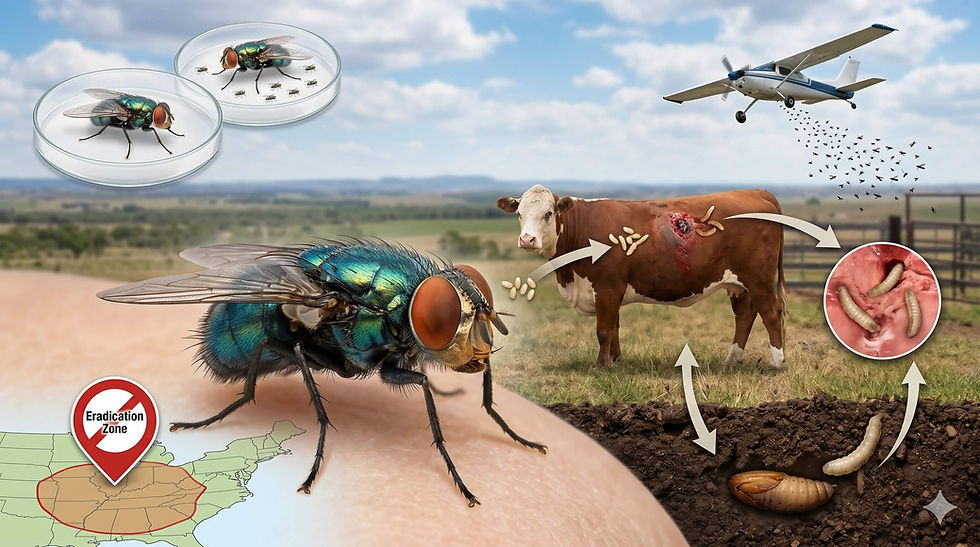
The regulatory response to the incursion relies upon the immediate establishment of temporary quarantine zones. Upon a confirmed detection, state and federal authorities implement a 12.4-mile (approximately 20-kilometer) infested zone radiating from the index premises21. Within these perimeters, stringent animal movement restrictions are enforced. The movement of any warm-blooded animal out of an infested zone requires prior authorization, a thorough veterinary inspection to verify the absence of egg masses or larvae, and the prophylactic application of approved parasiticides21. To accommodate the biological life cycle of the fly and ensure that latent, early-stage infestations are not missed, agricultural producers are required to initiate the inspection permitting process a minimum of five days prior to their intended movement date28.
As intensive surveillance, trapping, and sterile fly dispersals successfully eliminate wild fly populations within specific geographic nodes, state authorities systematically release these zones from movement restrictions. By September 2026, the Texas Animal Health Commission had officially released portions of Coke, Tom Green, and several other counties, contingent upon sustained negative surveillance data as stipulated by the federal response playbook25.
Predictive Spatial Modeling and Climate Implications
The spatial dynamics of the screwworm resurgence are heavily influenced by environmental variables and climatological limits. Historically, the northward expansion of C. hominivorax during the summer months was naturally constrained by the winter frost line, as the pupae are highly susceptible to freezing temperatures in the topsoil1. Prolonged exposure to sub-freezing conditions generally prevents the insect from successfully overwintering in temperate zones32.
To anticipate the pest's trajectory, researchers and epidemiologists utilize advanced geographic information systems and spatial modeling algorithms, such as Maximum Entropy models, which integrate historical occurrence data, habitat utilization metrics, and host availability34. These models rely on the calculation of thermal degree days to project generational turnover and potential range expansion35. The contemporary concern is that shifting global climate patterns, characterized by rising mean temperatures and the poleward retreat of historic frost lines, could facilitate the establishment of permanent, overwintering screwworm populations further north than previously recorded32. This expanded physiological niche necessitates the deployment of predictive artificial intelligence frameworks to strategically allocate surveillance resources, direct sterile fly aircraft, and position ground traps in the highest-risk ecological corridors34.
Macroeconomic Impact and International Trade Disruption
The biological threat of the screwworm is paralleled by its profound capacity to disrupt international agricultural markets. The North American cattle industry operates as a highly integrated supply chain, with the United States historically importing over one million feeder cattle annually from Mexico to supply domestic feedlots16. As the parasite advanced through Mexican states in 2024 and 2025, the United States Department of Agriculture implemented sequential suspensions of live cattle, bison, and equine imports across southern ports of entry to protect domestic biosecurity19.
This prolonged border closure generated severe macroeconomic friction. Within the United States, the reduction in imported feeder cattle—which typically constitute three to five percent of domestic placements—exacerbated historically low domestic cattle inventories, driving procurement costs higher for feedyards and placing upward pressure on retail beef prices16. Conversely, Mexican producers in export-dependent regions like Chihuahua faced saturated local markets, depressed calf prices, and logistical bottlenecks, incurring estimated opportunity costs exceeding five hundred million dollars annually16.
The confirmation of the pest in Texas in June 2026 triggered further international trade barriers, shifting the United States from a protected market to a restricted exporter. The Canadian Food Inspection Agency immediately suspended the importation of horses, cattle, swine, and other susceptible species originating from Texas41. Canadian protocols dictated that livestock from other states could only enter Canada if they had not resided in or transited through Texas during the twenty-one days immediately prior to arrival at the border41.
The aggregate economic exposure is staggering. Economic impact assessments indicate that a widespread, endemic establishment of the screwworm akin to historic outbreaks could cost Texas livestock producers up to 732 million dollars directly, with the total negative impact on the Texas economy reaching 1.8 billion dollars annually due to combined mortality, treatment labor, and supply chain disruptions6. From a policy perspective, the economic theory of "buying time" suggests that the financial damages incurred by strict trade closures are offset if those closures delay endemic establishment long enough for authorities to deploy effective eradication infrastructure38.
Economic and Trade Impacts of the 2026 Outbreak | Estimated Value / Constraint |
Historical U.S. Imports from Mexico | ~1,000,000 feeder cattle annually |
Mexican Producer Opportunity Costs | ~$500 million annually (Chihuahua alone) |
Potential Direct Cost to Texas Producers | $732 million annually |
Total Potential Economic Loss to Texas | $1.8 billion annually |
Canadian Import Restriction Protocol | 21-day avoidance of transit/residency in Texas |
U.S. Import Suspensions | Live cattle, bison, equines, and canines from Mexico |
Biological Pathology and Host-Parasite Immunology
The severity of the screwworm threat originates from the highly specialized biology of the parasite. Gravid female flies locate hosts by detecting the volatile organic compounds and semiochemicals emitted from open wounds, mucous membranes, or minor skin abrasions3. A single female deposits an average of two hundred to four hundred eggs in a shingle-like array at the margin of the wound4.
Extracorporeal Digestion and Tissue Degradation
Upon hatching within twelve to twenty-four hours, the first-instar larvae immediately dive into the living tissue3. The physical mechanism of invasion relies on sharp, curved anterior mouth hooks that shear cellular structures, combined with encircling bands of backward-pointing spines on the body segments that anchor the maggot securely within the expanding cavity4.
The primary driver of tissue destruction, however, is chemical. The larvae perform extracorporeal digestion by secreting a complex matrix of excretory and secretory products directly into the host tissue46. Laboratory profiling of these secretory products reveals a high concentration of proteolytic enzymes, predominantly serine endopeptidases and metalloproteases, including specific collagenases that aggressively dissolve the host's extracellular matrix and connective tissues46. This enzymatic liquefaction provides the necessary nutrient slurry for the larvae to rapidly progress through three instar stages over a period of five to seven days43.
This pathogenesis contrasts starkly with therapeutic myiasis, or Maggot Debridement Therapy, which utilizes the larvae of the green bottle fly, Lucilia sericata. In debridement therapy, the larvae exclusively secrete enzymes that target necrotic tissue and biofilms, promoting wound healing50. Cochliomyia hominivorax, conversely, indiscriminately digests healthy, viable tissue, leading to deep pocket-like lesions, severe hemorrhage, and systemic toxemia43. Furthermore, the secretory products of the screwworm appear to modulate the host immune system, inducing a localized inflammatory infiltrate heavily composed of eosinophils and mast cells while potentially suppressing effective T-cell responses to facilitate continued parasitism46.
Diagnostic Morphology
Accurate morphological identification of the extracted larvae is critical to distinguish the primary screwworm from facultative species. Diagnostic protocols primarily focus on the fully developed third-instar larvae, which present a muscidiform shape and measure between 6.5 and 17 millimeters in length4.
The hallmark diagnostic feature of C. hominivorax is the presence of darkly pigmented tracheal trunks extending anteriorly from the posterior spiracles, visibly spanning across at least two body segments through the dorsal cuticle4. The posterior spiracular plates themselves display three roughly parallel, straight slits, accompanied by an incomplete peritreme that fails to fully enclose the indistinct spiracular button4. In contrast, related species such as Cochliomyia macellaria possess clear or translucent tracheal tubes and distinct V-shaped spines on the anal protuberance43.
Morphological Feature | Cochliomyia hominivorax (Third Instar) | Cochliomyia macellaria (Third Instar) |
Tracheal Trunks | Dark brown to black, visible across ≥2 segments | Clear or translucent |
Posterior Spiracular Slits | Three, straight and roughly parallel | Three, straight |
Peritreme Structure | Incomplete, not enclosing the button | Incomplete |
Anal Protuberance Spines | Absent or indistinct | Distinct V-shaped formation |
Oral Sclerite | Present | Absent or indistinct |
Chemical Ecology: Olfaction, Attractants, and Surveillance
The behavioral ecology of C. hominivorax offers unique vulnerabilities that can be exploited for surveillance and suppression. Host location is a highly developed sensory process dependent on the insect's olfactory system.
The Orco Coreceptor and Host Detection
Gravid females seek out oviposition sites by detecting specific volatile sulfur compounds, ammonia, and microbial byproducts emitted from host wounds57. Molecular research demonstrates that this capability is governed by the odorant coreceptor gene, Orco, an atypical receptor that complexes with diverse odorant receptors on the insect's antennae to form functional ion channels58. Utilizing CRISPR/Cas9-mediated gene editing, researchers have generated Orco null mutants in C. hominivorax60. These Orco-deficient mutants exhibit profound behavioral deficits, failing to orient toward wound-derived volatiles or nutritional sources in two-choice trap assays, confirming that odorant receptor-mediated pathways are the primary biological mechanism for host detection and foraging60.
Optimization of Synthetic Lures and Trapping Mechanics
This reliance on olfactory cues is the basis for artificial surveillance networks. For decades, the standard chemical attractant deployed in field traps was Swormlure-4, a precise formulation of ten organic compounds designed to mimic the volatile profile of decaying tissue and wound exudate57. The composition of Swormlure-4 is heavily reliant on an optimized ratio of high-volatility compounds like iso-butanol, sec-butanol, and acetic acid, combined with lower-volatility stabilizing components like phenol and benzoic acid57.
A critical component of Swormlure-4 is dimethyl disulfide. However, due to its toxicity and hazard classification, dimethyl disulfide faces severe international air transport restrictions, creating logistical bottlenecks for rapid deployment during multi-national outbreaks57. To address this, chemical ecologists developed Swormlure-5, substituting dimethyl trisulfide—a less stringently regulated compound that is highly prevalent in the microbial decomposition of animal tissue and waste larval diets57. Field release-recapture trials in Panama demonstrated that traps baited with Swormlure-5 performed equivalently to those using Swormlure-4 in capturing C. hominivorax, though the newer formulation also attracted higher levels of non-target blow flies like C. macellaria62.
The physical geometry of the trap also significantly influences surveillance efficacy. Controlled studies comparing traditional triangle-shaped Vertical Sticky Traps with Cylinder Sticky Traps revealed that the cylindrical design captured significantly more screwworm flies63. The cylindrical geometry provides a continuous, unbroken aerodynamic surface that facilitates superior landing stability for the insect as it tracks the odor plume upwind63.
Reproductive Biology and Cuticular Hydrocarbons
The foundation of the eradication strategy depends entirely upon the reproductive biology of the female screwworm. While males are polygynous and will mate repeatedly, females are strictly monandrous, mating only once in their lifespan15. This biological reality means that a single successful copulation with a sterile male completely and permanently neutralizes the female's reproductive potential67.
This monandrous behavior is mediated by complex chemical communication utilizing cuticular hydrocarbons15. These long-chain lipids coat the insect's epicuticle, preventing desiccation while serving as critical contact pheromones for species and sex recognition15. Advanced gas chromatography-mass spectrometry reveals pronounced sexual dimorphism in virgin flies; males are characterized by lower-molecular-weight hydrocarbons, while females express higher abundances of longer-chain compounds15.
Crucially, the act of copulation induces a dramatic structural remodeling of the female's cuticular hydrocarbon profile15. Following insemination, specific methyl- and dimethyl-branched alkanes are transferred from the male to the female, shifting her chemical signature to an intermediate state15. This acquired chemical signature acts as an anti-aphrodisiac, deterring subsequent courtship attempts by other males and enforcing the lifelong behavioral refractoriness necessary for the success of autocidal control programs15.
Pharmacological Interventions and Genetic Resistance
While the ultimate goal is biological eradication, managing the acute animal welfare and economic impacts of the 2026 outbreak requires robust pharmacological intervention. The primary agents utilized are macrocyclic lactones for systemic prophylaxis and organophosphates for topical larvicidal treatment72.
During the escalation of the crisis, the United States Food and Drug Administration issued specialized Emergency Use Authorizations to expand the veterinary toolkit. This included approvals for specific ivermectin liquid formulations and topical barrier ointments (such as F10 Antiseptic Spray) designed to provide short-term prevention and immediate treatment of active myiasis74. Ivermectin and related macrocyclic lactones, such as doramectin, operate by binding with high affinity to glutamate-gated chloride channels in the insect's nervous system, triggering hyperpolarization and flaccid paralysis77. Organophosphates, like coumaphos, function topically by inhibiting the enzyme acetylcholinesterase, leading to acetylcholine accumulation, continuous nerve firing, and tetanic paralysis of the larvae79.
Mechanisms of Insecticide Resistance
The intense, decades-long reliance on these chemical classes across Latin America has exerted significant selective pressure, driving the evolution of resistant screwworm lineages80. Genomic analyses have elucidated distinct molecular mechanisms underlying this resistance.
Resistance to organophosphates and pyrethroids in C. hominivorax is primarily mediated by target-site mutations within the carboxylesterase E3 gene79. The wild-type function of this enzyme relates to lipid metabolism. However, specific single-nucleotide polymorphisms fundamentally alter its active site, transforming the enzyme into an organophosphate hydrolase79. The Gly137Asp mutation confers high-level resistance to diethyl-organophosphates, while the Trp251Leu and Trp251Ser mutations confer robust resistance to dimethyl-organophosphates and cross-resistance to pyrethroids79.
Conversely, resistance to macrocyclic lactones like ivermectin is predominantly driven by systemic metabolic detoxification rather than specific target-site insensitivity83. Pharmacological inhibition assays demonstrate that resistant strains massively upregulate ATP-Binding Cassette transporters83. These transmembrane efflux pumps actively excrete the toxicant from the cells, preventing the drug from reaching critical concentrations at the neural receptors83. Secondary detoxification is facilitated by the concurrent upregulation of esterases and cytochrome P450 oxidases80.
The existence of these multigenic resistance traits complicates chemical management. Furthermore, the broad-spectrum application of avermectins and organophosphates carries significant off-target ecological risks, particularly the lethal impact of excreted drug residues on beneficial pasture invertebrates such as dung beetles, which are essential for nutrient cycling and natural parasite suppression85.
Insecticide Class | Mechanism of Action | Primary Resistance Mechanism in C. hominivorax |
Organophosphates (e.g., Coumaphos) | Acetylcholinesterase inhibition | Carboxylesterase E3 gene point mutations (Gly137Asp, Trp251Leu/Ser) |
Macrocyclic Lactones (e.g., Ivermectin) | Glutamate-gated chloride channel activation | Enhanced efflux via ATP-Binding Cassette (ABC) transporters |
Pyrethroids | Voltage-gated sodium channel modulation | Metabolic detoxification / Carboxylesterase cross-resistance |
Area-Wide Eradication: Population Dynamics and the Sterile Insect Technique
The foundation of the federal response remains the Sterile Insect Technique. The efficacy of SIT relies on artificially manipulating population dynamics to exploit the Allee effect—a phenomenon of inverse density dependence where a population's per capita growth rate becomes negative at exceptionally low densities9.
In a natural environment, screwworm populations are resilient. However, by dispersing staggering quantities of radiation-sterilized male flies across the landscape, authorities create an overwhelming overflooding ratio8. Because wild females mate only once, encounters with sterile males result in the oviposition of non-viable eggs8. This relentless reproductive suppression drives the wild population density progressively downward. Once the density breaches the critical Allee threshold, the vast physical distances between the remaining wild individuals lead to mate-finding failure, and the population collapses into extinction9. The mathematical modeling of this dynamic reveals a saddle-node bifurcation, wherein continuous sterile male releases reshape the ecosystem's bistability, eliminating the positive equilibrium points and driving every initial state toward local elimination9.
Infrastructure, Irradiation, and Strain Competitiveness
Executing this strategy requires immense industrial output. Historically, the eradication effort has been sustained by the COPEG facility in Pacora, Panama, which routinely produces over one hundred million sterile flies weekly66. The sterilization protocol typically involves exposing late-stage pupae to X-ray or gamma irradiation. Research indicates that an optimal dose of 20 to 40 Gray achieves greater than 98% sterility while minimizing somatic deformities and preserving male flight and mating competitiveness8.
Recognizing the vulnerability of relying entirely on international supply chains during a rapidly advancing outbreak, the United States executed an accelerated infrastructure expansion in 2026. In April, federal officials broke ground on a highly secure, 750 million dollar sterile fly production facility at Moore Air Base in Edinburg, Texas17. Engineered by the U.S. Army Corps of Engineers, this biosecure plant is designed to reach an initial production capacity of 100 million flies per week by late 2027, with the architectural footprint to scale up to 300 million flies weekly17.
A critical variable in the success of SIT is the physiological fitness and mating competitiveness of the mass-reared males. The primary production strain, Jamaica-06 (J-06), has been maintained in continuous laboratory culture for decades57. Prolonged domestication under artificial rearing conditions often selects for traits that are detrimental in the wild, such as reduced overall body mass and shorter wing spans68. Recent comparative studies evaluated the J-06 strain against the wild-type Yaviza outbreak strain68. Flight mill assays demonstrated that while J-06 flies are capable flyers, wild-type males often display superior flight velocity and distance68. More importantly, open-choice mating assays revealed that wild-type males secured nearly double the number of copulations with wild females compared to the J-06 males68. If factory-reared males cannot effectively compete for wild mates, the required overflooding ratio increases dramatically, heavily taxing the program's financial and logistical resources.
Next-Generation Genetic Engineering: Male-Only Sexing Strains
To overcome the inefficiencies of releasing mixed-sex populations—where sterile males waste reproductive effort courting sterile females, and sterile females cause minor tissue irritation through pseudo-oviposition—the vanguard of screwworm research is focused on developing Genetic Sexing Strains7. These advanced genomic constructs permit the exclusive mass-rearing and release of males, vastly improving field suppression rates7.
Leveraging precise CRISPR/Cas9 homology-directed repair, geneticists have engineered transgenic lines featuring conditional, female-specific lethal systems7. This architecture capitalizes on the endogenous Cochliomyia hominivorax transformer gene (Chtra), which governs sexual differentiation through the sex-specific alternative splicing of its pre-mRNA94. Researchers have fused the female-specific spliced intron of the Chtra gene with a tetracycline-repressible transactivator system (Tet-off) and a pro-apoptotic lethal effector gene, such as LshidAla291.
In a mass-rearing facility, these transgenic colonies are maintained on a larval diet supplemented with the antibiotic tetracycline91. The tetracycline binds to the transactivator, repressing the expression of the lethal gene and allowing both males and females to survive and propagate the colony91. However, in the final generation intended for release, the eggs are reared on a diet lacking tetracycline. As the larvae develop, the sex-specific splicing mechanism ensures that the lethal effector protein is translated exclusively in the female insects, triggering widespread apoptosis and death during the late larval or early pupal stages91.
Extensive phenotypic analyses confirm that the surviving males from these transgenic strains incur no significant fitness penalties. Their pupal weights, adult emergence rates, flight capacities, and mating competitiveness match or exceed those of the traditional parental strains11. Furthermore, because the transgene is expressed at negligible levels in the male transcriptomes, these genetically engineered males remain highly viable candidates for integration into the operational SIT framework97. The transition from traditional radiation-based bisexual releases to precision-engineered male-only releases represents the ultimate biological weapon in the campaign to secure the North American continent.
Conclusion
The 2026 progression of the New World screwworm into Texas and New Mexico constitutes a severe biological and economic shock to the North American agricultural system. Driven by complex ecological interactions, host availability, and potential climatological shifts, the breach of historic containment lines has exposed the vulnerabilities of a deeply integrated livestock supply chain. The resultant economic damage is dual-natured: the direct pathological destruction wrought by the obligate, tissue-consuming larvae, and the massive systemic financial losses triggered by necessary, but highly disruptive, international trade closures.
The strategy to repel this invasion and re-establish eradication requires a highly coordinated, scientifically rigorous response. While pharmacological tools such as macrocyclic lactones and organophosphates provide immediate prophylactic and therapeutic utility, the documented emergence of multigenic resistance pathways dictates that chemical control cannot be a permanent solution. True eradication relies upon the mastery of the insect’s behavioral ecology and population dynamics. By exploiting the chemical signatures of female monandry, deploying advanced surveillance technologies reliant on coreceptor olfaction, and executing overwhelming sterile male dispersals to force the population below the Allee threshold, authorities possess the theoretical framework to induce extinction. Supported by rapid domestic infrastructure investments and the integration of next-generation CRISPR-engineered genetic sexing strains, the combined forces of federal, state, and international partners are equipped to push the biological barrier southward and secure the continent against this devastating parasite.
Works cited
Cochliomyia hominivorax (New World screwworm), https://www.cabidigitallibrary.org/doi/full/10.1079/cabicompendium.11753
New World Screwworm in the US - What We Know So Far - Expana, https://www.expanamarkets.com/insights/article/new-world-screwworm-in-the-us-what-we-know-so-far/
The Continued Screwworm Resurgence: Causes, Countermeasures, https://www.crvscience.com/post/the-continued-screwworm-resurgence-causes-countermeasures-and-consequences
DPDx - New World Screwworm - CDC, https://www.cdc.gov/dpdx/newworldscrewwormmyiasis/index.html
Screwworms kill 80% of Deer in Texas. What's next? - YouTube, https://www.youtube.com/watch?v=zEWR7zRGcMg
Beef cattle and dairy producers wary as flesh-eating parasite comes, https://ucanr.edu/blog/food-blog/article/new-world-screwworm
Advancing the sterile insect technique for the New World screwworm, https://academic.oup.com/jee/advance-article/doi/10.1093/jee/toag283/8825325
The Sterile Insect Release Method and Other Genetic Control, https://ipmworld.umn.edu/bartlett
Allee Thresholds, Saddle-Node Bifurcations, and Optimal Sterile, https://arxiv.org/pdf/2606.17125
The US eradicated this flesh-eating parasite decades ago. Now it is, https://m.economictimes.com/magazines/panache/the-us-eradicated-this-flesh-eating-parasite-decades-ago-now-it-is-detected-in-texas-and-new-mexico/articleshow/134270236.cms
Fitness Characteristics of Transgenic Strains of Cochliomyia, https://digitalcommons.unl.edu/cgi/viewcontent.cgi?article=1010&context=entomologyfacpub
Re-invasion of the New World screwworm in Central and North, https://www.biorxiv.org/content/10.64898/2026.07.16.738939v1.full-text
Decoding the New World Screwworm: From Life Cycle to Eradication, https://www.crvscience.com/post/decoding-the-new-world-screwworm-from-life-cycle-to-eradication
The dangerous New World screwworm has returned to parts of the, https://www.facebook.com/wesaveblueplanet/posts/the-dangerous-new-world-screwworm-has-returned-to-parts-of-the-united-states-wit/1046720921330997/
chemical signatures of mating in Cochliomyia hominivorax (Diptera, https://academic.oup.com/jme/article/63/4/tjag133/8754059
Mexico's cattle ranchers fear screwworm crisis could permanently, https://www.tpr.org/news/2026-07-13/mexicos-cattle-ranchers-fear-screwworm-crisis-could-permanently-reshape-cross-border-trade
Screwworm Fight: $750M Sterile Fly Facility Groundbreaking in Texas, https://www.drovers.com/news/screwworm-fight-border-remains-closed
American ports have been closed to Mexican livestock imports since, https://www.facebook.com/KUSINews/posts/american-ports-have-been-closed-to-mexican-livestock-imports-since-may-2025-as-n/1514950320677927/
Minutes of the 425th TAHC Commission Meeting, https://www.tahc.texas.gov/agency/meetings/minutes/Minutes_CommMtg_2025-08-26.pdf
New World Screwworm Outbreak - CDC, https://www.cdc.gov/new-world-screwworm/situation-summary/index.html
The Screwworm Battle Begins on U.S. Soil: Now What? - Drovers, https://www.drovers.com/news/screwworm-battle-begins-u-s-soil-now-what
Cautious optimism on Ebola, rare New World screwworm in a horse, https://www.cidrap.umn.edu/ebola/quick-takes-cautious-optimism-ebola-rare-new-world-screwworm-horse-hiv-alert-fiji
Texas Gains Ground Against Screwworm by Releasing Infested Zones, https://www.dtnpf.com/agriculture/web/ag/livestock/article/2026/09/21/texas-gains-ground-screwworm-zones
Two additional cases of New World screwworm confirmed by USDA, https://www.brownfieldagnews.com/news/two-additional-cases-of-new-world-screwworm-confirmed-by-usda/
executive director order releasing animal movement restrictions, https://www.tahc.texas.gov/regs/pdf/2026-09-03_NWS_EDO-InfestedZoneRelease_05.pdf
Texas Animal Health Commission - Facebook, https://www.facebook.com/TexasAHC/posts/tahc-teams-are-out-in-the-field-coordinating-checkpoint-locations-and-resources-/1439055521595276/
If You're Inside the Zone, Here's Exactly What You Need to Do, https://www.drovers.com/news/if-youre-inside-zone-heres-exactly-what-you-need-do
New World Screwworm 2026: Food Safety & Compliance Impact, https://www.icomplai.com/news/new-world-screwworm-food-safety-compliance-2026
New World Screwworm | San Angelo, TX, https://www.sanangelo.gov/834/New-World-Screwworm
USDA Approves First Screwworm Zone Releases in Texas, Clears, https://www.drovers.com/news/usda-approves-first-screwworm-zone-releases-texas-clears-new-mexico
What is the New World screwworm, and why does it matter to Texas?, https://stories.tamu.edu/stories/what-is-the-new-world-screwworm-and-why-does-it-matter-to-texas/
Deconstructing the eradication of new world screwworm in North, https://www.researchgate.net/publication/331071587_Deconstructing_the_eradication_of_new_world_screwworm_in_North_America_retrospective_analysis_and_climate_warming_effects
Forecasting where New World screwworm infestations may emerge, https://www.nationalhogfarmer.com/livestock-management/forecasting-where-new-world-screwworm-infestations-may-emerge
One Health against the extinction of the mountain tapir (Tapirus, https://www.cabidigitallibrary.org/doi/10.1079/cabionehealth.2025.0031
The Effect of Climate Change on Emergence and Evolution of ... - PMC, https://pmc.ncbi.nlm.nih.gov/articles/PMC12508791/
Tracking path of New World screwworm - Beef Magazine, https://www.beefmagazine.com/livestock-management/tracking-path-of-new-world-screwworm
The Economics of Buying Time: Lessons from the New World, https://agribusiness.purdue.edu/2026/09/02/the-economics-of-buying-time-lessons-from-the-new-world-screwworm-response/
New World Screwworm and Livestock Border Closures - Publications, https://pubs.nmsu.edu/_z/Z131.pdf
Economic Impacts of the New World Screwworm Border Closure on, https://ageconsearch.umn.edu/record/404394/files/177484_197129_115232_AAEA_Paper_NWS_2026_v05.pdf
Texas cattle, other animals, banned from entering Canada, https://www.texastribune.org/2026/07/14/texas-animals-exports-canada-suspended/
Canada Blocks Texas Livestock Over Flesh-Eating Screwworm, https://refdesk.ca/blog/canada-screwworm-livestock-ban-texas-june-5-2026-farmers-ranchers-consumers-guide
Cochliomyia - Wikipedia, https://en.wikipedia.org/wiki/Cochliomyia
Myiasis Caused by Old and New World Screwworms, https://www.cfsph.iastate.edu/Factsheets/pdfs/screwworm_myiasis.pdf
Case 2022-1 | Gorgas Course, https://www.uab.edu/medicine/gorgas/cases-blog/2022/2022-case1
Proteolytic activity of excretory/secretory products of Cochliomyia, https://www.scielo.br/j/pvb/a/rPH953VmJbrQfQrKBSZVwsc/?lang=en
New Insights Into Culturable and Unculturable Bacteria Across the, https://www.frontiersin.org/journals/microbiology/articles/10.3389/fmicb.2020.00505/full
Larval therapy from antiquity to the present day: mechanisms ... - PMC, https://pmc.ncbi.nlm.nih.gov/articles/PMC2600045/
Lab Identification of New World Screwworm | CDC, https://www.cdc.gov/dpdx/resources/pdf/benchaids/NWS-Bench-Aid-2024-508.pdf
(PDF) Effectiveness of Chronic Wound Debridement with the Use of, https://www.researchgate.net/publication/336983392_Effectiveness_of_Chronic_Wound_Debridement_with_the_Use_of_Larvae_of_Lucilia_Sericata
Maggot debridement therapy: utility in chronic wounds and a, https://journals.cambridgemedia.com.au/wpr/volume-26-number-3/maggot-debridement-therapy-utility-chronic-wounds-and-perspective-beyond
Larval Wound Therapy: Possibilities and Potential Limitations—A, https://www.mdpi.com/2077-0383/12/21/6862
myiasis-causing flies | CABI Compendium, https://www.cabidigitallibrary.org/doi/full/10.1079/cabicompendium.74573
Tetracycline has no long-term effects on gut physiology and ... - PMC, https://pmc.ncbi.nlm.nih.gov/articles/PMC12060240/
Answering Common Questions About New World Screwworms, https://todaysveterinarypractice.com/parasitology/answering-common-questions-about-new-world-screwworms/
Lab Identification of New World screwworm, https://oeps.wv.gov/media/1535/download?inline
(PDF) A new formulation of screwworm fly attractant with reduced, https://www.researchgate.net/publication/370154339_A_new_formulation_of_screwworm_fly_attractant_with_reduced_hazardous_chemicals_and_transport_restrictions
Genetic analyses suggest that larval and adult stages of Lucilia, https://www.biorxiv.org/content/10.1101/2024.12.20.629795v1.full
A Review of Bacterial Interactions With Blow Flies (Diptera, https://forensicentomology.tamu.edu/wp-content/uploads/sites/2/2017/10/Tomberlin-et-al-2017.pdf
Disruption of ChomOrco impairs foraging and host-seeking, https://www.researchgate.net/figure/Disruption-of-ChomOrco-impairs-foraging-and-host-seeking-behaviors-in-screwworm-A_fig4_351995582
[PDF] Disruption of the odorant coreceptor Orco impairs foraging, https://www.semanticscholar.org/paper/Disruption-of-the-odorant-coreceptor-Orco-impairs-Paulo-Junqueira/0c16ac4ab4dc0ee3db9d6092e0a1f58c8967a2bb
A new formulation of screwworm fly attractant with reduced, https://bioone.org/journals/journal-of-medical-entomology/volume-60/issue-4/tjad043/A-new-formulation-of-screwworm-fly-attractant-with-reduced-hazardous/10.1093/jme/tjad043.full
Trap shape affects efficacy of sticky traps for New World screwworm, https://www.researchgate.net/publication/401224915_Trap_shape_affects_efficacy_of_sticky_traps_for_New_World_screwworm_Cochliomyia_hominivorax_Diptera_Calliphoridae
Swormlure-4: Enhanced Attractant for Screwworms | PDF - Scribd, https://www.scribd.com/document/834041175/Swomrlure-4
A new formulation of screwworm fly attractant with reduced, https://pubmed.ncbi.nlm.nih.gov/37079723/
new formulation of screwworm fly attractant with reduced hazardous, https://academic.oup.com/jme/article/60/4/631/7133752
Officials break ground on new Texas sterile fly production facility, https://hpj.com/2026/04/18/officials-break-ground-on-new-texas-sterile-fly-production-facility/
Readdressing methods for evaluating New World screwworm (Diptera, https://academic.oup.com/jee/advance-article/doi/10.1093/jee/toag281/8825273
(PDF) Cuticular hydrocarbon profiles as a taxonomic tool, https://www.researchgate.net/publication/229086924_Cuticular_hydrocarbon_profiles_as_a_taxonomic_tool_advantages_limitations_and_technical_aspects
The chemical signatures of mating in Cochliomyia hominivorax, https://scholars.uky.edu/en/publications/the-chemical-signatures-of-mating-in-cochliomyia-hominivorax-dipt/
Comparison of areas of screwworm endemicity in North America, https://www.researchgate.net/figure/Comparison-of-areas-of-screwworm-endemicity-in-North-America-based-on-m-cold-computed_fig4_331071587
Lysenko and the Screwworm Fly—When Politics Interferes ... - MDPI, https://www.mdpi.com/1660-4601/17/18/6687
Green Management Strategies for Cochliomyia hominivorax Myiasis, https://www.mdpi.com/2079-7737/15/18/1654
New World Screwworm: Latest News, Prevention Tips & USDA, https://www.drovers.com/newworldscrewworm?__hstc=46679096.c47e4abf187deb778a9f930376dabe6a.1775606400567.1775606400568.1775606400569.1&__hssc=46679096.1.1775606400570&__hsfp=34c0e580a2dfcf1a0c65d71d36ead30e&p=2
New World screwworm: Groundbreaking for new facility, https://www.tsln.com/news/new-world-screwworm-groundbreaking-for-new-facility-emergency-use-authorization-for-treatments-mexico-facility-75-complete/
FactSheet Ivermectin Liquid for Horses EUA 006681 - FDA, https://www.fda.gov/media/193613/download?attachment
Macrocyclic lactones and ectoparasites control in livestock - PMC, https://pmc.ncbi.nlm.nih.gov/articles/PMC11366916/
Persistent activity of doramectin and ivermectin in the prevention of, https://www.researchgate.net/publication/12690909_Persistent_activity_of_doramectin_and_ivermectin_in_the_prevention_of_cutaneous_myiasis_in_cattle_experimentally_infested_with_Cochliomyia_hominivorax
Incongruent Nuclear and Mitochondrial Genetic Structure of New, https://journals.plos.org/plosone/article?id=10.1371/journal.pone.0128441
A survey of mutations in the Cochliomyia hominivorax (Diptera, https://www.researchgate.net/publication/7079504_A_survey_of_mutations_in_the_Cochliomyia_hominivorax_Diptera_Calliphoridae_esterase_E3_gene_associated_with_organophosphate_resistance_and_the_molecular_identification_of_mutant_alleles
An Overview of the Components of AW-IPM Campaigns against the, https://pmc.ncbi.nlm.nih.gov/articles/PMC4553557/
Investigation of mutations associated with pyrethroid resistance in, https://www.researchgate.net/publication/26790349_Investigation_of_mutations_associated_with_pyrethroid_resistance_in_populations_of_the_New_World_Screwworm_fly_Cochliomyia_hominivorax_Diptera_Calliphoridae
Detoxification mechanisms involved in ivermectin resistance ... - PMC, https://pmc.ncbi.nlm.nih.gov/articles/PMC6097998/
Organophosphate and Pyrethroid Hydrolase Activities of Mutant, https://journals.plos.org/plosone/article?id=10.1371/journal.pone.0077685
Cooperative Screwworm Eradication Program - USDA-Aphis, https://www.aphis.usda.gov/sites/default/files/screwworm-environmental-assessment.pdf
Horn Fly (Diptera: Muscidae)—Biology, Management, and Future, https://utbeef.tennessee.edu/wp-content/uploads/sites/127/2022/02/Horn-Fly-Biology-Management-and-Future-Research-Directions.pdf
Programmatic environmental assessment for the use of antiparasitic, https://www.fda.gov/media/194628/download
(PDF) Inverse Density Dependence and the Allee Effect, https://www.researchgate.net/publication/12819342_Inverse_Density_Dependence_and_the_Allee_Effect
Combining Tactics to Exploit Allee Effects for Eradication of Alien, https://academic.oup.com/jee/article/105/1/1/844279
disease response strategy new world screwworm myiasis, https://www.aphis.usda.gov/sites/default/files/nws_myiasis_disease_strategy.pdf
It's a boy: Controlling pest populations with modified males, https://www.eurekalert.org/news-releases/868089
(PDF) Sterile insect technique for suppressing and eradicating, https://www.researchgate.net/publication/279654731_Sterile_insect_technique_for_suppressing_and_eradicating_insect_population_55_years_and_counting
Cryopreservation of Embryos of the Mediterranean Fruit Fly Ceratitis, https://pmc.ncbi.nlm.nih.gov/articles/PMC4990230/
Conservation and Sex-Specific Splicing of the transformer Gene in, https://pmc.ncbi.nlm.nih.gov/articles/PMC3567074/
Genome and Transcriptome Analyses Facilitate Genetic Control of, https://www.mdpi.com/2075-4450/14/7/620
Improving the sex-specificity of a conditional female lethal system for, https://pmc.ncbi.nlm.nih.gov/articles/PMC12627594/
AMANDA PIERCE - Public Technologies (PUBT), https://docs.publicnow.com/viewDoc.aspx?filename=139931\EXT\3CCF8C0F09CB96180952B23DB9C327C12E4F6BE3_289C2A01F344BE69124EE46D3FED180A0FC86740.PDF


Comments