The Continued Screwworm Resurgence: Causes, Countermeasures, and Consequences


Introduction and Historical Context of NW Screwworm
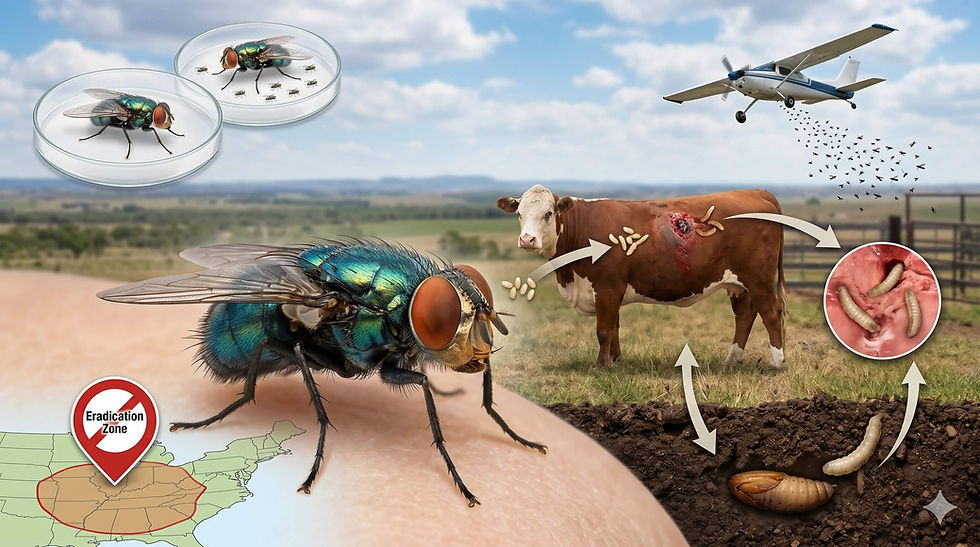
The New World screwworm, scientifically classified as Cochliomyia hominivorax, is an obligate ectoparasite native to the tropical and subtropical environments of the Western Hemisphere. Unlike the vast majority of blowflies that colonize necrotic tissue, the larvae of C. hominivorax feed exclusively on the living flesh of warm-blooded animals, causing a rapidly progressing and highly destructive condition known as myiasis1. Throughout the early and mid-twentieth century, the New World screwworm functioned as a devastating agricultural plague in the United States, inflicting profound economic losses on the livestock industry, decimating wildlife populations, and posing a severe zoonotic threat to companion animals and human populations2.
Driven by the extensive agricultural and ecological burden of the parasite, the United States Department of Agriculture initiated an unprecedented eradication campaign in the 1950s. Entomologists Edward Knipling and Raymond Bushland pioneered the Sterile Insect Technique, an autocidal control strategy that leveraged the unique reproductive biology of the female screwworm fly, which typically mates only once in her lifetime3. By flooding wild populations with millions of radiation-sterilized male flies, the reproductive cycle was systematically broken. This intensive biological intervention officially eradicated the parasite from the United States in 1966, with the exception of a brief, highly localized outbreak among Key deer in Florida during the 2016 to 2017 season that was rapidly contained3. The successful agricultural program was subsequently expanded southward over several decades, eventually establishing a permanent biological barrier at the Darien Gap—a dense, mountainous rainforest bridging Colombia and Panama—to prevent the northward migration of the flies from endemic regions in South America4.
For nearly six decades, the United States maintained its general screwworm-free status in agricultural sectors. However, the integrity of the Darien Gap barrier suffered a critical breach in 2023. Driven by a confluence of climatic shifts, illicit livestock movement, and pandemic-related disruptions to sterile fly production facilities, the parasite rapidly advanced northward through Central America and Mexico7. On June 3, 2026, federal agricultural authorities confirmed the presence of C. hominivorax in a calf in Zavala County, Texas, marking the first domestic livestock detection of the pest in over half a century10. As of mid-June 2026, the situation has escalated into a multi-state agricultural emergency, mobilizing federal, state, and academic resources to contain an outbreak that threatens a geographically vast and economically critical livestock industry during a period of pre-existing market fragility11.
Macroeconomic Vulnerability and Trade Implications
The timing of the 2026 incursion presents a particularly severe threat to the domestic agricultural economy. The United States beef supply chain is currently operating under intense pressure, with the national cattle herd size falling to levels not recorded since the 1950s, driven primarily by years of severe, drought-induced herd liquidation8. Consequently, retail beef prices had already reached record highs entering the summer of 2026. The re-emergence of the screwworm introduces massive direct costs—derived from animal mortality, weight loss, and hide degradation—as well as immense indirect costs associated with the daily labor required to manually inspect herds and administer prophylactic wound treatments across millions of acres of rugged rangeland8.
Furthermore, the outbreak intersects with complex international trade dynamics. The United States relies heavily on the integrated North American cattle market. Following the confirmation of cases in southern Mexico in late 2024, federal authorities implemented intermittent closures of southern ports of entry to live cattle imports, significantly restricting the supply of feeder cattle available to Texas feedlots6. These sanitary embargoes occurred simultaneously with delicate trade negotiations between the United States and Mexico, raising concerns that the biological crisis could be compounded by broader tariff or border disputes13. Canada has also reacted to the Texas detections by implementing a temporary 21-day ban on livestock and horses originating from or transiting through Texas, demonstrating the rapid ripple effects of a localized detection on international commerce12.
Entomological Profile and Biological Imperatives
Morphology and Taxonomic Identification
Accurate taxonomic identification of Cochliomyia hominivorax is paramount for epidemiological surveillance, particularly to distinguish it from its closely related congener, the secondary screwworm (Cochliomyia macellaria). Both species belong to the family Calliphoridae and share a metallic blue-green major coloration, an orange gena, and three dark longitudinal stripes located on the dorsal thorax17. However, morphological nuances differentiate the two adults. In C. hominivorax, the central thoracic stripe is distinctly shorter than the outer two, whereas the stripes on C. macellaria are uniform in length. Furthermore, C. hominivorax presents with dark setulae on the fronto-orbital plate outside the row of frontal bristles, and the adult female possesses a brown basicosta, contrasting with the yellowish basicosta of C. macellaria17.
In the larval stages, the distinction becomes biologically critical, as C. macellaria is a facultative scavenger that consumes only necrotic tissue, while C. hominivorax is an obligate parasite of living flesh. Third-instar C. hominivorax larvae, which can reach up to 18 millimeters in length, exhibit a cylindrical, anteriorly tapering, muscidiform shape characterized by prominent bands of robust, backward-facing spines4. The most definitive diagnostic feature of the mature C. hominivorax larva is the presence of darkly pigmented tracheal trunks extending anteriorly from the posterior spiracular plates across at least two body segments, visible through the translucent body wall17. The posterior spiracular plates of C. hominivorax possess three straight slits partially surrounded by a dark peritreme, distinguishing them from related species that may lack a peritreme or possess V-shaped spines on the anal protuberance17.
Lifecycle, Thermoregulation, and Environmental Constraints
The lifecycle of C. hominivorax is inextricably linked to the availability of living hosts and specific climatic conditions. Gravid females are highly sensitive to the semiochemicals and volatile organic compounds released by open wounds, mucous membranes, or even minor abrasions such as tick bites, utilizing the odorant coreceptor gene to navigate and locate suitable oviposition sites18. Upon locating a host, a single female can deposit a mass of 200 to 400 eggs at the margin of a wound2. The eggs hatch within 12 to 24 hours, yielding highly aggressive first-instar larvae that immediately burrow head-first into the living tissue17.
The larvae tear through healthy flesh using sharp, curved mouth hooks, feeding continuously and progressing through three instar stages over a period of five to seven days7. Once fully mature, the third-instar larvae drop from the host to the ground, burrowing into the topsoil to pupate1. Environmental temperature dictates the duration and success of this pupal stage. The ideal climatic window for adult emergence and survival centers around 81.5 degrees Fahrenheit, accompanied by a relative humidity of 30 to 70 percent22. In such optimal conditions, the entire lifecycle can be completed in less than three weeks.
However, the geographic expansion of the parasite is strictly constrained by thermal thresholds. Pupal development halts entirely when ambient temperatures fall below approximately 58 degrees Fahrenheit, and sustained soil temperatures below 46 degrees Fahrenheit are fatal to the organism18. Conversely, extreme heat is equally detrimental, with adult survival and reproductive activities ceasing when temperatures exceed 110 degrees Fahrenheit23. These strict biological parameters have historically defined the overwintering boundaries of the species, confining it to tropical zones; however, shifts in climate patterns are currently altering these traditional limitations.
Epidemiological Dynamics of the 2026 Outbreak
The Collapse of the Darien Gap Barrier
The resurgence of the New World screwworm in North America is the result of a multi-factorial collapse of biosecurity measures that had successfully contained the parasite for decades. In mid-2023, health and agricultural authorities recognized that C. hominivorax had breached the established biological barrier located at the Darien Gap9.
Epidemiological modeling and retroactive analyses suggest that this breach was driven by a combination of geopolitical and environmental catalysts. Unprecedented flows of human migration through the Darien Gap, coupled with the unregulated movement of illicit livestock driven by regional cartel activity, facilitated the rapid transport of infested hosts across previously secure zones8. These anthropogenic factors were exacerbated by the lingering impacts of the global pandemic, which caused critical interruptions in the mass production and deployment of sterile flies6. Furthermore, shifting climate patterns characterized by warming mean temperatures and a decreasing frequency of severe winter cold snaps expanded the viable overwintering habitat for the fly, allowing it to establish sustained breeding populations further north than previously modeled7.
By late 2024, the outbreak had swept through Costa Rica, Nicaragua, and Honduras, breaching the southern borders of Mexico. Despite efforts to establish new buffer zones, the parasite's progression was relentless, driven by the rapid transport of domestic cattle along major agricultural trade routes. By mid-2026, the outbreak in Central America and Mexico had generated over 185,000 confirmed animal cases and over 2,100 human cases, with intense transmission clusters located in the southern Mexican states of Chiapas and Oaxaca accounting for a massive proportion of the burden9. The subsequent detection of extensive active clusters in the Mexican states of Tamaulipas and Nuevo León—fewer than 100 miles from the Texas border—signaled an imminent threat of domestic incursion27.
The United States Incursion: June 2026
The anticipated cross-border transmission event was confirmed on June 3, 2026, when larvae extracted from the umbilical region of a three-week-old beef calf in La Pryor, Zavala County, Texas, were definitively identified as C. hominivorax10. This index case catalyzed an immediate federal and state emergency response, activating a Level 3 emergency protocol by the Centers for Disease Control and Prevention and a unified Incident Command Team led by the United States Department of Agriculture and the Texas Animal Health Commission10.
Despite immediate quarantine implementations, the outbreak rapidly dispersed. As of June 19, 2026, federal dashboards reported a total of twelve confirmed domestic cases spanning across multiple counties in Texas and one isolated case in New Mexico. Of these twelve cases, eleven remain classified as active—meaning the animals are currently undergoing veterinary treatment and disease mitigation—while one case has been reclassified as inactive16.
The geographic dispersion and variety of host species affected underscore the extreme difficulty of containing the parasite. The confirmed domestic cases have impacted cattle, goats, a sheep, and a companion animal11. The companion animal detection—a small-breed dog residing in Lea County, New Mexico, which was initially diagnosed across the state line in Andrews County, Texas—has particularly alarmed public health and veterinary officials31. It highlights the vulnerability of domestic pets and demonstrates that the outbreak has already expanded outside of traditional livestock production vectors. The presence of cases over 400 miles apart suggests multiple, parallel introduction events rather than a single point-source diffusion, likely facilitated by the transport of sub-clinically infested animals prior to the implementation of strict border quarantines30.
Summary of Domestic and Border Detections
The following tables summarize the active and inactive cases reported in the United States and the highly proximate cases detected in bordering Mexican states, illustrating the regional pressure of the outbreak.
Table 1: Confirmed New World Screwworm Detections in the United States (as of June 19, 2026)
State | County | Host Species | Current Status | Epidemiological Notes |
Texas | Zavala | Bovine (Calf) | Active | Index case; umbilical infestation detected June 310. |
Texas | Zavala | Bovine (Calf) | Active | Second detection; located 5.6 miles from index case14. |
Texas | La Salle | Bovine (Calf) | Active | Proximate to established surveillance zone14. |
Texas | Edwards | Bovine (Calf) | Active | Indicates northern movement away from border36. |
Texas | Edwards | Caprine (Goat) | Active | Demonstrates cross-species vulnerability in rural settings36. |
Texas | Gillespie | Caprine (Goat) | Active | Located approximately 162 miles from index case33. |
Texas | Sutton | Ovine (Sheep) | Inactive | Confirmed June 12; officially classified as inactive11. |
Texas | Sutton | Caprine (Goat) | Active | Confirmed June 1336. |
Texas | Tom Green | Bovine (Calf) | Active | Confirmed June 12; signifies spread into west-central Texas36. |
Texas | La Salle | Bovine (Calf) | Active | Third detection in La Salle county area36. |
Texas | Zavala | Bovine (Calf) | Active | Additional detection within initial quarantine boundary36. |
New Mexico | Lea | Canine (Dog) | Active | Eunice resident; initially reported via Andrews Co., TX vet31. |
Table 2: High-Risk Proximate Cases in Northern Mexico (as of June 18, 2026)
State | Host Species | Date Confirmed | Approximate Distance to U.S. Border | Status |
Nuevo León | Bovine (Calf) | Jun. 10, 2026 | ~42 miles | Active27 |
Coahuila | Bovine (Adult) | Jun. 10, 2026 | ~69 miles | Active27 |
Tamaulipas | Bovine (Calf) | Jun. 10, 2026 | ~85 miles | Active27 |
Nuevo León | Feline (Cat) | Jun. 10, 2026 | ~87 miles | Active27 |
Tamaulipas | Bovine (Adult) | Jun. 12, 2026 | ~91 miles | Active27 |
Nuevo León | Canine (Dog) | Jun. 11, 2026 | ~96 miles | Active27 |
The Surveillance Dilemma in Extensive Agriculture
A critical factor complicating the containment of the 2026 outbreak is the fundamental nature of landscape-scale livestock management. Federal and state health commissions stress that the primary defense against the spread of the parasite is establishing daily visual contact with susceptible animals to detect early-stage wounds8. However, this "eyes on animals" approach faces severe logistical hurdles in the American Southwest.
County-level agricultural data reveals stark operational realities. In Zavala County, the site of the index case, approximately 45 percent of farms exceed 1,000 acres in size, and in neighboring Kinney County, 41 percent meet this threshold14. Conversely, counties like Maverick exhibit extreme fragmentation, with a high density of small-acreage operations. Monitoring livestock across these vast, rugged, or highly fragmented landscapes makes the early detection of a localized myiasis infestation exceptionally difficult, as afflicted animals naturally seek dense brush for isolation when injured3.
This agricultural challenge is compounded by the presence of unmanaged wildlife reservoirs. White-tailed deer, feral hogs, and exotic game species are highly abundant throughout South and Central Texas14. Unlike managed cattle or sheep, these populations cannot be routinely inspected or treated with prophylactic larvicides. A wound as minor as a male deer scraping velvet from antlers or a feral hog sustaining a territorial laceration can support a screwworm lifecycle, allowing the parasite to establish a silent, persistent presence in the environment entirely outside the purview of commercial agricultural monitoring14.
Clinical Pathology and Public Health Implications
The clinical manifestation of a C. hominivorax infestation is characterized by severe, rapidly progressing tissue destruction. Because the larvae must feed on living flesh to mature, they burrow deep into the subcutaneous layers and musculature of the host, deliberately avoiding necrotic tissue on the periphery1. The constant mechanical tearing by the larvae's mouth hooks, combined with the excretion of localized proteolytic enzymes, produces a rapidly expanding, cavernous wound. Infected animals frequently exhibit signs of extreme discomfort, lethargy, anorexia, and isolation behavior41. Wounds emit a distinct, highly offensive putrid odor accompanied by a bloody or purulent discharge1. If left untreated, severe secondary bacterial infections manifest, and the host generally succumbs to systemic toxicity, toxemia, or catastrophic tissue loss within seven to fourteen days2.
While primary agricultural concerns center on livestock, the zoonotic potential of the New World screwworm poses a persistent risk to human populations. Any individual with an exposed open wound, scratch, tick bite, or localized skin infection is susceptible to opportunistic oviposition by a gravid female fly, particularly individuals engaging in outdoor agricultural labor or those sleeping in unscreened environments43. Symptoms in humans mirror those in animals, presenting as rapidly deteriorating, painful lesions often accompanied by the sensation of internal movement as the larvae progress through their instar stages1.
Public health advisories strongly recommend covering all lacerations, utilizing EPA-registered insect repellents, treating outerwear and gear with 0.5 percent permethrin, and seeking immediate medical intervention if myiasis is suspected24. Larval extraction must be performed meticulously by a healthcare professional—often requiring surgical debridement—to ensure no larvae are left to trigger secondary septic infections, and extracted specimens must be preserved in 70 percent ethanol for definitive taxonomic identification by pathology laboratories1.
Veterinary Countermeasures and Interstate Containment
To manage localized outbreaks and individual clinical cases, the United States Food and Drug Administration has expedited emergency use authorizations for several pharmacological interventions. For companion animals, authorizations have been issued for generic nitenpyram tablets, which operate systemically to kill most screwworm larvae within hours of administration, requiring a second dose six hours later34. Additionally, lotilaner-based formulations combined with moxidectin and praziquantel, such as Credelio Quattro, have received conditional approval for canine treatment20. For livestock, treatment primarily involves the meticulous manual removal of visible eggs and larvae, followed by the application of topical larvicides, comprehensive wound dressings, and systemic antimicrobials to combat secondary bacterial infections20.
Beyond individual animal treatment, state and federal authorities have implemented stringent geographic containment strategies. The standard protocol involves establishing a 20-kilometer infested zone around each confirmed detection site, strictly prohibiting the transport of any warm-blooded animals out of the region without prior veterinary inspection, official identification, and prophylactic treatment certification10.
Recognizing the extreme mobility of the agricultural supply chain, numerous states have proactively instituted comprehensive import bans and quarantine requirements for any livestock originating from or transiting through the affected regions. For example, Michigan implemented regulations requiring veterinary inspection certificates and explicit approval permits prior to transport, expressly forbidding animals from infested premises46. Pennsylvania has issued a precautionary quarantine order requiring health documentation to limit unnecessary animal movements into the state, and Louisiana prohibited animals that have passed through another state's infested zone11.
Table 3: Summary of State and International Movement Restrictions
Jurisdiction | Restriction Policy | Rationale |
Texas | 20 km internal quarantine zones | Contains local spread; requires health certificate for movement10. |
New Mexico | 12.5-mile infested zone | Established around the Lea County canine detection16. |
Michigan | Import permit and vet inspection | Pre-transport verification for animals moving from adjacent states46. |
Pennsylvania | Quarantine/Inspection order | Limits susceptible livestock imports to protect local farms11. |
Louisiana | Transit prohibition | Bans animals that physically transited through an infested zone16. |
Canada | Temporary 21-day ban | Prevents entry of livestock/horses that resided in Texas12. |
Evolution of Control Tactics: SIT, SWASS, and Biological Innovation
The cornerstone of the global strategy to control and eradicate C. hominivorax remains the Sterile Insect Technique. Decades of operational data confirm that maintaining a persistent, high-density release of sterilized male flies into affected areas guarantees that wild females will mate with infertile partners, leading to population collapse3. To combat the current crisis, agricultural authorities have drastically escalated mass-rearing capabilities. The international network currently relies on the COPEG facility in Panama, which produces approximately 100 million flies weekly, supplemented by a 21 million dollar investment to renovate an existing facility in Metapa, Mexico, to yield an additional 100 million flies4. Most critically for domestic defense, a state-of-the-art dispersal and production facility has been completed at Moore Air Base in Texas, which will ultimately produce 300 million sterile flies per week48. Currently, millions of dyed, irradiated pupae are being distributed via aircraft and ground release chambers targeting the infested zones in South and Central Texas10.
Despite the historical efficacy of sterile insect releases, the speed of the federal deployment has generated significant political friction. Prominent agricultural officials have publicly criticized the reliance on SIT as a solitary intervention, characterizing the response as structurally insufficient for a rapid incursion52. Texas officials have petitioned the federal executive branch to immediately deploy the Screwworm Adult Suppression System (SWASS). Unlike SIT, which relies on a gradual population decline over successive generations, SWASS is a lethal suppression tool utilizing targeted baits formulated with attractants (such as SwormLure) and laced with EPA-approved adulticides11. The objective of SWASS is to actively kill fertile flies before they have the opportunity to oviposit, creating an immediate localized perimeter. While historical iterations of SWASS heavily utilized organophosphates like Dichlorvos—which is now highly restricted due to carcinogenic properties—proponents argue that modern, safer insecticidal alternatives exist and that a combined arms approach utilizing both SWASS and SIT is critical55.
Simultaneously, the methodology behind insect sterilization is evolving. To reduce reliance on hazardous radioactive isotopes like Cobalt-60, the Department of Energy is currently partnering with university researchers to sterilize screwworm flies using advanced electron beam technology, while parallel projects evaluate X-ray irradiators for pupal sterilization16. The federal government has allocated 105 million dollars across forty research projects designed to modernize the eradication toolkit, encompassing everything from manipulating the sexual drive of sterile males to deploying artificial intelligence, automated drones, and scent-detection dogs to monitor fly populations across vast agricultural expanses48.
Next-Generation Eradication: Genomics, CRISPR, and SIT 2.0
As the geographic footprint of the screwworm expands alongside changing climatic boundaries, agricultural scientists have increasingly recognized the limitations of mid-twentieth-century methodologies. Current irradiation techniques required for classical sterilization inevitably inflict somatic damage upon the male flies, incrementally reducing their overall fitness, flight longevity, and mating competitiveness relative to wild populations57. Furthermore, mass-rearing bisexual colonies consumes massive facility resources, as fifty percent of the reared pupae are females, which are entirely counterproductive for sterile releases and must be systematically separated or sterilized alongside the males, posing inherent biosecurity risks in the event of an accidental escape57. To address these structural inefficiencies, researchers have developed advanced genetic interventions, effectively inaugurating "SIT 2.0."
Transgenic Female-Lethal Systems (Strain FL12-56)
A paradigm shift in screwworm eradication has emerged through the engineering of a transgenic strain of C. hominivorax, designated FL12-56. This strain incorporates a tetracycline-repressible, dominant female-lethal genetic system57. The genetic architecture leverages a sex-specific alternative splicing mechanism derived from native insect sex-determination genes, such as transformer and doublesex. In this system, only female transcripts are correctly spliced to produce a functional, highly active transcription factor (tTA) that creates a lethal positive feedback loop, driving cellular toxicity57.
Under permissive laboratory mass-rearing conditions, the addition of an antibiotic—specifically tetracycline or doxycycline—to the larval diet serves as a chemical antidote. The antibiotic binds directly to the transcription factor, preventing it from interacting with the DNA and disrupting the toxic feedback loop, thereby allowing both males and females to survive and reproduce normally to maintain the colony57. However, when rearing for operational dispersal, the antibiotic is completely withheld from the diet. In this restrictive environment, the lethal genetic cascade is fully expressed exclusively in females, causing 100 percent mortality during the late larval and pupal stages60.
The operational integration of the FL12-56 strain promises to revolutionize eradication logistics. By eliminating the rearing of non-productive females, production facilities can effectively double their output of competitive sterile males without requiring any expansion of physical infrastructure or consumable resources57. The transgenic lines perform exceptionally well in male mating success and competition assays, proving to be sexually competitive with wild-type strains in the field60.
Genomic Mapping and Precision CRISPR Disruption
The foundation for these advanced genetic interventions relies on high-resolution sequencing of the C. hominivorax genome. Early assemblies, while useful, suffered from haplotypic duplication and unresolved genomic structures resulting from residual heterozygosity in the sequenced inbred lines64. Entomologists have recently achieved a major milestone by generating haplotype-resolved, chromosome-scale genome assemblies utilizing a trio-binning approach. This sophisticated technique segregates sequencing reads into their respective parental haplotypes based on heterozygosity, yielding a highly accurate 455.6 megabase assembly comprising five autosomes and two distinct sex chromosomes64.
Armed with this precise genomic map, researchers have begun deploying CRISPR-Cas9 technologies to execute targeted gene disruption. A primary target is the Orco gene, an odorant coreceptor that functions as a required, universal partner for all olfactory receptors in the fly21. Because C. hominivorax relies entirely on volatile olfactory cues from animal wounds to locate suitable living hosts for oviposition, olfaction is the absolute linchpin of its obligate parasitic lifestyle. Laboratory assays utilizing CRISPR-mediated mutagenesis have demonstrated that Orco-deficient mutants exhibit profound impairments in navigating toward host-associated odors, effectively neutralizing the insect's ability to forage and reproduce21.
Other genetic editing applications currently under investigation involve the targeting of the femaleless gene using a bicomponent CRISPR-based approach to induce targeted daughter gynecide66. Parallel research into Ribonucleic Acid interference techniques aims to suppress endogenous gene expression related to reproduction and longevity67. As these genetic technologies and juvenile hormone analogues transition from the laboratory to large-scale field trials, they provide the necessary scalable tools required to combat a rapidly adapting species without the collateral physiological damage inherent in traditional radiation therapy58.
Conclusion
The 2026 resurgence of the New World screwworm within the domestic borders of the United States represents a critical failure of international biosecurity and an urgent threat to modern agricultural stability. The rapid geographical dissemination of the parasite from Zavala County, Texas, to as far as Lea County, New Mexico, underscores the extreme vulnerability of heavily consolidated, highly mobile livestock supply chains. The surveillance difficulties associated with massive agricultural acreages and unmanaged wildlife reservoirs make traditional visual detection strategies highly complex. Furthermore, the expansion of the parasite into companion animal populations emphasizes that the risk extends beyond commercial ranching operations directly into the purview of general veterinary medicine and public health.
Addressing this multi-faceted crisis requires a synthesis of classical epidemiology, strict logistical enforcement, and advanced biotechnology. While immediate containment relies heavily on the enforcement of strict internal quarantine zones, targeted international trade restrictions, and the rapid deployment of localized suppression systems such as SWASS, the ultimate eradication of the current outbreak hinges on the massive scaling of sterile insect interventions. As climatic shifts continue to expand the hospitable zones for Cochliomyia hominivorax, integrating next-generation innovations—such as the tetracycline-repressible male-only strain and CRISPR-mediated olfactory disruption—will be vital. Only through aggressive, sustained, and genetically targeted countermeasures can the United States hope to rebuild the biological barrier and successfully drive the New World screwworm back into localized eradication.
Works cited
Clinical Overview of New World Screwworm - CDC, https://www.cdc.gov/new-world-screwworm/hcp/clinical-overview/index.html
New World Screwworm - Integumentary System - Merck Veterinary Manual, https://www.merckvetmanual.com/integumentary-system/flies/new-world-screwworm
New World Screwworm in the U.S.: From Eradication to Resurgence - Drovers, https://www.drovers.com/news/new-world-screwworm-u-s-eradication-resurgence
Cochliomyia hominivorax, New World Screwworm Fly (Diptera: Calliphoridae) - LSU AgCenter, https://www.lsuagcenter.com/articles/page1775058458668
USDA Confirms New World Screwworm Detections in Texas and New Mexico in June 2026, https://www.swinehealth.org/usda-confirms-new-world-screwworm-detections-in-texas-and-new-mexico-in-june-2026/
Screwworm is in Texas. Here is what to know. - The Texas Tribune, https://www.texastribune.org/2026/06/04/screwworm-texas-united-states/
What You Need to Know About Screwworm - UConn Today - University of Connecticut, https://today.uconn.edu/2026/06/what-you-need-to-know-about-screwworm/
How the screwworm broke through US defences and returned to Texas cattle, https://www.ft.com/content/7857e93b-68a2-492b-802a-d128aceab01e?syn-25a6b1a6=1
Situation update as of 20 Jan 2026: New World screwworm confirmed in 14 animals in Tamaulipas, with ongoing human transmission across Mexico and Central America - BEACON, https://beaconbio.org/en/report/?reportid=be511496-7d38-4cac-9b12-ff3c0c3ea02e&eventid=7a1ae0cb-6d86-4ea3-95cc-c1c141b3f696
USDA Confirms Presence of New World Screwworm in the United States, https://www.aphis.usda.gov/news/agency-announcements/usda-confirms-presence-new-world-screwworm-united-states
US screwworm cases rise as outbreak spreads beyond initial contamination zones, https://www.theguardian.com/us-news/2026/jun/16/screwworm-cases-rise-outbreak-spreads
More countries, states restrict imports of livestock from NW Screwworm infested regions, https://kbhbradio.com/more-states-restrict-imports-of-livestock-from-nw-screwworm-infested-regions/
Soaring U.S. Beef Prices Likely to Rise Further Thanks to Trade Tensions and Disease Outbreaks, https://www.foodmanufacturing.com/supply-chain/news/22969242/soaring-us-beef-prices-likely-to-rise-further-thanks-to-trade-tensions-and-disease-outbreaks
First U.S. Cases of New World Screwworm Detected | Market Intel, https://www.fb.org/market-intel/first-u-s-cases-of-new-world-screwworm-detected
USDA Officials Highlight Wildlife Threat as They Press to Curb New World Screwworm Cases, https://www.dtnpf.com/agriculture/web/ag/columns/washington-insider/article/2026/06/16/usda-officials-highlight-wildlife
50 screwworm cases within 100 miles of U.S.-Mexico border, https://www.farmprogress.com/farm-policy/usda-allots-105-million-for-new-efforts-to-fight-screwworm
Cochliomyia - Wikipedia, https://en.wikipedia.org/wiki/Cochliomyia
Understanding the New World Screwworm - Biology, Identification, and Prevention, https://extension.psu.edu/understanding-the-new-world-screwworm-biology-identification-and-prevention
DPDx - New World Screwworm - CDC, https://www.cdc.gov/dpdx/newworldscrewwormmyiasis/index.html
Cochliomyia hominivorax - Companion Animal Parasite Council, https://capcvet.org/guidelines/cochliomyia-hominivorax/
Disruption of the odorant coreceptor Orco impairs foraging and host finding behaviors in the New World screwworm fly - PubMed, https://pubmed.ncbi.nlm.nih.gov/34059738/
Myiasis Caused by Old and New World Screwworms - The Center for Food Security and Public Health, https://www.cfsph.iastate.edu/Factsheets/pdfs/screwworm_myiasis.pdf
How Far Could New World Screwworm Spread This Summer?, https://www.drovers.com/news/how-far-could-new-world-screwworm-spread-summer
New World Screwworm Outbreak - CDC, https://www.cdc.gov/new-world-screwworm/situation-summary/index.html
New World screwworm detected within 60 miles of US border, https://www.avma.org/news/new-world-screwworm-detected-within-60-miles-us-border
What to know about the New World screwworm fly and its U.S. reappearance - PBS, https://www.pbs.org/newshour/nation/what-to-know-about-the-new-world-screwworm-fly-and-its-u-s-reappearance
Current Status of New World Screwworm - usda aphis, https://www.aphis.usda.gov/animals/animal-health/livestock-and-poultry-disease/current-status
CDC Activates Emergency Operations Center for New World Screwworm Response, https://www.cdc.gov/media/releases/2026/cdc-activates-emergency-operations-center-for-new-world-screwworm-response.html
Confirmed Detections of New World Screwworm - usda aphis, https://www.aphis.usda.gov/animals/animal-health/livestock-and-poultry-disease/current-status/us-confirmed-cases-new-world
10 Jun 2026: New World screwworm reintroduction expands to seven confirmed cases across Texas and New Mexico, USA - BEACON, https://beaconbio.org/en/report/?reportid=f6b48092-a9bc-4689-91b9-89db883cc114&eventid=b5bde48c-0ffa-4fdb-9721-e6cda09cdb0d
USDA: New World screwworm detected in New Mexico dog - Petfood Industry, https://www.petfoodindustry.com/latest-news/news/15827314/new-world-screwworm-detected-in-new-mexico-dog
USDA Confirms First Case of New World Screwworm in a Dog in Lea County, New Mexico, Fourth Case in Texas | Animal and Plant Health Inspection Service, https://www.aphis.usda.gov/news/agency-announcements/usda-confirms-first-case-new-world-screwworm-dog-lea-county-new-mexico
New World screwworm confirmed in New Mexico dog as US case count rises to 5 | dvm360, https://www.dvm360.com/view/new-world-screwworm-confirmed-in-texas-dog-as-us-case-count-rises-to-four
New World screwworm live updates: Tracking detections, treatment authorizations, and response efforts | dvm360, https://www.dvm360.com/view/new-world-screwworm-updates-the-latest-on-government-industry-response
USDA confirms additional cases of New World screwworm, https://ocj.com/2026/06/usda-confirms-additional-cases-of-new-world-screwworm/
News Release: June 13, 2026: Situational Update: New World Screwworm - TPWD, https://tpwd.texas.gov/newsmedia/releases/?req=20260605a
Screwworm initital update memo, https://www.capcog.org/wp-content/uploads/2026/06/screwworm-memo-6-15-26.pdf
Screwworm in Texas: Pest found in Sutton Co. goat, state cases climb to 11 | FOX 7 Austin, https://www.fox7austin.com/news/texas-screwworm-update-june-16-2026
Screwworm in Texas: Pest found in Sutton Co. goat, state cases climb to 11, https://www.fox26houston.com/news/texas-screwworm-update-june-16-2026
USDA: Southwest US screwworm cases reach 12 - Pest Management Professional, https://www.mypmp.net/usda-texas-screwworm-cases-up-to-7/
USDA Confirms New World Screwworm Infestations in Texas and New Mexico | Ohio BEEF Cattle Letter - U.OSU, https://u.osu.edu/beef/2026/06/17/usda-confirms-new-world-screwworm-infestations-in-texas-and-new-mexico/
State alerts livestock, pet owners after New World screwworm found in SENM, https://www.scdailypress.com/2026/06/11/state-alerts-livestock-pet-owners-new-world-screwworm-found-senm/
Texas Declares Quarantine As New World Screwworm Spreads To 10 Counties, https://dallasexpress.com/state/texas-declares-quarantine-as-new-world-screwworm-spreads-to-10-counties/
Officials confirm 6 cases of New World screwworm in Texas, https://www.fox4news.com/news/new-world-screwworm-texas-june-11-update
New World Screwworm: Outbreak Moves into Northern Mexico | HAN - CDC, https://www.cdc.gov/han/php/notices/han00526.html
Michigan officials taking protective action after screwworm detected in U.S., https://www.cbsnews.com/detroit/news/michigan-taking-protective-action-screwworm-detected-u-s/
Sunday Edition: New World Screwworm | Food Safety News, https://www.foodsafetynews.com/2026/03/sunday-edition-new-world-screwworm/
Screwworm.gov | Unified Government Response To Protect the United States - usda aphis, https://www.aphis.usda.gov/animals/animal-health/livestock-and-poultry-disease/stop-screwworm
Groundbreaking Ceremony Marks New Era in Agricultural Biosecurity at Moore Air Base, https://www.swf.usace.army.mil/Media/News-Stories/Article/4465585/groundbreaking-ceremony-marks-new-era-in-agricultural-biosecurity-at-moore-air/
USDA Confirms Two Additional Cases of New World Screwworm in the United States, https://www.aphis.usda.gov/news/agency-announcements/usda-confirms-two-additional-cases-new-world-screwworm-united-states
Screwworm in Texas: Infested Zone established after confirmed case in Gillespie County, https://www.fox7austin.com/news/screwworm-texas-infested-zone-established-after-confirmed-case-gillespie-county
Commissioner Miller: First Suspected New World Screwworm Case in Texas Demands Use of All Available Tools to End Threat, https://texasagriculture.gov/News-Events/Article/11929/Commissioner-Miller-First-Suspected-New-World-Screwworm-Case-in-Texas-Demands-U
First U.S. screwworm case confirmed in South Texas - The Texas Tribune, https://www.texastribune.org/2026/06/03/new-world-screwworm-texas-reported-case/
SwormLure formulation controlled release from Screwworm Adult Suppression System (SWASS) - Special Collections at the USDA National Agricultural Library, https://archivesspace.nal.usda.gov/repositories/4/digital_objects/7931
Commissioner Sid Miller Responds to New Screwworm Detections, Demands Immediate Deployment of SWASS - Texas Department of Agriculture, https://texasagriculture.gov/News-Events/Article/11932/Commissioner-Sid-Miller-Responds-to-New-Screwworm-Detections-Demands-Immediate
USDA challenges scientists to thwart screwworms - Capital Press, https://capitalpress.com/2026/06/17/usda-challenges-scientists-to-thwart-screwworms/
SIT 2.0: 21st Century genetic technology for the screwworm sterile-insect program - PMC, https://pmc.ncbi.nlm.nih.gov/articles/PMC5029077/
The impact of sterile insect technique processes on the performance of tephritid flies | Request PDF - ResearchGate, https://www.researchgate.net/publication/395957109_The_impact_of_sterile_insect_technique_processes_on_the_performance_of_tephritid_flies
USDA's "Male-Only" Fly Breakthrough to Transform Screwworm Eradication - Drovers, https://www.drovers.com/news/screwworm-eradication-usdas-male-only-fly-breakthrough
(PDF) A transgenic male-only strain of the New World screwworm for an improved control program using the sterile insect technique - ResearchGate, https://www.researchgate.net/publication/307534162_A_transgenic_male-only_strain_of_the_New_World_screwworm_for_an_improved_control_program_using_the_sterile_insect_technique
A transgenic male-only strain of the New World screwworm for an improved control program using the sterile insect technique - PubMed, https://pubmed.ncbi.nlm.nih.gov/27576512/
(PDF) Nirala et al - ResearchGate, https://www.researchgate.net/publication/381614817_Nirala_et_al
Innovation and Research - Screwworm.gov - usda aphis, https://www.aphis.usda.gov/animals/animal-health/livestock-and-poultry-disease/innovation-research
Haplotype-resolved genome assemblies for the New World screwworm, Cochliomyia hominivorax (Diptera: Calliphoridae), using the tr - Oxford Academic, https://academic.oup.com/g3journal/advance-article-pdf/doi/10.1093/g3journal/jkag053/67168797/jkag053.pdf
Haplotype-resolved genome assemblies for the New World screwworm, Cochliomyia hominivorax (Diptera: Calliphoridae), using the trio binning approach | G3 Genes - Oxford Academic, https://academic.oup.com/g3journal/article/16/5/jkag053/8502022
New World screwworm transgenic lines are dominant female lethal.... | Download Scientific Diagram - ResearchGate, https://www.researchgate.net/figure/New-World-screwworm-transgenic-lines-are-dominant-female-lethal-Embryos-from-homozygous_fig1_308719579
Advanced Techniques to Control Mosquitoes and their Disease Transmission: A Review, https://microbiologyjournal.org/advanced-techniques-to-control-mosquitoes-and-their-disease-transmission-a-review/


Comments