Why is the US Risking a Trade Conflict Over Greenland?


Abstract
As of January 2026, the international order is confronting a tripartite crisis where macroeconomic instability, resource security, and geopolitical maneuvering have converged into a singular flashpoint: Greenland. This report provides an exhaustive analysis of the collision between the United States’ domestic economic trajectory—characterized by an internal, termite-like erosion of manufacturing despite sturdy headline growth—and its aggressive foreign policy pivot toward the Arctic. Specifically, it examines the ultimatum issued by the United States to acquire Greenland for the deployment of the "Golden Dome" missile defense system and the subsequent threat of punitive tariffs on eight European nations. Furthermore, the report details the European Union’s unprecedented mobilization of the Anti-Coercion Instrument (ACI), a legislative mechanism designed to weaponize the Single Market against economic intimidation. By synthesizing data from financial forecasts, geological surveys of rare earth deposits, and legal analyses of trade regulations, this document argues that the transatlantic alliance is undergoing a fundamental structural transformation, shifting from cooperative security to transactional coercion, with profound implications for the global economy.
1. Introduction: The Winter of Discontent
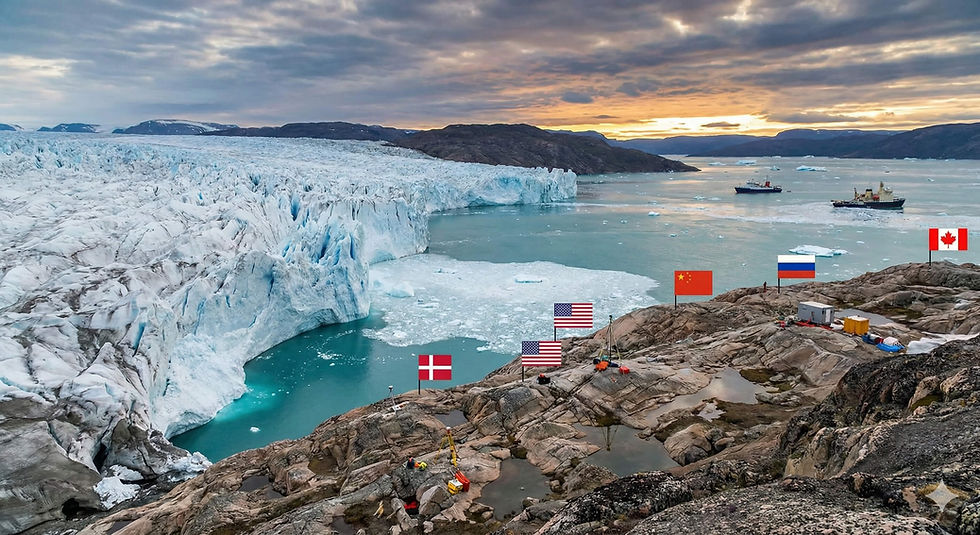
The genesis of the 2026 transatlantic crisis lies not in a single event, but in the slow accumulation of strategic divergences that have widened the gap between Washington and Brussels over the preceding decade. However, the catalyst for the current rupture was the abrupt escalation of the United States' long-standing interest in Greenland. On January 17, 2026, the administration transformed a dormant diplomatic proposal into an active ultimatum: the Kingdom of Denmark must negotiate the transfer of sovereignty over the Arctic territory, or face a tiered tariff regime targeting eight specific European allies.1
This ultimatum, delivered via social media and later formalized through administrative directives, linked the acquisition of Greenland directly to the "Golden Dome" missile defense architecture—a 175 billion dollar initiative deemed existential for US national security.3 The ultimatum explicitly targeted Denmark, Sweden, France, Germany, the Netherlands, Finland, the United Kingdom, and Norway, citing their participation in the "Arctic Endurance" military exercises as an act of obstruction.4 The proposed penalties are severe: a 10 percent tariff on all goods effective February 1, 2026, escalating to 25 percent by June 1 if sovereignty is not transferred.5
This geopolitical maneuver lands upon a global economy that is already fragile. The "sturdy" growth figures projected for the US economy mask deep-seated vulnerabilities in the manufacturing sector, which is currently in recession.6 Simultaneously, the European Union is grappling with its own economic stagnation and is uniquely sensitive to external shocks. The invocation of the Anti-Coercion Instrument (ACI) by European leaders marks a historic turning point; it is the first time this "trade bazooka" has been seriously considered for use against a NATO ally, signaling that the era of automatic transatlantic alignment on trade and security issues has effectively ended.1
2. The US Economic Landscape in Early 2026: A House Divided
To fully comprehend the leverage—and the risks—inherent in the United States' aggressive trade posture, one must first dissect the domestic economic reality of January 2026. The narrative emanating from Washington is one of revitalization and strength, predicated on the success of the "America First" agenda. However, a granular analysis of economic indicators reveals a bifurcated economy: a resilient services sector and a buoyant stock market masking a hollowing-out of the industrial base.
2.1 The Divergence: Sturdy Headlines, Crumbling Foundations
Macroeconomic forecasters, including Goldman Sachs Research, have maintained a relatively optimistic outlook for the US economy in 2026. Projections place GDP growth at approximately 2.6 percent, a figure that outperforms consensus estimates and exceeds the projected growth of other advanced economies.8 This headline growth is largely attributed to the stimulative effects of recent tax cuts, which have injected approximately 100 billion dollars into consumer wallets, and easier financial conditions that have buoyed equity markets.8
However, this aggregate data obscures a critical recession in the very sector that tariffs were promised to save: manufacturing. By the end of 2025, the Bureau of Labor Statistics reported that the economy had shed 8,000 manufacturing jobs in December alone, capping off eight consecutive months of losses.6 Since the implementation of the "Liberation Day" tariff rates in April 2025, the sector has lost a total of 70,000 jobs. Employment levels in American factories have now slipped below the pre-pandemic levels of the previous administration, suggesting that protectionist barriers have failed to incentivize domestic hiring.6
The Institute for Supply Management’s (ISM) Purchasing Managers’ Index (PMI) provides further evidence of this industrial contraction. In December 2025, the PMI fell to 47.9, marking the tenth consecutive month of contraction (any reading below 50 indicates shrinkage). More alarmingly, the intensity of this contraction is deepening. The share of manufacturing GDP in "strong contraction" (defined as a PMI of 45 or lower) rose from 39 percent in November to 43 percent in December.6 This data indicates that while the service economy and tech sectors (particularly Artificial Intelligence) are growing, the physical economy of making things is shrinking, burdened by the higher input costs that tariffs inevitably create.
2.2 The "Termite" Effect: Structural Erosion
Economists have begun to describe this phenomenon as the "termite" effect. Unlike a sudden financial crash, the damage inflicted by prolonged trade wars and tariffs is analogous to termites eating away at the woodwork of a house: the structure remains standing and looks solid from the outside, but its internal integrity is slowly compromised until it eventually crumbles.9
The "termite" hypothesis explains why the predicted recession has not yet materialized in headline GDP figures. The negative consequences of tariffs—higher costs for steel, aluminum, and intermediate components—are currently being offset by a massive wave of investment in Artificial Intelligence and a temporary lull in retaliatory measures from trading partners.9 However, this offset is temporary. Manufacturers are reportedly hesitant to invest in physical plant and equipment due to the uncertainty of trade policy. Instead of "reshoring" supply chains, many companies are simply freezing capital expenditures or automating aggressively to reduce labor costs, leading to the observed job losses.6
The administration’s promise of 5 trillion dollars in foreign investment remains largely unfulfilled as of early 2026. Global capital, while attracted to the US tech sector, is wary of the unpredictable tariff regime. The "Greenland Tariffs" add a new layer of volatility, potentially freezing investment from European multinationals who now face the prospect of a double-taxation environment—taxed on production in Europe and taxed on entry into the US.10
2.3 The Inflationary Paradox and the "Sticky" Floor
Inflation remains the central political and economic variable in the US calculus. As of January 2026, US Consumer Prices were growing at 2.7 percent year-over-year. While this is significantly lower than the spikes seen in the early 2020s, it marks 58 consecutive months where inflation has remained above the Federal Reserve’s 2 percent target.11 This "sticky" inflation suggests that price stability remains elusive.
The composition of this inflation is particularly worrying for policymakers.
Goods Inflation: Core goods inflation flatlined at 0.0 percent month-over-month in December 2025, largely due to a drop in used car prices. However, this masks significant volatility in other areas; apparel prices, for instance, jumped 0.6 percent in a single month. Crucially, analysts warn that the pass-through of existing tariffs to consumer prices is not yet complete. The peak impact of the 2025 tariff rounds is expected to hit in the second quarter of 2026.11
Services and Housing: The "floor" under inflation is being held up by the services sector and housing costs. Owner’s Equivalent Rent (OER), which accounts for a massive 26.5 percent of the CPI basket, rose 3.4 percent year-over-year in December.11 This structural inflation is largely immune to trade policy but limits the Federal Reserve's ability to cut interest rates, thereby keeping borrowing costs high for the struggling manufacturing sector.
The Food Factor: Food inflation rose 0.7 percent month-over-month in December, the highest jump since 2022.11 Because food prices disproportionately affect low-to-middle-income voters, this metric creates immense political pressure on the administration to deliver economic "wins," potentially driving the aggressive posture toward Greenland as a distraction or a Hail Mary for resource security.
2.4 The Revenue Illusion
A key pillar of the administration's economic logic is that tariffs generate revenue that can offset tax cuts. The "Trump tariffs" are projected to raise approximately 2.2 trillion dollars in revenue over the next decade on a conventional basis. However, when accounting for the negative economic effects—reduced consumption, lower corporate profits, and retaliatory measures—the effective revenue falls to 1.7 trillion dollars.12
Moreover, the Tax Foundation estimates that these tariffs amount to an average tax increase of 1,100 dollars per US household in 2025, rising to 1,500 dollars in 2026.12 This represents the largest tax increase as a percentage of GDP since 1993. The administration argues that foreign exporters pay these tariffs, but economic consensus and empirical data from US importers suggest that the cost is almost entirely passed through to domestic businesses and consumers, further eroding the purchasing power gains from the tax cuts.13
3. The Geostrategic Pivot: Greenland and the "Golden Dome"
To understand why the United States is willing to risk a trade war with its closest allies during a delicate economic period, one must look beyond economics to the realm of high-stakes security strategy. The dispute over Greenland is not merely a territorial vanity project; it is driven by two specific, interlinked imperatives: the deployment of the "Golden Dome" missile defense system and the global race for critical minerals.
3.1 The Military Imperative: The Golden Dome Architecture
The "Golden Dome" represents the cornerstone of the United States' 2026 defense posture. It is a 175 billion dollar multi-layered missile defense initiative designed to counter next-generation threats that current systems cannot intercept—specifically, hypersonic glide vehicles (HGVs) and AI-enabled drone swarms.3
Unlike traditional ballistic missile defense, which relies on intercepting projectiles in a predictable parabolic arc, the Golden Dome requires a "system of systems" approach. This includes:
Space-Based Sensors: A constellation of satellites in polar orbits to track heat signatures of hypersonic launches.
Ground-Based Interceptors: Launch sites positioned to intercept threats in their boost or mid-course phase.
Command and Control: AI-driven processing centers to manage the intercept geometry.15
Greenland’s geography is indispensable to this architecture. Situated directly on the "Great Circle" route between the Eurasian landmass and North America, Greenland offers the shortest and most effective vantage point for radar tracking and interception of missiles launched from Russia or China.3 The island is already home to the Pituffik Space Base (formerly Thule Air Base), which houses the United States' most advanced solid-state phased-array warning radars.16
On January 15, 2026, the President explicitly linked the acquisition of Greenland to this project, stating on social media: "The United States needs Greenland for the purpose of National Security. It is vital for the Golden Dome that we are building... Nato becomes far more formidable and effective with Greenland in the hands of the UNITED STATES".3
The administration argues that relying on a semi-autonomous territory of Denmark—a nation with its own parliamentary politics and environmental regulations—creates an unacceptable vulnerability. They fear that a future Greenlandic government could restrict US military expansion or, worse, grant dual-use infrastructure contracts to Chinese entities.17 However, defense experts contest this narrative, noting that the 1951 Defense of Greenland Agreement already grants the US extensive rights to operate and expand military facilities without requiring sovereignty.16 The push for ownership, therefore, is viewed by allies not as a military necessity, but as a political assertion of hegemony.
3.2 The Resource Race: Critical Minerals and Rare Earths
Beneath the ice, Greenland holds a geological fortune that is equally critical to US national security. The island ranks eighth in the world for rare earth reserves and hosts two of the largest undeveloped deposits of rare earth elements (REEs) on the planet: Tanbreez and Kvanefjeld.17 These minerals—specifically neodymium, praseodymium, dysprosium, and terbium—are essential for the manufacturing of permanent magnets used in F-35 fighter jets, guided missiles, electric vehicles, and wind turbines.
The strategic anxiety in Washington stems from China’s near-monopoly on the global supply chain. In 2025, China imposed export controls on heavy rare earths, exposing the fragility of the US defense industrial base.17 The US strategy for 2026 is defined by "friend-shoring" and total supply chain control.
3.2.1 The Tanbreez Project: The Approved Path
The Tanbreez deposit is rich in heavy rare earths, zirconium, and niobium. It is distinct because it contains low levels of radioactive elements, making it easier to mine under Greenland’s strict environmental laws. In early 2026, the US strategy bore fruit when Critical Metals Corp., a NASDAQ-listed company, announced a joint venture with a Saudi Arabian industrial conglomerate to develop Tanbreez.
The Deal: The joint venture will construct a processing facility in Saudi Arabia. The rare earth concentrate will be mined in Greenland, shipped to Saudi Arabia for processing (bypassing China), and then the finished oxides will be shipped to the United States for use in the defense industry.19
Significance: This deal represents a victory for the US "friend-shoring" strategy, creating a supply chain entirely outside the purview of Beijing. It also demonstrates that US companies can access Greenland’s resources without US sovereignty, undermining the administration’s argument that annexation is necessary for resource security.21
3.2.2 The Kvanefjeld Controversy: The Blocked Path
The Kvanefjeld project presents the opposite scenario. It is a massive deposit that contains rare earths alongside significant uranium reserves. It was partly owned by Shenghe Resources, a Chinese company, making it a target of US concern.
The Ban: In 2021, the Greenlandic government (Naalakkersuisut) passed legislation banning the mining of uranium. This effectively halted the Kvanefjeld project.22
The Litigation: The owners of the project are currently suing the Greenlandic and Danish governments for 11.5 billion dollars in compensation, arguing expropriation.23
US Motive: The US administration views the potential for Chinese involvement in Kvanefjeld as a strategic threat. By acquiring sovereignty, the US could unilaterally control the licensing of this site, ensuring that Chinese firms are permanently locked out and potentially overriding the local uranium ban if national security required the rare earths contained therein.17
3.3 The Ultimatum and the "Coalition of the Willing"
The tension reached a breaking point when eight European nations—Denmark, Sweden, France, Germany, the Netherlands, Finland, the United Kingdom, and Norway—participated in the "Arctic Endurance" military exercise in Greenland. While the Europeans described this as a standard NATO maneuver to demonstrate Arctic readiness, the US administration interpreted it as a "pre-coordinated" signal of resistance to US acquisition efforts.4
On January 17, 2026, the President weaponized this interpretation. He announced that these eight nations would face a 10 percent tariff on all goods exported to the US starting February 1, 2026. This rate is scheduled to more than double to 25 percent on June 1, 2026, unless a deal for the "Complete and Total purchase" of Greenland is reached.2 This ultimatum effectively merged the economic and security tracks, using trade policy as a blunt instrument of territorial expansion.
4. The Weaponization of Trade: Sectoral Impact of the Tariffs
The proposed tariffs target some of the United States' largest and most integrated trading partners. Unlike previous trade skirmishes that focused on specific commodities like steel or aluminum, this threat encompasses "all goods" from the eight named nations. The economic fallout would ripple through the global economy, disrupting supply chains in automotive, pharmaceutical, and luxury sectors, and threatening to tip the fragile European economy into recession.
4.1 The Automotive Sector: Germany in the Crosshairs
The German automotive industry, the engine of Europe’s largest economy, stands to be the primary casualty of the new tariff regime. The sector was already under immense pressure; in the first nine months of 2025, German car exports to the US had fallen by nearly 14 percent due to a pre-existing 15 percent base tariff.25
Financial Impact: A new 10 percent to 25 percent tariff would likely destroy the profitability of German exports to the US. Volkswagen has already projected a tariff hit of up to 5 billion euros (approx. 5.8 billion dollars) for 2025. An escalation to 25 percent would likely triple this figure, potentially forcing the company into a loss on its US operations.26
Supply Chain Integration: Major German OEMs (Original Equipment Manufacturers) like BMW and Mercedes-Benz operate large factories within the United States (e.g., Spartanburg, South Carolina). However, these plants rely on the importation of high-value components—engines, transmissions, and electronics—from Germany. The tariffs would tax these components, raising the production cost of "American-made" German cars by an estimated 4,000 dollars per vehicle.27
Consumer Pass-Through: J.P. Morgan Global Research estimates that automakers will pass approximately half of these costs to consumers, leading to a 3 percent increase in new vehicle price inflation in the US. This would further depress US auto sales, which are predicted to fall to 15.5 million units (SAAR) in 2026, down from 16 million in 2024.13
4.2 The Pharmaceutical Sector: The Betrayal of the UK
The inclusion of the United Kingdom in the tariff list represents a significant diplomatic rupture. Just weeks prior, the US and UK had reached an "agreement in principle" to exempt UK-origin pharmaceuticals from Section 232 tariffs. This deal was hard-won; the UK agreed to increase NHS spending on medicines and reform its drug pricing scheme—effectively paying higher prices for US drugs—in exchange for tariff-free access to the US market for British pharmaceuticals.28
The Nullification: The January 17 ultimatum appears to override this sectoral agreement. British pharmaceutical exports, valued at over 5 billion pounds annually, are now exposed to the 10-25 percent levy. This creates a "worst of both worlds" scenario for the UK: they have committed to higher domestic drug costs to please the US, yet now face tariffs on their exports regardless.30
Irish Collateral Damage: While Ireland is not explicitly named in the "Targeted Eight," the integrated nature of the pharmaceutical supply chain means it is highly vulnerable. Ireland is the largest exporter of pharmaceuticals to the US by value. If intermediate ingredients from the UK or Germany (which are targeted) are taxed, the cost basis for Irish production rises. Furthermore, if the EU retaliates as a bloc, Ireland could be drawn into the trade war, jeopardizing its unique economic model.31
4.3 Luxury Goods: France and Italy
The luxury sector is a critical export engine for France and, by extension, the EU. The US is the second-largest market for personal luxury goods.
The End of "De Minimis": The US has already eliminated the "de minimis" exemption, which allowed shipments under 800 dollars to enter duty-free. This has hit the "aspirational" luxury market hard—consumers who buy perfumes, scarves, or small leather goods online.32
Pricing Power Limits: Brands like LVMH and Hermès have traditionally had strong pricing power, meaning they could raise prices without losing customers. However, a 25 percent tariff tests the limits of this elasticity. Analysts at Simon-Kucher warn that while the ultra-wealthy may absorb the cost, the broader market will not. LVMH has already reported a 1 percent earnings decline in Q2 2025; a trade war could turn this into a steep contraction.32
Strategic Shift: To mitigate tariffs, some luxury brands are considering moving more production to the US. LVMH already has factories in Texas and California. However, "Made in USA" dilutes the brand cachet of "Made in France" or "Made in Italy," creating a long-term risk to brand equity.32
4.4 Macroeconomic Implications for Europe
The aggregate impact on the European economy could be severe. The Cologne Institute for Economic Research predicts that the tariffs could reduce German GDP growth by 0.25 percentage points in 2026. Given that the German economy was already hovering near stagnation, this could push the eurozone’s locomotive into a technical recession.34
Furthermore, there is a risk of trade diversion. As the US closes its doors to Chinese goods (via high tariffs) and now European goods, there is a fear that Chinese exports will flood the European market, displacing local production. The EU is thus squeezed between US protectionism and Chinese overcapacity.31
5. The European Response: Activating the "Bazooka"
For decades, the European Union was characterized as a "soft power" superpower—an economic giant but a geopolitical dwarf, often unable to respond effectively to coercion. This changed with the passage of Regulation (EU) 2023/2675, known as the Anti-Coercion Instrument (ACI). As of January 2026, the EU stands ready to deploy this weapon for the first time, not against a systemic rival like China, but against its oldest ally.
5.1 The Anti-Coercion Instrument (ACI): Mechanism and Intent
The ACI was designed to fill a gap in the EU’s legal arsenal. Previous trade defense instruments allowed the EU to retaliate only after a lengthy dispute settlement process at the World Trade Organization (WTO)—a body effectively paralyzed by the US blockage of appellate judges. The ACI allows the EU to act swiftly and unilaterally when a third country attempts to coerce the Union or a Member State into a particular political choice.7
Definition of Coercion: The US ultimatum—"transfer sovereignty of Greenland or face tariffs"—fits the ACI’s definition of economic coercion perfectly: a measure affecting trade applied to obtain a specific political act.36
The "Bazooka" Measures: If activation is approved, the ACI grants the European Commission the power to impose a wide range of countermeasures. These include:
Tariffs: New customs duties on US goods.
Quotas: Restrictions on the quantity of US imports.
Public Procurement: Banning US companies from bidding on lucrative government contracts within the EU.
Financial Markets: Restricting access to EU financial services.36
Decision Making (QMV): Crucially, the activation of the ACI requires a Qualified Majority Vote (QMV) in the European Council. This means that a single Member State cannot veto the action. This was designed to prevent external powers from "picking off" a weak link in the EU chain to block retaliation.37
5.2 The Debate in Brussels: Deterrence vs. De-escalation
On January 18, 2026, the EU ambassadors convened an emergency meeting in Brussels to determine the response. The political fault lines are distinct:
The Hawks (France, European Parliament): French President Emmanuel Macron and Bernd Lange, Chair of the European Parliament’s Trade Committee, are pushing for immediate activation. They argue that the US threat is an attack on European sovereignty and that failure to respond would invite further bullying. Lange stated, "I cannot imagine that we can continue with business as usual," suggesting a suspension of all transatlantic trade talks.37
The Doves (Germany, Trade Pragmatists): German industry groups, while furious at the tariffs, are terrified of a full trade war. The VDMA (mechanical engineering association) and VDA (automotive association) have warned that a spiral of retaliation could cost German industry billions. However, even German voices like VDMA President Bertram Kawlath have admitted, "Europe must not allow itself to be blackmailed," signaling a reluctant shift toward support for the ACI.39
5.3 The Countermeasures List
Diplomatic sources indicate that the EU is dusting off a countermeasures list valued at approximately 93 billion euros (108 billion dollars). This list, originally drawn up during the previous Trump administration, targets politically sensitive US exports designed to inflict maximum pain on the President’s political base:
Agriculture: Soybeans, corn, and poultry.
Industrial Goods: Harley-Davidson motorcycles, blue jeans, and bourbon whiskey.
Aviation: Components for Boeing aircraft (though this is risky given European reliance on aerospace supply chains).36
The European Parliament has also signaled it will block the ratification of the EU-US trade deal agreed to in Scotland in July 2025. This deal, which lowered tariffs on some industrial goods, is now effectively dead in the water.38
6. Geopolitical Consequences and Future Outlook
The "Greenland Crisis" of 2026 represents a watershed moment in the 21st century. It marks the point where the post-WWII alliance structure, already strained, finally fractured under the weight of resource scarcity and "America First" nationalism.
6.1 The End of Article 5?
While the dispute is ostensibly economic, its implications for NATO are profound. The US has threatened tariffs on allies for participating in a NATO-aligned military exercise ("Arctic Endurance"). Danish Prime Minister Mette Frederiksen has warned that a US attack on Greenland (a theoretical escalation mentioned by the White House as an "option") would mean "the end of NATO".42 Even the economic aggression undermines the mutual defense clause's spirit; if an ally is an economic enemy, the political will to defend them militarily evaporates.
6.2 The China Factor
Ironically, the US move to secure Greenland against China may ultimately drive Europe closer to Beijing. If the US market becomes inaccessible due to tariffs, European exporters will be forced to seek alternative markets. China, despite its own economic challenges, remains the only market large enough to absorb German cars and French luxury goods. A trade war with the US could force the EU into a "strategic equidistance" policy, balancing between Washington and Beijing rather than aligning automatically with the West.44
6.3 Scenario Planning: The Path to June 1
As the February 1 deadline for the first tranche of tariffs approaches, three scenarios emerge:
Scenario A: The Trade War Spiral (High Probability): The US implements the 10 percent tariffs. The EU triggers the ACI, imposing counter-tariffs. The US retaliates by raising tariffs to 25 percent immediately. The global economy enters a recession in Q3 2026.
Scenario B: The Transactional Peace (Medium Probability): The US accepts a "sovereignty-lite" deal. Denmark grants the US exclusive 99-year leases on Golden Dome sites and rare earth deposits, without formally transferring sovereignty. Tariffs are suspended. This saves face for both sides but leaves Greenland as a de facto US protectorate.
Scenario C: The Congressional Block (Low Probability): The US Congress, alarmed by the economic damage and the threat to NATO, passes the "No Funds for NATO Invasion Act" and uses its authority to block the tariffs. However, given the President’s use of IEEPA (national security powers), Congress would need a veto-proof majority, which is unlikely in the current partisan environment.12
Conclusion
The events of January 2026 have laid bare the new rules of the global order: economic interdependence is no longer a guarantee of peace, but a vector for coercion. The US "termite" economy, gnawed by internal inefficiencies, has lashed out to secure external assets. Europe, armed with its ACI "bazooka," has signaled it will shoot back. The Arctic ice is melting, and with it, the frozen stability of the transatlantic alliance.
Table 1: Economic Exposure of Key Sectors to Proposed US Tariffs (Jan 2026)
Sector | Key Impacted Nations | Estimated Loss / Risk | Strategic Context |
Automotive | Germany, Sweden | Exports down ~14% (2025); Risk of €26bn further loss | High integration with US market; already struggling with 15% base tariff. Supply chain complexity creates "double taxation" risk. |
Pharmaceuticals | UK, Ireland, Denmark | Billions in export value; Price control agreements voided | UK-US "Zero Tariff" deal overridden by Jan 17 ultimatum. NHS drug costs committed to rise, but export benefits nullified. |
Luxury Goods | France, Italy | Margin compression; Consumer price sensitivity | "De minimis" exemption loss. 15-25% tariffs make aspirational goods uncompetitive vs. US domestic or Asian alternatives. |
Critical Minerals | Greenland (via Denmark) | Stalled projects (Kvanefjeld); Sovereign sale pressure | US seeking Tanbreez output for defense (Golden Dome); blocking Chinese access to Kvanefjeld is a priority. |
Machinery | Germany, Finland, Netherlands | Contraction in export volume | High correlation with US manufacturing investment; tariffs exacerbate US "termite" recession by raising capital equipment costs. |
Table 2: Timeline of the Greenland Crisis (2025-2026)
Date | Event | Significance |
Jan 2025 | US Executive Order on Critical Minerals | Prioritizes "friend-shoring" and securing processing capacity outside China (Tanbreez Strategy). |
July 2025 | EU-US Trade Deal (Scotland) | A temporary truce lowering some tariffs; now likely to be blocked by EU Parliament. |
Dec 2025 | US Manufacturing Jobs Report | 8th consecutive month of job losses; contradicts administration's "tariff success" narrative. |
Jan 14, 2026 | US-Denmark Summit | Diplomatic talks fail; Denmark and Greenland reject sale/transfer of sovereignty. |
Jan 15, 2026 | Trump links Greenland to "Golden Dome" | Militarizes the dispute; claims island is vital for 175bn missile defense system. |
Jan 17, 2026 | The Ultimatum | Trump announces 10% tariffs on 8 EU nations (inc. UK/Norway), rising to 25% on June 1. |
Jan 18, 2026 | EU Emergency Meeting | Leaders discuss activating the Anti-Coercion Instrument (ACI) and 93bn euro countermeasure list. |
Feb 1, 2026 | Scheduled Tariff Start | 10% tariffs to take effect if no deal is reached. |
Works cited
Trump’s Greenland tariffs spark calls for unprecedented EU ‘bazooka’ countermeasure, accessed January 18, 2026, https://www.timesofisrael.com/trumps-greenland-tariffs-spark-calls-for-unprecedented-eu-bazooka-countermeasure/
Lashing out at Europe, Trump announces 'Greenland tariffs', accessed January 18, 2026, https://timesofindia.indiatimes.com/business/international-business/lashing-out-at-europe-trump-announces-greenland-tariffs/articleshow/126623290.cms
Explained: How Greenland fits into Donald Trump's $175 billion Golden Dome missile shield, accessed January 18, 2026, https://timesofindia.indiatimes.com/world/us/explained-how-greenland-fits-into-donald-trumps-175-billion-golden-dome-missile-shield/articleshow/126531929.cms
European nations warn of 'dangerous downward spiral' after Trump threatens tariffs over Greenland, accessed January 18, 2026, https://www.cbc.ca/news/world/eight-countries-react-trump-tariff-threat-greenland-9.7050373
European leaders warn of ‘downward spiral’ after Trump threatens tariffs over Greenland – as it happened, accessed January 18, 2026, https://www.theguardian.com/world/live/2026/jan/17/hands-off-greenland-protests-denmark-us-donald-trump-europe-latest-news-updates
Trump’s tariffs aren’t raising prices, but they are shrinking America’s manufacturing workforce, accessed January 18, 2026, https://www.washingtonexaminer.com/policy/finance-and-economy/4418898/trumps-tariffs-not-raising-prices-shrinking-country-manufacturing-workforce/
The EU Anti-Coercion Regulation: A New Tool Against Economic Pressure - WilmerHale, accessed January 18, 2026, https://www.wilmerhale.com/en/insights/client-alerts/20240401-the-eu-anti-coercion-regulation-a-new-tool-against-economic-pressure
The Global Economy Is Forecast to Post 'Sturdy' Growth of 2.8% in 2026 | Goldman Sachs, accessed January 18, 2026, https://www.goldmansachs.com/insights/articles/the-global-economy-forecast-to-post-sturdy-growth-in-2026
Why Trump's Tariffs Are Like Termites | TIME, accessed January 18, 2026, https://time.com/collections/davos-2026/7339213/trump-tariffs-inflation-us-economy-global-trade-impact/
What PIIE researchers will be watching in 2026, accessed January 18, 2026, https://www.piie.com/blogs/realtime-economics/2026/what-piie-researchers-will-be-watching-2026
U.S. inflation stills stuck above comfort level - RBC Economics, accessed January 18, 2026, https://www.rbc.com/en/economics/us-analysis/us-data-flashes/u-s-inflation-stills-stuck-above-comfort-level/
Trump Tariffs: Tracking the Economic Impact of the Trump Trade War - Tax Foundation, accessed January 18, 2026, https://taxfoundation.org/research/all/federal/trump-tariffs-trade-war/
Auto Tariffs: Who Will Pay? | J.P. Morgan Global Research, accessed January 18, 2026, https://www.jpmorgan.com/insights/global-research/autos/auto-tariffs
Trump says US needs Greenland for Golden Dome. What is it?, accessed January 18, 2026, https://www.indiatoday.in/world/us-news/story/trump-pushes-us-control-greenland-golden-dome-missile-defence-arctic-security-glbs-2852150-2026-01-15
Golden Dome (missile defense system) - Wikipedia, accessed January 18, 2026, https://en.wikipedia.org/wiki/Golden_Dome_(missile_defense_system)
Trump’s Golden Dome excuse for Greenland grab is ‘detached from reality,’ experts say, accessed January 18, 2026, https://www.defenseone.com/threats/2026/01/trumps-golden-dome-excuse-greenland-grab-detached-reality-experts-say/410693/
Greenland, Rare Earths, and Arctic Security - CSIS, accessed January 18, 2026, https://www.csis.org/analysis/greenland-rare-earths-and-arctic-security
The US and NATO can avoid catastrophe over Greenland and emerge stronger. Here's how., accessed January 18, 2026, https://www.atlanticcouncil.org/dispatches/the-us-and-nato-can-avoid-catastrophe-over-greenland-and-emerge-stronger-heres-how/
Critical Metals Corp. Nasdaq-CRML Executes a Term Sheet for, accessed January 18, 2026, https://www.globenewswire.com/news-release/2026/01/15/3219652/0/en/Critical-Metals-Corp-Nasdaq-CRML-Executes-a-Term-Sheet-for-a-50-50-Joint-Venture-for-Up-To-1-500-000-000-USD-Rare-Earth-Processing-Facility-with-a-Leading-Saudi-Arabian-Industrial-.html
Here's Why Critical Metals Stock Jumped This Week, accessed January 18, 2026, https://finviz.com/news/279608/heres-why-critical-metals-stock-jumped-this-week
Trump & Greenland: Is There Logic in the Chaos? | The Arctic Institute, accessed January 18, 2026, https://www.thearcticinstitute.org/trump-greenland-logic-chaos/
Greenland's critical minerals require patient statecraft - Atlantic Council, accessed January 18, 2026, https://www.atlanticcouncil.org/dispatches/greenlands-critical-minerals-require-patient-statecraft/
Fearing toxic waste, Greenland ended uranium mining. Now, they could be forced to restart - or pay $11bn - The Guardian, accessed January 18, 2026, https://www.theguardian.com/environment/2025/mar/05/greenland-mining-energy-transition-minerals-environmental-laws-uranium-rare-earth-toxic-waste-investor-state-dispute-settlement-isds-aoe
Europe Promises United Response to Trump's 'Dangerous' Greenland Tariffs | TIME, accessed January 18, 2026, https://time.com/7347149/greenland-tariffs/
German auto industry significantly affected by US tariffs – study, accessed January 18, 2026, https://gmk.center/en/news/german-auto-industry-significantly-affected-by-us-tariffs-study/
Tariff impact grows for German carmakers as U.S. market tightens, accessed January 18, 2026, https://news.dealershipguy.com/p/tariff-impact-grows-for-german-carmakers-as-u-s-market-tightens-2025-12-30
Assessing the impact of US tariffs on the European automotive sector - Rabobank, accessed January 18, 2026, https://www.rabobank.com/knowledge/d011480100-assessing-the-impact-of-us-tariffs-on-the-european-automotive-sector
U.S. Exempts U.K. Pharmaceuticals from Section 232 Tariffs - GHY International, accessed January 18, 2026, https://www.ghy.com/trade-compliance/us-uk-pharmaceuticals-section-232/
UK-US Pharmaceutical Trade Deal: Impact on UK Drug Pricing, Tariffs, and Investment, accessed January 18, 2026, https://www.morganlewis.com/pubs/2025/12/uk-us-pharmaceutical-trade-deal-impact-on-uk-drug-pricing-tariffs-and-investment
From announcement to impact: what the UK–US pharmaceutical trade deal means now, accessed January 18, 2026, https://www.howdengroup.com/uk-en/from-announcement-to-impact-pharmaceutical-trade-deal
The economic impact of Trump's tariffs on Europe: an initial assessment - Bruegel, accessed January 18, 2026, https://www.bruegel.org/analysis/economic-impact-trumps-tariffs-europe-initial-assessment
Tariffs and their effect on luxury goods: Even the 'de minimis' exemption is no more, accessed January 18, 2026, https://www.luxurydaily.com/tariffs-and-their-effect-on-luxury-goods-even-the-de-minimis-exemption-is-no-more/
How Trump's tariffs are reshaping luxury pricing strategies - Jing Daily, accessed January 18, 2026, https://jingdaily.com/posts/how-trump-s-tariffs-are-reshaping-luxury-pricing-strategies
Donald Trumps Grönland-Ultimatum: Eskalation am 17. Januar – Wenn der wichtigste Verbündete plötzlich zum Gegner wird, accessed January 18, 2026, https://xpert.digital/en/groenland-ultimatum/
Protecting against coercion - Trade and Economic Security, accessed January 18, 2026, https://policy.trade.ec.europa.eu/enforcement-and-protection/protecting-against-coercion_en
What is the EU's anti-coercion instrument, and how does it work?, accessed January 18, 2026, https://ca.news.yahoo.com/eus-anti-coercion-instrument-does-183949470.html
Europe remains ‘united and coordinated’ in response to US Greenland tariffs, accessed January 18, 2026, https://www.belganewsagency.eu/europe-remains-united-and-coordinated-in-response-to-us-greenland-tariffs
EU parliament trade chief urges anti-coercion response after Trump Greenland tariff threat, accessed January 18, 2026, http://www.xinhuanet.com/english/europe/20260118/f2bdf0d17bcb4d00a96481e374623335/c.html
German industry urges EU to resist Trump trade threats over Greenland, accessed January 18, 2026, https://www.dailyfinland.fi/europe/47362/German-industry-urges-EU-to-resist-Trump-trade-threats-over-Greenland
EU considering hitting US with 93 bln euro worth of tariffs: media - Chinadaily.com.cn, accessed January 18, 2026, https://global.chinadaily.com.cn/a/202601/19/WS696d2f06a310d6866eb345c4.html
EU-US trade deal to be called off as Trump announces 10% more tariffs? Here's what we know, accessed January 18, 2026, https://www.livemint.com/news/world/euus-trade-deal-to-be-called-off-as-trump-announces-10-more-tariffs-heres-what-we-know-11768695735002.html
What can the EU and Nato do to stop Trump from trying to claim Greenland?, accessed January 18, 2026, https://www.theguardian.com/world/2026/jan/12/what-can-the-eu-and-nato-do-to-stop-trump-from-trying-to-claim-greenland
White House: Trump 'discussing a range of options' to take Greenland — including military force - POLITICO Pro, accessed January 18, 2026, https://subscriber.politicopro.com/article/2026/01/white-house-trump-discussing-a-range-of-options-to-take-greenland-including-military-force-00713315
Now, Trump tariffs Europe over Greenland: And the winner is China—explained, accessed January 18, 2026, https://timesofindia.indiatimes.com/business/international-business/now-trump-tariffs-europe-over-greenland-and-the-winner-is-chinaexplained/articleshow/126639515.cms
Bipartisan Legislation Prohibiting a U.S. Invasion of a NATO State Introduced, accessed January 18, 2026, https://hoyer.house.gov/media/press-releases/bipartisan-legislation-prohibiting-us-invasion-nato-state-introduced


Comments