Bottlenecked: How Tariffs and Time Are Spoiling American Wine in Canada
- Bryan White

- Jul 10
- 18 min read
Introduction to the 2026 Wine and Alcohol Policy Dispute
The intersection of international trade policy and agricultural science presents a complex landscape where macroeconomic decisions trigger profound micro-level consequences. In the context of the 2025–2026 trade dispute between the United States and Canada, the weaponization of alcoholic beverage imports has provided a stark demonstration of how geopolitical maneuvering directly impacts regional agricultural economies and forces the confrontation of biochemical realities. Following the implementation of tariffs on Canadian goods by the United States administration, Canadian provincial governments retaliated by ordering their state-controlled liquor monopolies to halt the importation and sale of American alcohol1.
What began as a political pressure tactic quickly evolved into a multi-faceted crisis for the American wine industry, particularly in California. By mid-2026, the dispute had erased hundreds of millions of dollars in export revenue, exacerbated a pre-existing structural oversupply of grapes, and prompted federal legislative threats from the United States alongside diplomatic pleas from California lawmakers4. Furthermore, the retaliatory blockade inadvertently highlighted the delicate chemical stability of alcoholic beverages. As millions of bottles of American wine and cream liqueurs languished in Canadian provincial warehouses, the inevitable processes of oxidation and emulsion degradation forced provincial monopolies into emergency liquidation measures2.
This report provides an exhaustive analysis of the United States-Canada alcohol trade dispute. It examines the geopolitical framework of the boycotts, the macroeconomic fallout experienced by California's viticulture sector, and the specific chemical degradation mechanisms that dictate the shelf life of the embargoed inventories. By synthesizing international trade law, agricultural economics, and beverage biochemistry, the analysis elucidates the cascading effects of protectionist policies on perishable commodities.
The Geopolitical Landscape and Trade Architecture
Origins of the Retaliatory Boycott
The catalyst for the alcohol trade dispute was the imposition of broad tariffs on Canadian exports—most notably steel, aluminum, and softwood lumber—by the United States1. In response to what were perceived as unjustified trade barriers, the Canadian government implemented a 25 percent retaliatory tariff on all United States wine, beer, and spirits entering the country on March 4, 202511. However, the federal tariff was quickly superseded by a much more severe action at the provincial level. Because Canada utilizes a system of government-controlled monopolies for alcohol distribution in most provinces, these boycotts were executed with immediate, systemic efficiency.
Major Canadian provincial liquor boards, including the Société des alcools du Québec (SAQ) and the Liquor Control Board of Ontario (LCBO), enacted complete bans on the importation, distribution, and sale of American alcoholic beverages8. Products were physically removed from store shelves and held in warehousing facilities. The boycott was initially adopted by eight provinces10. British Columbia originally limited the removal to spirits from states leaning toward the Republican party but subsequently expanded the order to cover all American alcohol11. While privatized retail systems in Alberta and Saskatchewan eventually allowed for the resumption of some American alcohol sales, the lucrative markets of Ontario and Quebec remained firmly closed into the summer of 20261.
The USMCA Framework and State-Owned Enterprises
The legality of the Canadian provincial boycotts has been highly contested under the framework of the United States-Mexico-Canada Agreement (USMCA), the successor to the North American Free Trade Agreement. The USMCA explicitly addresses trade in agricultural goods, with Annex 3-C directly applying to trade in distilled spirits, wine, beer, and other alcoholic beverages15. Among its provisions, the agreement protects geographical indications like Bourbon and Tennessee Whiskey and specifically prohibits provinces like Quebec from requiring that wine sold in grocery stores be bottled within the province, provided alternative outlets exist16.
However, the central legal friction point lies in Chapter 22 of the USMCA, which governs State-Owned Enterprises and Designated Monopolies17. Under Article 22.4, designated monopolies are required to accord non-discriminatory treatment to goods and services from other parties. Crucially, the text mandates that these entities must act in accordance with "commercial considerations" in their purchase and sale of goods18. The United States trade apparatus has argued that by banning American alcohol for explicitly political reasons, Canadian provincial liquor boards violated these terms. The removal of products from shelves was not based on consumer demand, pricing, profitability, or product quality, but rather on direct government mandates intended to exert political leverage12.
Canadian defense of the policy has rested on the assertion that the United States initiated the breach of free-trade norms. Canadian officials, including Quebec Premier Christine Fréchette and Ontario Premier Doug Ford, framed the alcohol blockade as a necessary countermeasure to protect Canadian workers and industries from the tariffs impacting their domestic manufacturing and resource sectors8.
Legislative Escalation: The CANADA Act and Section 301
By July 2026, the diplomatic impasse prompted an aggressive legislative response from the United States Congress. Representative Claudia Tenney introduced the Combating Attacks on our National Alcoholic Drinks by Allies Act, officially acronymized as the CANADA Act6. The legislation was designed to bypass stalled diplomatic negotiations and compel the Office of the United States Trade Representative (USTR) to take enforcement action.
The CANADA Act directs the USTR, led by Ambassador Jamieson Greer, to initiate an investigation under Section 301 of the Trade Act of 19746. Section 301 is a potent statute that allows the United States to investigate and impose trade sanctions on foreign countries that engage in acts, policies, or practices deemed unjustifiable, unreasonable, or discriminatory, and that burden or restrict United States commerce25. Unlike temporary emergency tariffs, Section 301 grants the executive branch the authority to impose uncapped tariffs on unrelated goods to compensate for the economic burden suffered by domestic producers25.
The introduction of the CANADA Act coincided with a broader, highly aggressive application of Section 301 by the USTR. In the spring of 2026, the USTR initiated massive parallel investigations into 16 countries for structural industrial overcapacity and 60 countries for the failure to enforce prohibitions on goods produced with forced labor25.
Milestone Event | Industrial Overcapacity Investigation | Forced Labor Investigation |
USTR Initiation Date | March 11, 2026 | March 12, 2026 |
Written Comment Deadline | April 15, 2026 | April 15, 2026 |
Public Hearings Commence | May 5, 2026 | April 28, 2026 |
Target Date for Determinations | July 24, 2026 | July 24, 2026 |
Summary of the parallel Section 301 investigations undertaken by the USTR in early 2026, establishing the aggressive trade enforcement environment into which the CANADA Act was introduced25.
By placing the Canadian alcohol dispute within the purview of Section 301, lawmakers signaled a willingness to impose punitive tariffs on unrelated Canadian sectors if the provincial liquor boards did not relent23. Ambassador Greer publicly noted that Canada and China were the only two nations to retaliate economically against the United States over the previous year, highlighting the severity with which Washington viewed the provincial boycotts6.
Despite coordinated efforts by California lawmakers, including Senators Adam Schiff and Alex Padilla, who authored letters to Quebec Premier Fréchette pleading for a restoration of trade based on the mutual economic harm being suffered by producers who had no influence over federal tariff policy, Quebec maintained its prohibition3. Fréchette explicitly stated that the measure would remain in effect as long as the United States maintained its tariffs on Canadian goods22.
Macroeconomic Repercussions in the American Viticulture Sector
The sudden closure of the Canadian market acted as a catalyst for a broader crisis within the United States wine industry, which was already facing systemic vulnerabilities. The macroeconomic fallout was particularly concentrated in California, which accounts for 95 percent of all United States wine exports5.
Export Collapse and Market Shifts
Prior to the dispute, the United States enjoyed a significant trade surplus in wine with Canada. That surplus evaporated almost entirely over the course of 2025.
Beverage Category | 2024 Export Value (USD) | 2025 Export Value (USD) | Year-Over-Year Decline |
Wine | 446.5 Million | 103.7 Million | -76.8% |
Spirits | 324.6 Million | 176.0 Million | -45.8% |
Beer | 46.7 Million | 16.7 Million | -64.2% |
Data summarizes the precipitous drop in United States beverage exports to Canada following the implementation of provincial liquor board restrictions in March 202532.
While American producers attempted to pivot to alternative international markets, the gains were marginal. Exports to Japan, South Africa, Belgium, and the United Arab Emirates saw slight increases, but these markets could not absorb the sheer volume previously consumed by Canada4. Furthermore, the American export market was simultaneously battered by hostile tariffs in other major jurisdictions. Exports to China collapsed by 70 percent, representing an additional 67 million dollar loss, following the imposition of a 55 percent tariff4. Exports to the European Union and the United Kingdom also declined under 15 percent tariff regimes5.
These international headwinds collided with domestic softening in the wine market. The post-pandemic landscape saw continuous drops in direct-to-consumer shipment volumes, which fell by 15 percent in 202533. Changing consumer habits pushed younger demographics toward ready-to-drink cocktails, which surged 30 percent to 1.2 billion dollars in sales, and hard seltzers, further eroding traditional wine consumption4.
The California Glut and Vineyard Removals
The loss of the Canadian market exacerbated a structural oversupply of wine grapes in California. Following decades of continuous growth initiated by the "French Paradox" health claims in the early 1990s, the state was producing vastly more grapes than the heavily restricted markets could consume31.
To return the industry to market equilibrium, agricultural economists and industry cooperatives, such as Allied Grape Growers, recommended the permanent removal of approximately 50,000 acres of wine grapes statewide31. The economic pain of these removals was highly concentrated in California's Central Valley, specifically the Lodi and Delta regions, which had built their economies on high-volume production.
California Region | Recommended Acreage Removal | Implied Regional Economic Impact |
Lodi / Delta | 15,000 acres | Devastation of multi-generational farms; transition to alternative crops |
Central Valley | 15,000 acres | Structural shift in agricultural output |
Central Coast | 15,000 acres | Consolidation of mid-tier vineyards |
Sonoma / Napa | 5,000 acres | Removal of underperforming or disease-susceptible vines |
Summary of vineyard removal recommendations necessary to correct the 2025–2026 supply imbalance across California31.
In the Lodi region alone, the tariff and boycott regime threatened 850 jobs and directly caused an estimated 45 million dollars in regional export revenue losses5. In 2025, an estimated 30 percent of wine grapes statewide went unsold, leaving tens of thousands of acres abandoned with fruit rotting on the vine35. The cost of removing vineyards proved substantial, particularly given incoming environmental regulations in the San Joaquin Valley prohibiting the open-air burning of agricultural waste31. Consequently, the industry underwent a painful, capital-intensive contraction, with approximately 40,000 acres of vines actively pulled from the ground between late 2025 and mid-202635.
Compounding Agricultural Threats: The Glassy-Winged Sharpshooter
The economic fragility caused by the trade dispute was further compounded in mid-2026 by an acute biological threat that required massive capital to mitigate. In May 2026, the California Department of Food and Agriculture identified nursery stock infested with the glassy-winged sharpshooter distributed across 24 counties through commercial retail outlets39. The infested vines were purchased by consumers and transported to residential properties in at least 38 counties across the state39.
The glassy-winged sharpshooter is a highly invasive insect vector for the bacterium responsible for Pierce's Disease39. Pierce's Disease is an incurable condition that kills grapevines by colonizing and clogging the water-conducting vessels of the plant, effectively starving the vine of hydration and nutrients41. State agricultural officials estimated that if left unchecked, the spread of Pierce's Disease could result in losses exceeding 104 million dollars annually, devastating both the wine grape and the 2.59 billion dollar table grape industries39.
In response, a bipartisan coalition of California lawmakers petitioned the United States Department of Agriculture for the immediate release of 32.2 million dollars in emergency funding from the Commodity Credit Corporation to finance tracing, surveying, and eradication programs39. Recognizing the existential threat, wine grape growers voted to assess themselves a fee of 1.25 dollars per 1,000 dollars of grape value to fund ongoing mitigation research, a severe financial strain on an industry already experiencing negative margins41. The emergence of this pest amid a catastrophic collapse in export revenues illustrates the highly precarious state of the California viticulture industry in 2026.
The Biochemistry of Perishable Inventories: The SAQ Liquidation
While politicians utilized alcoholic beverages as static bargaining chips in international trade negotiations, they fundamentally ignored the biochemical realities of the products. Unlike steel or lumber, alcoholic beverages—particularly wines and cream liqueurs—are highly perishable, thermodynamically unstable systems subject to continuous chemical degradation.
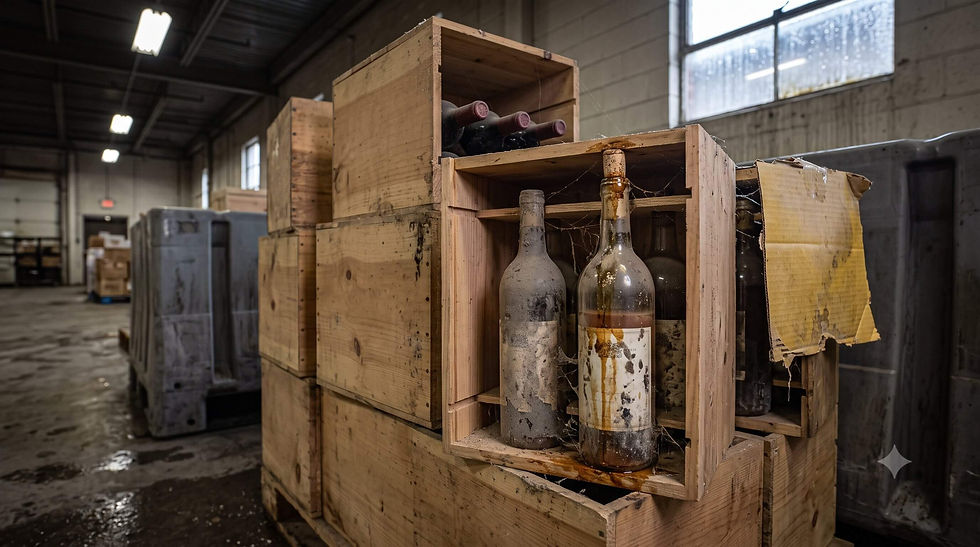
By early 2026, the Société des alcools du Québec realized that the millions of bottles of American alcohol sitting in their warehouses were beginning to spoil. Over one million bottles, representing an inventory value of more than 27 million dollars, had been removed from shelves and subjected to prolonged storage20. Recognizing that the inventory would soon become unsalable and burden the state with massive warehousing fees, Quebec Finance Minister Eric Girard authorized an exceptional measure2. Beginning February 12, 2026, the SAQ permitted the sale of highly perishable American stock—specifically products whose quality would precipitously decline by 2027—at a 15 percent discount, with proceeds estimated at up to 8.6 million dollars directed to the Food Banks of Quebec2.
This forced liquidation provides a critical lens into the science of beverage shelf life, governed primarily by the mechanics of oxidation and emulsion instability. The assumption that sealed bottles of alcohol remain static indefinitely is a profound misunderstanding of the fluid dynamics and chemical kinetics at play.
Wine Oxidation Chemistry: The Fenton Reaction
The primary mechanism limiting the shelf life of wine is non-enzymatic oxidation. Even in sealed glass bottles, the slow ingress of oxygen through the closure, combined with the dissolved oxygen present at bottling, drives a continuous cascade of chemical reactions43. Research by enologists, notably Dr. Andrew Waterhouse, extensively outlines the pathways of wine oxidation, emphasizing that oxygen in its triplet ground state does not directly react with the organic molecules in wine at its naturally low acidity44.
Instead, the activation of oxygen requires transition metal catalysts, specifically trace amounts of iron and copper naturally present in the wine44. The oxidation cascade proceeds through several distinct biochemical phases:
First, dissolved oxygen is reduced by iron in its plus two oxidation state, and copper in its plus one state, to form the highly reactive hydroperoxyl radical44. This radical subsequently attacks phenolic compounds—specifically those containing a catechol structure, such as epigallocatechin or 4-methylcatechol48. The oxidation of the catechol yields a semiquinone radical, which further oxidizes into a highly electrophilic quinone, simultaneously generating hydrogen peroxide as a byproduct44.
Second, the accumulation of hydrogen peroxide sets the stage for the most destructive phase of wine oxidation: the Fenton reaction. In this step, hydrogen peroxide reacts with the reduced iron to yield oxidized iron, a hydroxide ion, and a free hydroxyl radical46. The addition of manganese has also been shown to catalyze and accelerate these radical chain reactions in specific varietals like Sauvignon Blanc50.
Third, the hydroxyl radical acts as a profoundly powerful and indiscriminate oxidant. Because ethanol is the most abundant organic molecule in wine, comprising 12 to 15 percent by volume, the hydroxyl radical primarily attacks ethanol. It abstracts a hydrogen atom to form a 1-hydroxyethyl radical, or ethoxyl radical44. This intermediate subsequently reacts with oxygen to form acetaldehyde44.
Finally, the sensory degradation becomes apparent. The accumulation of acetaldehyde is the primary chemical marker of spoiled, oxidized wine. It shifts the sensory profile from fresh, fruity, and floral notes to a dull, flat, bruised apple characteristic that consumers find highly undesirable44. Furthermore, oxidation drives Strecker degradation, where amino acids react with dicarbonyls or quinones to form Strecker aldehydes, such as methional and phenylacetaldehyde, contributing further to the stale, oxidized aroma profile48.
To mitigate these reactions, winemakers rely on sulfur dioxide, which acts as a sacrificial antioxidant. Sulfur dioxide protects the wine by reducing hydrogen peroxide to water, thus preempting the Fenton reaction, and by reducing electrophilic quinones back to their original phenolic state44. However, the pool of free sulfur dioxide is finite. Once the sulfur dioxide is fully consumed during prolonged storage, the oxidative cascade accelerates logarithmically, leading to rapid and irreversible spoilage46. The SAQ's decision to liquidate white wines, lower alcohol products, and specific vintages reflects the reality that the sulfur dioxide reserves in these bottles had been completely depleted during the year-long embargo.
Emulsion Instability in Cream Liqueurs
While wine suffers from chemical oxidation, cream-based liqueurs suffer from acute physical instability. Cream liqueurs are highly complex oil-in-water emulsions, characterized by dairy fat globules dispersed within an aqueous continuous phase that contains high concentrations of sucrose and ethanol53.
The creation of a shelf-stable cream liqueur is a delicate feat of food engineering. The high ethanol content inherently threatens the emulsion because ethanol is a potent protein denaturant. To counteract this, manufacturers utilize high-pressure homogenization, forcing the mixture through valves at pressures between 100 and 200 bar, to reduce the milk fat globules to a microscopic size of 0.5 to 2.0 micrometers53.
To stabilize these newly created, microscopic fat droplets, emulsifiers are introduced. The industry standard is sodium caseinate, a highly refined, water-soluble milk protein derivative53. Sodium caseinate rapidly adsorbs at the fat-water interface, lowering the interfacial tension and creating a steric and electrostatic barrier around each fat droplet, which prevents them from coalescing55.
However, this emulsion is thermodynamically unstable over long periods. The shelf life of a premium cream liqueur is strictly limited to 18 to 24 months from the date of manufacture, regardless of whether the bottle is opened53. During prolonged warehouse storage, especially if temperatures fluctuate, several degradation mechanisms occur:
Ethanol-Induced Dehydration: The high concentration of ethanol in the continuous phase gradually alters the dielectric constant of the solvent and dehydrates the protective casein layer surrounding the fat droplets53.
Ionic Calcium Bridging: Trace amounts of ionic calcium present in the dairy components interact with the sodium caseinate proteins. Over time, these calcium ions form intermolecular bridges between the protein layers of adjacent fat droplets, leading to agglomeration53.
Phase Separation and Gelation: As the droplets flocculate, they undergo creaming, where the fat rises to the top of the bottle to form a dense neck-plug. Eventually, this leads to coalescence, where the droplets merge into large, visible pools of separated butterfat. Simultaneously, the protein structures may undergo sulfhydryl interactions, leading to a massive increase in apparent viscosity and the eventual transformation of the liquid into an unpourable gel54.
To extend stability, manufacturers sometimes incorporate low-molecular-weight emulsifiers like glycerol monostearate or sodium stearyl lactylate, which displace caseins at the interface to yield viscoelastic films that resist coalescence53. Nevertheless, because the American alcohol embargo began in March 2025, by early 2026, the cream liqueurs trapped in Canadian warehouses were rapidly approaching the terminal phase of their stability window. The SAQ's targeted liquidation of alcoholic creams and liqueurs was not merely a financial calculation; it was a biological necessity dictated by the breakdown of sodium caseinate layers at the fat-water interface53.
General Spirits Degradation
Even highly distilled, stable spirits with alcohol by volume percentages exceeding 40 percent are not entirely immune to the ravages of time under poor warehousing conditions. While hard liquors do not spoil biologically, they suffer from chemical and physical degradation. Ethanol possesses a lower boiling point than water, leading to gradual evaporation even in tightly sealed bottles, which alters the balance, viscosity, and dilution behavior of the spirit over extended periods43.
Furthermore, spirits housed in clear glass are highly susceptible to light-induced degradation. Ultraviolet photons possess sufficient energy to cleave carbon-carbon bonds in the complex aromatic congeners that give spirits their distinct flavor profiles. Clear glass bottles exposed to daylight or harsh warehouse lighting can lose up to 30 percent of volatile aromatic compounds in a matter of weeks, muting the aroma and flattening the flavor43.
Alcohol Category | Primary Degradation Mechanism | Sealed Shelf Life Constraint | Physical/Sensory Markers |
White Wine | Oxidation (Fenton reaction) | 1 to 3 years depending on sulfur dioxide | Browning, bruised apple aroma, acetaldehyde accumulation |
Cream Liqueurs | Emulsion breakdown | 18 to 24 months max | Creaming, fat coalescence, gelation, serum separation |
Vermouth | Rapid oxidation of botanical sugars | 3 to 4 years | Loss of botanical intensity, vinegary or flat taste |
Clear Spirits | UV degradation / Evaporation | Indefinite safety, but flavor degrades | Loss of volatile aromatics, reduced proof |
Summary of the chemical and physical vulnerabilities of alcoholic beverages that compelled the SAQ to liquidate embargoed inventories43.
Synthesis and Implications
The data and narratives surrounding the United States-Canada alcohol dispute reveal several deep, second- and third-order insights regarding international trade in the modern era.
First, the dispute exposes the fundamental flaw in utilizing perishable agricultural goods as instruments of geopolitical leverage. When governments enact tariffs on inert commodities like steel or aluminum, the primary consequences are pricing inefficiencies and supply chain reconfigurations. However, when embargoes are applied to biologically and chemically active commodities like wine and dairy emulsions, the state takes on the liability of thermodynamic degradation. The Quebec government's realization that they were paying hundreds of thousands of dollars in warehousing fees to watch 27 million dollars of inventory slowly turn to acetaldehyde and flocculated fat highlights the profound inefficiency of the policy20. Ultimately, the SAQ was forced to break its own political boycott to salvage capital for local food banks, proving that the immutable laws of chemistry supersede state trade policy.
Second, the crisis highlights a permanent restructuring of market shares. While the CANADA Act and the USTR's Section 301 investigations aim to force Canadian provincial boards to eventually restock American wine, the delay has already allowed domestic Canadian producers and international competitors to entrench themselves in the void left by California14. Consumer habits are notoriously difficult to reset; Canadians who transitioned to local VQA (Vintners Quality Alliance) wines or alternative imports during the two-year absence of California vintages may not return to American products even if the embargo is lifted32.
Third, the dispute reveals the profound vulnerability of monocultural agricultural regions like California's Central Valley. The viticulture sector operated on the assumption of perpetual export growth, heavily indexed to the Canadian market5. When political actions severed that market, it exposed a structural oversupply that could only be remedied by the physical destruction of the means of production—the removal of tens of thousands of acres of vines31. This economic contraction significantly weakens the industry's ability to absorb concurrent, localized shocks, such as the outbreak of Pierce's Disease spread by the glassy-winged sharpshooter39. The request for emergency federal agricultural funds to fight pests is intrinsically linked to the loss of capital reserves that were drained by the collapse of Canadian exports.
Conclusion
The 2025–2026 trade dispute between the United States and Canada represents a critical case study in agricultural economics and trade law. What was intended as a political countermeasure to United States industrial tariffs evolved into a comprehensive crisis for the California wine industry, resulting in hundreds of millions of dollars in lost revenue and the forced contraction of regional viticulture.
The legal mechanisms deployed to resolve the dispute, including USMCA Chapter 22 regulations on state-owned monopolies and the aggressive implementation of Section 301 investigations via the CANADA Act, underscore the severity of the economic damage. Yet, the most instructive element of the embargo was its unintended interaction with beverage biochemistry. The forced liquidation of American inventory by the SAQ serves as a testament to the inexorable mechanisms of the Fenton reaction in wine and the physical instability of dairy-alcohol emulsions. It demonstrates that while international trade borders can be closed by political decree, the chemical degradation of the commodities trapped behind those borders continues unabated, ultimately forcing the hands of the policymakers themselves.
Works cited
Monday, July 6, 2026 - Adam Gray Valley Solutions, https://valleysolutionsca.beehiiv.com/p/valley-solutions-a9f0
Here's why the SAQ is putting some American alcohol products back on its shelves - CTV News, https://www.ctvnews.ca/montreal/article/saq-to-sell-some-us-alcohol-products-before-they-go-bad-donate-proceeds-to-food-banks/
NEWS: Sen. Schiff Pushes to End Québec Restrictions on California Wine, Restore American Imports, https://www.schiff.senate.gov/news/press-releases/news-sen-schiff-pushes-to-end-quebec-restrictions-on-california-wine-restore-american-imports/
Canada's Alcohol Ban Hits U.S. Wine Exports, https://www.vinetur.com/en/20260515100770/canadas-alcohol-ban-hits-us-wine-exports.html
Tariffs and California Wine Exports - Lodi 411, https://lodi411.com/lodi-eye/tariffs-and-california-wine-exports
Congresswoman Tenney Introduces CANADA Act to Hold Canada Accountable for Unfair Provincial Trade Practices Targeting American Alcohol Producers, https://tenney.house.gov/media/press-releases/congresswoman-tenney-introduces-canada-act-hold-canada-accountable-unfair
California Democrat calls for Canada to end U.S. alcohol restrictions, https://www.insauga.com/california-democrat-calls-for-canada-to-end-u-s-alcohol-restrictions/
California politicians are begging Quebec to put American wine back on SAQ shelves, https://www.mtlblog.com/saq-quebec-california-wine
The SAQ authorized to sell selected U.S. products for the benefit of Food Banks of Quebec, https://www.saq.com/en/content/about-us/press-releases/american-products-baq
Republican bill aims to punish Canadian provinces with U.S. alcohol bans - Global News, https://globalnews.ca/news/11954559/republican-bill-targets-canadian-provincial-alcohol-bans/
Update: US Tariffs on Canadian Goods & Canada's Response - California Wine Export Program, https://www.calwinexport.com/wp-content/uploads/2025/03/Update-U.S.-Tariffs_Retaliatory-measures-march-18-2025.pdf
Withdrawal of U.S. Products from the SAQ, https://www.saq.com/en/content/about-us/clarifications/withdrawal-of-american-products-from-the-saq
California Democrat calls for Canada to end U.S. alcohol restrictions - CityNews Winnipeg, https://winnipeg.citynews.ca/2026/07/10/california-democrat-calls-for-canada-to-end-u-s-alcohol-restrictions/
US lawmaker to investigate Canada's alcohol bans, https://drinksint.com/us-lawmaker-to-investigate-canadas-alcohol-bans/
3-1 CHAPTER 3 AGRICULTURE Section A: General Provisions Article 3.1 - USTR, https://ustr.gov/sites/default/files/files/agreements/FTA/USMCA/Text/03_Agriculture.pdf
Is new North American trade deal good for U.S. agriculture? - Farm Progress, https://www.farmprogress.com/marketing/is-new-north-american-trade-deal-good-for-u-s-agriculture-
Canada-United States-Mexico Agreement – Canadian Statement on Implementation, https://www.international.gc.ca/trade-commerce/trade-agreements-accords-commerciaux/agr-acc/cusma-aceum/implementation-mise_en_oeuvre.aspx?lang=eng
1 ANNEX IV NON-CONFORMING ACTIVITIES EXPLANATORY NOTE 1. The Schedule of a Party to this Annex - USTR, https://ustr.gov/sites/default/files/files/agreements/FTA/USMCA/Text/Annex_IV-SOEs.pdf
United States - Mexico - Canada Agreement (USMCA) (2018) - Electronic Database of Investment Treaties (EDIT), https://edit.wti.org/document/show/03ea4951-bfef-4482-a906-59c400570b56?textBlockId=9db6fc0f-0a45-4726-b032-cafdc0c265cc&page=30
Canada's U.S. Alcohol Bans Are Coming Back to Haunt Provinces - Retail Insider, https://retail-insider.com/retail-insider/2026/07/canadas-u-s-alcohol-bans-are-coming-back-to-haunt-provinces/
Doug Ford responds to proposed U.S. alcohol law: 'We won't back down' | Globalnews.ca, https://globalnews.ca/news/11957898/doug-ford-response-proposed-us-alcohol-law/
Canada’s boycott of U.S. wines ‘causing devastating harm,’ California senator says, https://www.ctvnews.ca/world/trumps-tariffs/article/canadas-boycott-of-us-wines-causing-devastating-harm-california-senator-says/
Republican bill targets Canada's provincial booze bans | CBC News, https://www.cbc.ca/news/world/provincial-restrictions-us-alcohol-bill-republican-tenney-9.7260027
NY Lawmaker Says Canada Is Discriminating Against US Booze - Washington Trade & Tariff Letter, https://www.wttlonline.com/stories/ny-lawmaker-says-canada-is-discriminating-against-us-booze,15369
USTR Launches Awaited Section 301 Investigations of 16 Economies for Manufacturing Overcapacity | Insights | Holland & Knight, https://www.hklaw.com/en/insights/publications/2026/03/ustr-launches-awaited-section-301-investigations
USTR Initiates Section 301 Probe into Structural Excess Capacity and Production in Manufacturing Sectors - Brownstein Hyatt Farber Schreck, https://www.bhfs.com/insight/ustr-initiates-section-301-probe-into-structural-excess-capacity-and-production-in-manufacturing-sectors/
Q&A: What You Need to Know About USTR's New Section 301 Forced Labor Investigations Covering 60 Trading Partners, https://www.kelleydrye.com/viewpoints/blogs/trade-and-manufacturing-monitor/what-you-need-to-know-about-ustrs-new-section-301-forced-labor-investigations-covering-60-trading-partners
USTR Makes Findings and Proposes Action in 60 Section 301 Investigations Relating to Failures to Take Action on Trade in Forced Labor Goods, https://ustr.gov/about/policy-offices/press-office/press-releases/2026/june/ustr-makes-findings-and-proposes-action-60-section-301-investigations-relating-failures-take-action
USTR initiates Section 301 investigations of 16 US trade partners targeting industrial excess capacity | White & Case LLP, https://www.whitecase.com/insight-alert/ustr-initiates-section-301-investigations-16-us-trade-partners-targeting-industrial
Answering the Top Seven Questions About Pending Section 301 Deadlines, https://www.crowell.com/en/insights/client-alerts/answering-the-top-seven-questions-about-pending-section-301-comment-deadlines
VINEYARD REMOVALS: LODI GROWER CONSIDERATIONS, https://lodigrowers.com/vineyard-removals-lodi-grower-considerations/
How much damage have Canada's booze bans done to the U.S. wine industry? | CBC News, https://www.cbc.ca/news/canada/wine-damage-trade-war-9.7188375
Economy Continues to Press Wine Market - Terrain Ag, https://www.terrainag.com/insights/economy-continues-to-press-wine-market/
Allied Grape Growers President Once Again Makes Plea for Industry to Remove Thousands of Acres of Vines to Help Right Size Imbalanced Market - Wine Business, https://www.winebusiness.com/news/article/297775
California on track to raze another 40,000 acres of vineyards - Farm Progress, https://www.farmprogress.com/grapes/california-on-track-to-raze-another-40-000-acres-of-vineyards
California's wine harvest is shaping up to be even more brutal than last year - Reddit, https://www.reddit.com/r/wine/comments/1n7fj64/californias_wine_harvest_is_shaping_up_to_be_even/
As California's Wine Industry Struggles, Some Lodi Grape Growers Pivot to New Crops, https://www.kqed.org/news/12087134/as-californias-wine-industry-struggles-some-lodi-grape-growers-pivot-to-new-crops
Lodi grape growers concerned as farm bureau projects additional vine removal this year, https://www.cbsnews.com/sacramento/news/lodi-grape-growers-concerns-state-projects-more-vine-removal/
California lawmakers request emergency USDA funding to fight invasive pest threatening grape industry | U.S. Congressman Jared Huffman, https://huffman.house.gov/media-center/in-the-news/california-lawmakers-request-emergency-usda-funding-to-fight-invasive-pest-threatening-grape-industry
California Lawmakers Push USDA Funding for GWSS Response - Fruit Growers News, https://fruitgrowersnews.com/news/california-lawmakers-usda-funding-glassy-winged-sharpshooter/
June 16, 2026 The Honorable Brooke Rollins Secretary U.S. Department of Agriculture 1400 Independence Ave. SW Washington D.C. 20 - Senator Alex Padilla, https://www.padilla.senate.gov/wp-content/uploads/CA-Delegation-Letter-to-USDA-re-Glassy-Winged-Sharpshooter-and-Pierces-Disease-6.16.26.pdf
Rep. Garamendi, Bipartisan CA Lawmakers Request Emergency Funding to Combat Invasive Pests Threatening CA Grapes and Wine Industry, https://garamendi.house.gov/2026/06/22/media-press-releases-rep-garamendi-bipartisan-ca-lawmakers-request-emergency-funding-combat/
When Liquors and Cocktail Ingredients Expire: Science-Based Shelf Life Guide - LifeTips, https://lifetips.alibaba.com/kitchen-hacks/when-liquors-and-cocktail-ingredients-expire
Oxygen and SO2 Consumption Rates in White and Rosé Wines: Relationship with and Effects on Wine Chemical Composition - ACS Publications, https://pubs.acs.org/doi/10.1021/acs.jafc.7b02762
Bottle Aging and Storage of Wines: A Review - PMC - NIH, https://pmc.ncbi.nlm.nih.gov/articles/PMC7866556/
Sulfur dioxide and glutathione promote acetaldehyde accumulation under aerobic conditions in a model wine system: Impacts on hydroxyl radical formation - PMC, https://pmc.ncbi.nlm.nih.gov/articles/PMC12870478/
The Kinetics of Autoxidation in Wine - IntechOpen, https://www.intechopen.com/chapters/81513
Formation and Accumulation of Acetaldehyde and Strecker Aldehydes during Red Wine Oxidation - PMC, https://pmc.ncbi.nlm.nih.gov/articles/PMC5817066/
recent observations in wine oxidation - IVES International Viticulture and Enology Society, https://ives-openscience.eu/wp-content/uploads/2024/06/MW-2010-s1-.2-WATERHOUSE.pdf
Chemistry of Manganese and Interaction with Iron and Copper in Wine, https://www.ajevonline.org/content/67/4/377.figures-only
Controlling the Fenton Reaction in Wine | Journal of Agricultural and Food Chemistry, https://pubs.acs.org/doi/abs/10.1021/jf903127r
Does Alcohol Expire? | Wine-n-Gear, https://www.wine-n-gear.com/blog/does-alcohol-expire-how-long-does-liquor-really-last/
Cream liqueur - Grokipedia, https://grokipedia.com/page/Cream_liqueur
Cream Liqueurs: Science & Technology Insights | PDF | Milk | Emulsion - Scribd, https://www.scribd.com/document/971248515/Science-and-Technology-of-Cream-Liqueurs
Sodium Caseinate-Stabilized Emulsions: Factors Affecting Coverage and Composition of Surface Proteins - ACS Publications, https://pubs.acs.org/doi/10.1021/jf960135h
Effect of sodium caseinate on the stability of cream liqueurs | Request PDF - ResearchGate, https://www.researchgate.net/publication/230388963_Effect_of_sodium_caseinate_on_the_stability_of_cream_liqueurs
Effect of sodium caseinate on the stability of cream liqueurs - Academia.edu, https://www.academia.edu/32161319/Effect_of_sodium_caseinate_on_the_stability_of_cream_liqueurs
U.S. alcohol returning to Quebec liquor stores in limited quantities | Globalnews.ca, https://globalnews.ca/news/11655852/saq-allows-american-booze-sales/
Does Alcohol Expire? A Guide to the Shelf Life of Liquor - Level up - Make Me a Cocktail, https://makemeacocktail.com/en/level-up/1038/does-alcohol-expire-a-guide-to-the-shelf-life-of-liquor
California pleads with Quebec to lift trade ban - The Drinks Business, https://www.thedrinksbusiness.com/2026/07/california-pleads-with-quebec-to-lift-trade-ban/


Comments